Six days. That’s all it took for the world to be transfixed by a drama that unfolded on the grey, storied streets of London, yet its chaotic heartbeat was louder than the city had ever known.
The Iranian Embassy siege in May 1980 electrified a global audience as a tense dispute turned into a pitched assault in the heart of England's capital. At 16 Princes Gate, a diplomatic haven transformed overnight into a cauldron of anxiety and fear when armed men stormed the embassy and took twenty-six hostages. The assailants, storming in with the intent of broadcasting their political cause, found themselves under the gaze not only of their captives but also of an entire world gripped by the unfolding spectacle.
While politicians negotiated and strategists weighed options behind closed doors, the population at large observed with anxious anticipation. The building itself, a stately edifice seemingly removed from such violence, stood on the edge of Hyde Park—its ornate presence now a crucible for geopolitical tension. But the eyes of spectators, both local and international, were soon to see more than mere pulchritude; they were about to witness audacious action.
Outside, a phalanx of press and public, held back by police lines, kept vigil. As days stretched on, whispers reached fever pitch—a crescendo of speculation and dread. The moral and strategic calculus weighed heavily on Prime Minister Margaret Thatcher, the Iron Lady, who bore the responsibility of her decision with characteristic resolve. With lives hanging in the balance, the clock ticked ominously, each hour a step closer to either resolution or ruin.
Read next: The Day a Cornish Surgeon Walked Into a Condemned Cell
As the calendar turned to May 5th, tension found its last chord. Broadcasts hummed through living rooms and pubs, where ordinary Britons sat mesmerized. Emerging from this tangled mass of anticipation came the men in black—the Special Air Service (SAS), Britain's elite forces whose exploits were as shrouded in secrecy as their faces beneath their balaclavas.
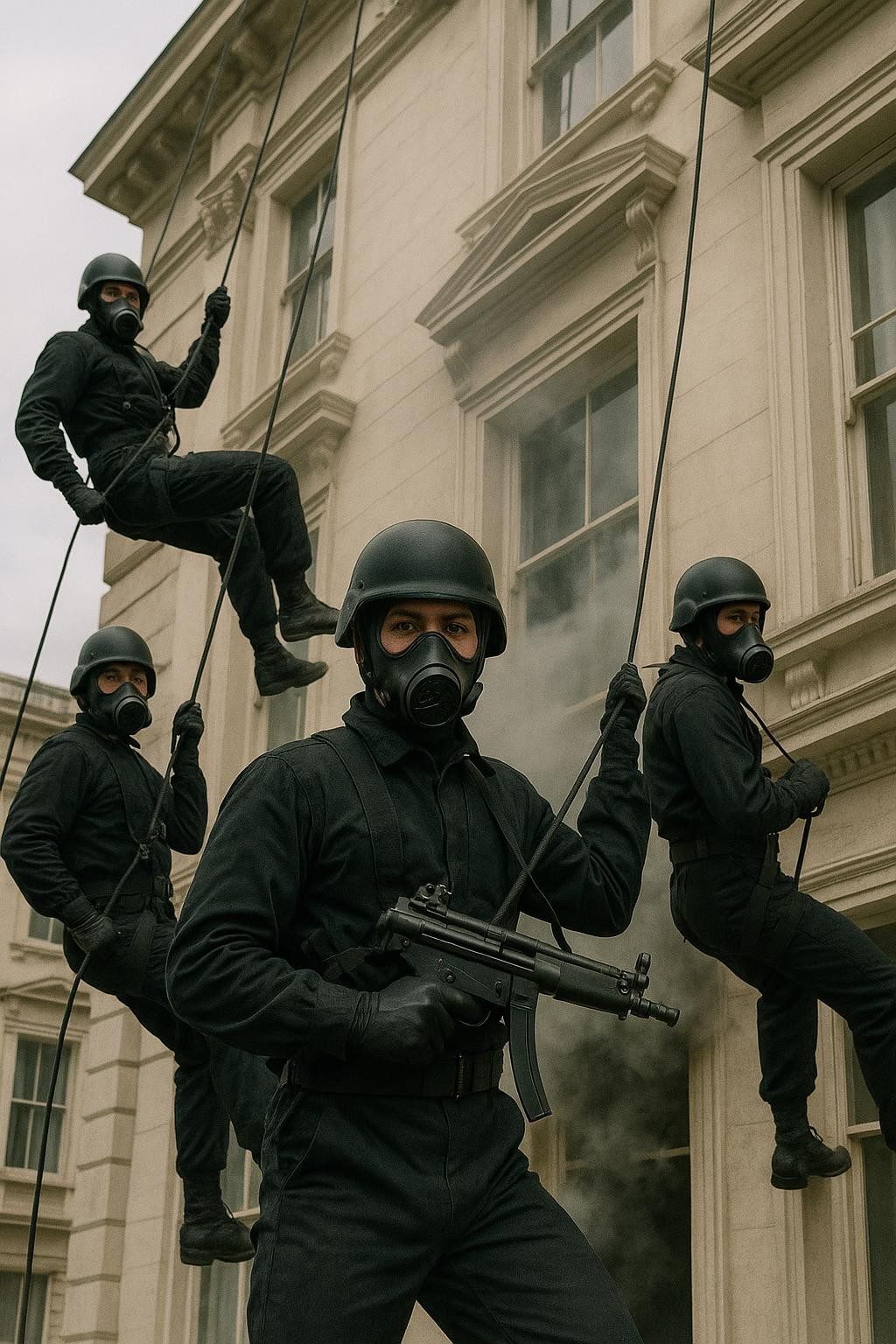
In the shadows of late afternoon, these figures ghosted into action, silent and methodical. Their entrance would become the stuff of legend. Fast-roping from the roof of the embassy, the SAS demonstrated the precision and training for which they were known but rarely seen. This was no ordinary military action; it was theatre played out in real-time, broadcast live into millions of homes, each viewer hanging on the edge of their seat in a mixture of awe and trepidation.
For eleven breathless minutes, this elite unit embodied the very concept of controlled chaos. Smashing windows with sledgehammers and using explosive charges to breach the stronghold, their every move was deliberate, their resolve undeniable. Inside the embassy, chaos met its match in the form of an orchestrated assault. The black-clad operatives, equipped with submachine guns and breaching gear, exemplified the kind of strategic prowess that turned what could have been a drawn-out tragedy into a marvel of tactical execution.
The crackling of gunfire interspersed with the shrill wail of police sirens heightened the sensory overload. Sections of the building were claimed in swift succession, painted with the stark contrasts of shadows and muzzle flashes. Each corridor, each room, a carefully crafted theater of surprise. The scent of smoke and spent ammunition filled the air as hostages were shepherded to safety, each one a testament to the precision and ferocity of that vespertine ballet.
Meanwhile, within command centers across the city, maps and murmured communications were mere echoes of the live drama playing out on the screens of those encircling the embassy. Among them, politicians, strategists, and civilians alike watched spellbound, psychically connected by the shimmering broadcast signals that bore witness to those clamorous eleven minutes.
Read next: The Day a Vicar's Son Walked Into a Debtor's Cell and Freed Them All
As the last hostages emerged, eyes squinted against the blinding sun after days in gloom, a collective sigh of relief echoed. Inside, two of the gunmen lay dead, their crusade extinguished not by negotiation, but by unyielding force. It was an outcome unsought yet accepted—a stark reminder of the high stakes in the games of power and ideologies. The endeavor had ended as swiftly as it had begun, a whirlwind of action now dissipating in the evening light.
The SAS operatives, faces obscured but presence indelible, slipped back into shadows, their deeds leaving an imprint far beyond the May evening on which they had acted. In the aftermath, as news anchors breathlessly recounted the event, the realization settled into public consciousness—a revolutionary tactic had been laid bare, each minute scrutinized and analyzed, turning myth into reality.
This operation changed the perception of the SAS and special forces at large, setting the stage for future engagements where speed, precision, and secrecy would redefine the rules of engagement. More than a display of firepower, it exemplified Britain's stance on terrorism and the lengths to which it would go to protect its interests and its people.
The tale of the siege that captivated the globe endures as a lesson in audacity and resolve. It remains an emblem of the often unseen but ever-present guardians in the shadows, ready to leap into action when the fabric of civility is rent by violence. As viewers turned off their sets that day, they were left with an unmistakable reminder: amidst the complexity of geopolitics and human emotion, the truth of action often speaks louder than words.