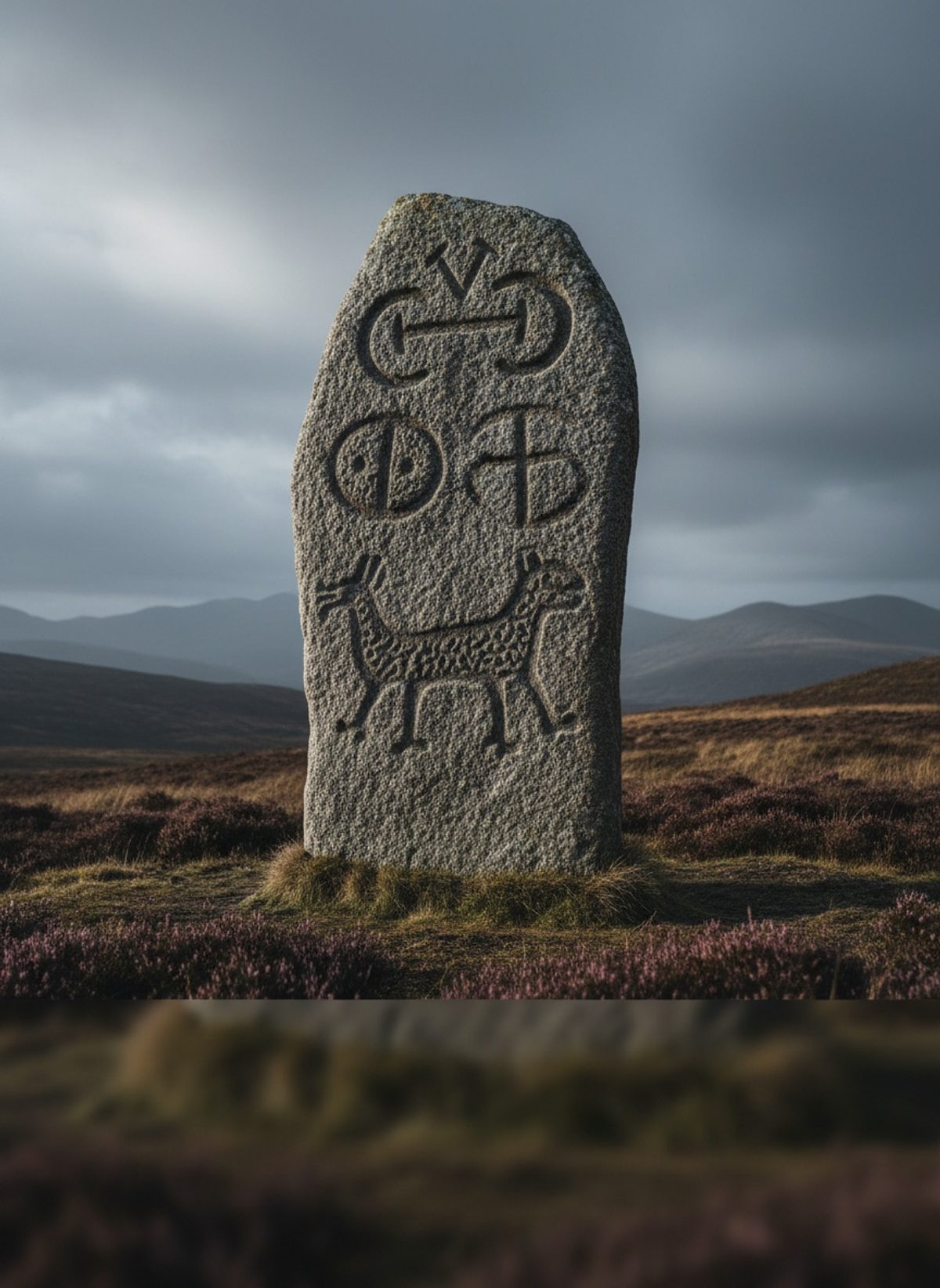
The stone feels cool and silent under your fingertips, its rough surface marked by intricate carvings. In the damp, lush landscape of northern Scotland, a quiet mystery stands tall and stoic. The mist hangs heavy in the air, shrouding the pasture of Aberlemno in a veil as ancient as the stones scattered across this land.
As you trace the grooves of a crescent and a V-rod, you wonder what hands inscribed these lines over a millennium ago. These are the Pictish symbol stones, crafted from granite and mystery, speaking a language lost to time.
The Enigmatic Craftsmanship of the Pictish Stones
The Pictish stones are scattered across the rugged expanse of northern Scotland, with over 200 known examples surviving today. These stones, carved between 600 and 900 CE, are monumental in both literal and metaphorical senses. The symbols on them—crescents, V-rods, double discs—are recurring motifs etched with precision. Yet, despite the attention to detail and care poured into each inscription, their meanings remain beyond modern scholars’ grasp.
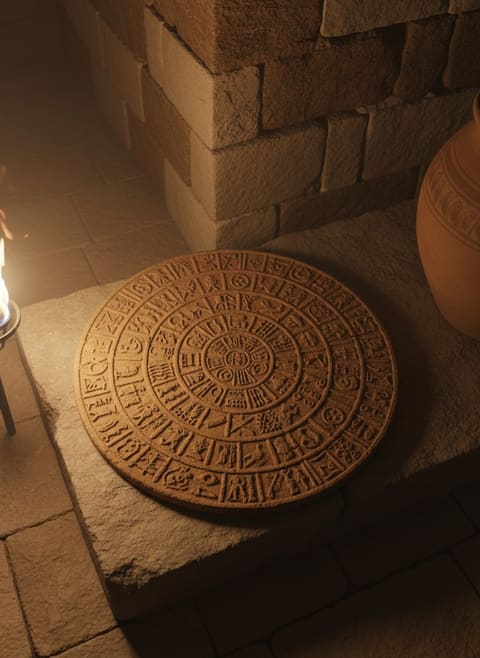
These symbols are not just random artwork; they repeat with a tantalizing regularity that suggests a language, a code, or a deeply symbolic script. However, with no written records, no Rosetta Stone equivalent, historians and linguists are left to piece together scant clues.
Read next: The Antikythera Mechanism: A Computer Built 2,000 Years Ago
The Picts themselves were a unique group, distinct from their neighbors. As noted by Bede in his Ecclesiastical History of the English People, the Picts’ language was different from Irish, Briton, and English tongues, indicating a separate cultural and linguistic heritage.
Formed by nature's erosion, cut by human hands, the Pictish stones reflect an intricate social system. Names, events, ideologies—the stones perhaps hold the key to these aspects of Pictish life. Some scholars speculate the symbols carried meanings relating to lineage or tribal identity. Others propose a calendar system or even spiritual representation. But without a bilingual text, the true message of these stones whispers on the wind, unreachable.
Theories and Pursuits of Meaning
If we're to crack the code of these symbols, we must explore the Picts' cultural milieu. The Picts inhabited a landscape at the crossroads of tradition and shifting powers. By the time of Donald II's reign (889–900 CE), Pictland was giving way to the burgeoning concept of Alba, a sign of cultural convergence with the Gaelic world.
This transformation hints at a complex cultural tapestry where the Pictish language might have gradually merged into Gaelic. The stones stand as sentinels of a time when these linguistic and cultural boundaries were strikingly delineated.
Their symbols provoke scholarly debate. Were the Picts leaving a record as historians of their time, or were the stones cryptic messages of a spiritual or ritualistic nature? Some researchers lean toward a linguistic purpose, comparing them to ogham inscriptions, while others suggest a purely emblematic function based on iconographic parallels. The vivid symbols call to mind not only pictograms but also an early form of branding, tying individuals to their landscapes and gods.
Read next: The Copper Scroll Listed Real Treasure. No One Has Found It.
As theories abound, recent technology offers fresh possibilities. Advances in digital mapping and photogrammetry allow for meticulous examination of the stones in high detail, potentially uncovering subtle patterns or connections that the naked eye could miss. But despite technological strides, the Pictish symbols defy full translation, their complexity and cultural specificity eluding modern understanding.
Echoes of a Forgotten World
The stones' existence challenges us to consider a landscape bustling with vibrant, though now invisible, narratives. As Gaelic pushed northward, absorbing regional dialects and identities, Pictish culture was bound to fade. However, its echoes remain. The enigmatic stones endure as bridges to a mysterious past that shaped the present-day Scottish identity. They're more than historical artifacts; they are provocations of curiosity, urging us to ask questions about inheritance, language evolution, and cultural memory.
Despite the mystery, perhaps the Pictish stones' greatest gift is in what they represent—a powerful testament to human creativity and secrecy. They elevate narrative above raw fact, standing as a monument to the endurance of mystery itself.
For in not knowing everything about them, we hold space for imagination and discovery. The Pictish symbols are a dialog with the past, an invitation for each generation to stand before them and question what they truly wish to say about a long-lost people whose voice we strain to hear.