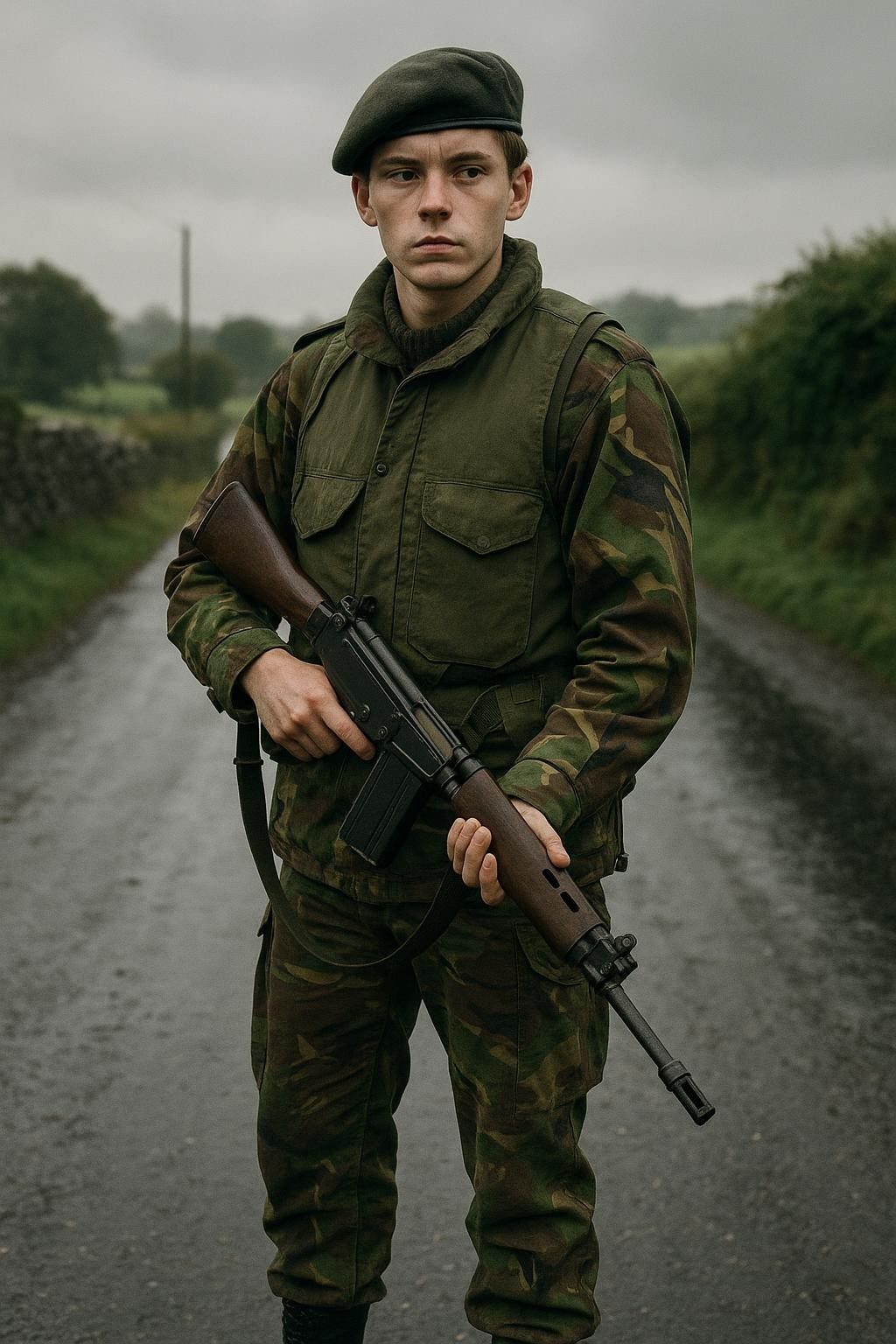
July 17, 1973. The mist clung stubbornly to the rolling green hills of South Armagh.
This was the landscape that every young British soldier faced, an almost picture-perfect scene that belied its dangers. South Armagh, dubbed "Bandit Country," was a place where peace was a fragile illusion and the valleys whispered tales of conflict. Nestled within the picturesque hedgerows and quaint stone bridges lurked the shadowy figures of the Provisional Irish Republican Army (IRA), vigilant, waiting, their presence almost tangible in the tension that filled the air.
These soldiers, most hailing from small towns and cities in Britain, were thrust into a land both foreign and familiar. They carried with them the weight of Operation Banner, a British military campaign aimed at quelling the conflagration of sectarian violence that erupted during The Troubles. Yet, this was not a battlefield of sand dunes or towering canopies; instead, they faced the unpredictable gauntlet of intimate landscapes, where any doorstep or hedgerow could conceal an adversary.
Patrols through South Armagh were not simple routes drawn on a map. They were complex, ever-shifting labyrinths of strategy, learning to tango with a foe who knew the land far better. Each pathway was an exercise in tension, every encounter shrouded in distrust. Young men would trudge through the wet grass, each receding step swallowed by the soft earth, while every snap of a twig was enough to send hearts racing.
Read next: The Day a Cornish Surgeon Walked Into a Condemned Cell
The rising of the sun brought with it no respite; the daylight betrayed little of the dangers that hid in plain sight. To walk those roads was to dance with uncertainty. Burgeoning soldiers, barely beyond adolescence, became seasoned men overnight, their eyes scanning ceaselessly for the glint of a sniper’s scope in the distant hills or the faintest sign of a booby trap nestled in the undergrowth.
South Armagh was a crucible, testing courage and resolve with its blend of beauty and menace. Soldiers would routinely check the lanes and byways, often on foot, sometimes on vehicle patrols, the hum of engines vibrating through the air. The locals they encountered were a mix of wary stares and tight-lipped silence, the loyalty of each face as uncertain as the next bend in the road. In such an environment, trust was a luxury no one could afford.
Memorable among those who returned was the story of a soldier, whose name became an emblem of resilience and the human cost of conflict. These were not tales sung around campfires but stark, visceral narratives etched into the memories of those who served. Each return was celebrated not with pomp, but with a quiet acknowledgment of hardship survived.
Read next: The Day a Vicar's Son Walked Into a Debtor's Cell and Freed Them All
Yet, with each rotation back to civilian life, soldiers carried more than just the visible scars of war. They bore the weight of invisible memories, the echoes of gunfire, the faces of comrades who didn’t return. It was a war that was fought far from the public eye, its stories often overshadowed by more headline-grabbing conflicts. Their stories slipped through the cracks of the broader narrative, whispered among veterans and seldom voiced in the public sphere.
The question that loomed large was what these young men did with the immense experiences they carried. Some spoke candidly; others remained silent, their memories not confined to words. They were forever changed, eyes still scanning for threats in the unconsciously remembered habits of soldiering. The stories of their patrols in "Bandit Country" speak volumes about the nature of duty, sacrifice, and the thin line between peace and conflict.
As time moves inexorably forward, the patchwork fields of South Armagh remain. To those unacquainted, they might seem as benign as a painting, the morning mist softening every edge. But for those who patrolled here, who walked with uncertainty hanging like the very mist itself, South Armagh is more than a quiet corner of Northern Ireland. It represents a chapter of history, a testament to courage displayed in the most unassuming of battlegrounds. These soldiers remind us that the events of the past shape the present, interweaving their legacy into the fabric of peace we strive to construct.