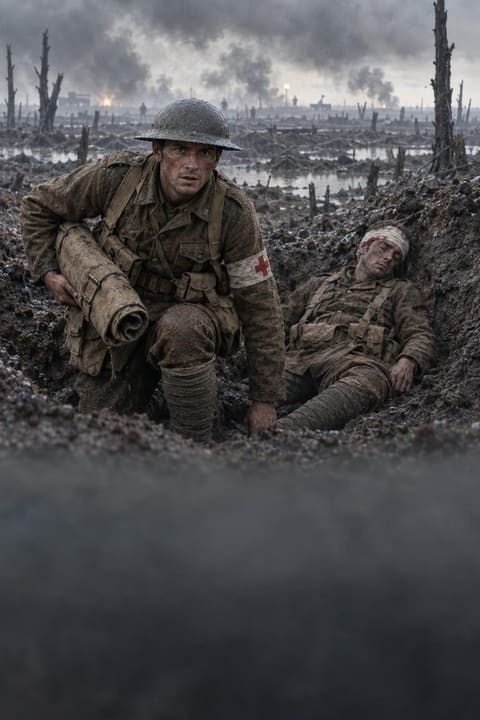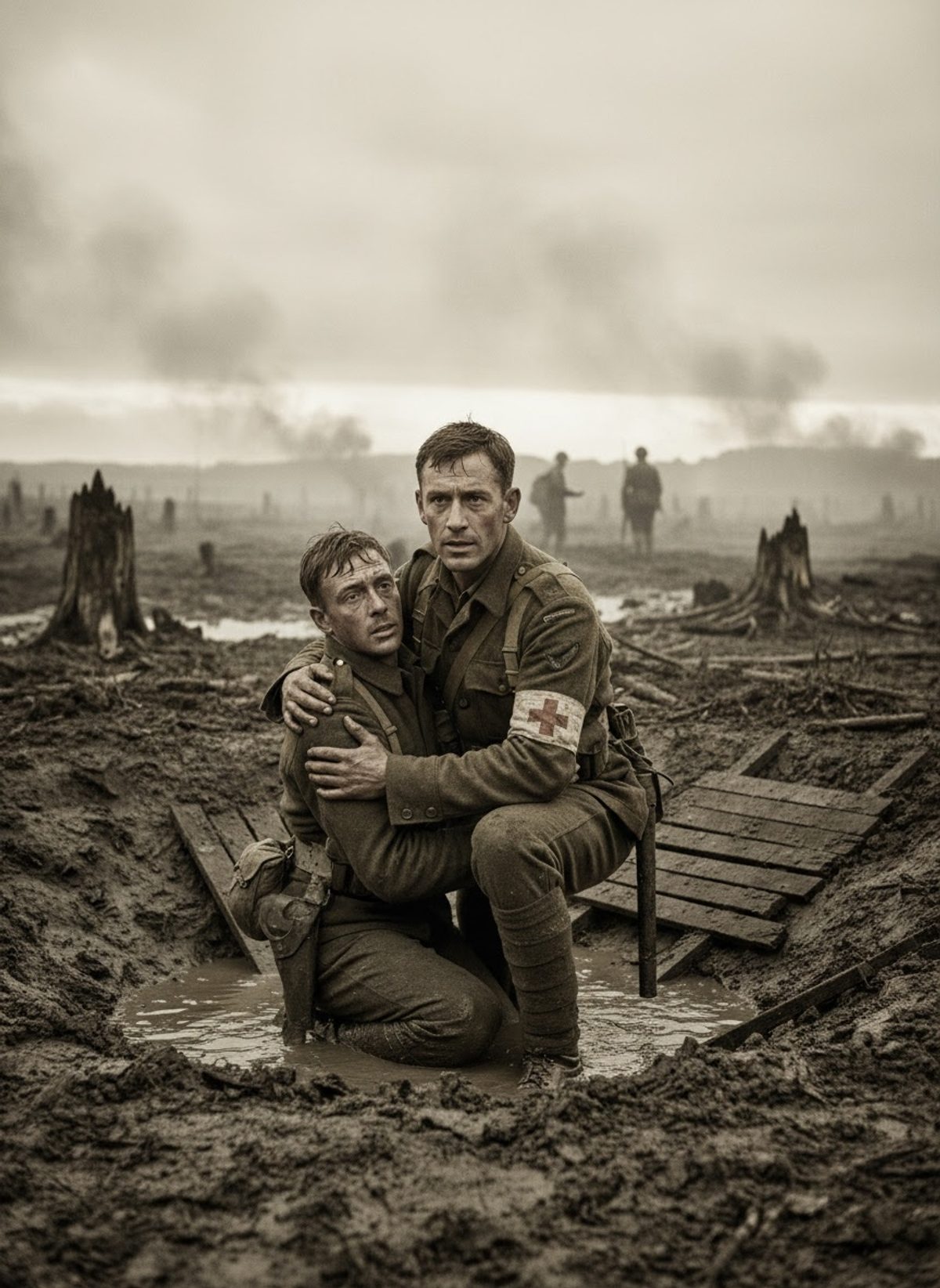
The mud clutched at his knees as if trying to drag him down to join the dead. Shells burst overhead, a symphony of chaos. Yet William Harold Coltman didn’t flinch. Inch by painful inch, he crawled over the corpse-riddled ground of Passchendaele, playing a deadly game with death itself. Somewhere ahead, hidden in the muck and mire, lay another wounded soldier desperately clinging to life. Coltman would crawl through hell to reach him.
The Reluctant Warrior
In a war that demanded destruction, Private William Harold Coltman stood apart. His battlefield was one of compassion, a paradox in a landscape crafted by horror and havoc. As a deeply religious man and a conscientious objector, Coltman refused to carry a weapon.
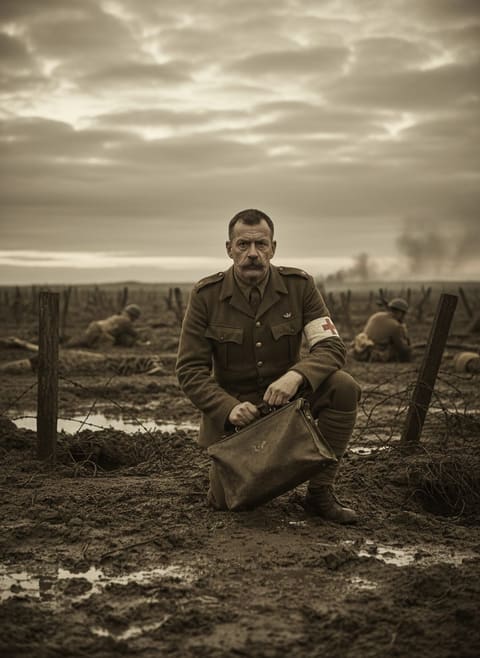
His uniform bore no rifle, only a badge inscribed with his duties as a stretcher-bearer. It was a role fraught with peril: to bring back the wounded from the no man's land, where the living could quickly join the dead with one stray bullet or shell.
Coltman’s choice was no easy path; the odds of survival for stretcher-bearers were slim, their knowledge of battlefield danger ever present. Yet, Coltman persevered, driven by his belief that life was sacred. He was considered by some as the bravest man on the front, not because of medals or valorous titles, but because he chose not to contribute to the war’s violence. Though unarmed, his courage was weapon enough to tear through the impossible.
Read next: The Nurse Who Cycled Through the Blitz to Reach Her Patients
The Battlefield of Compassion
In July 1917, Passchendaele became synonymous with the futility and mud-laden nightmare of World War One. Weeks of constant rain turned the battlefield into a quagmire, swallowing men, horses, and artillery alike. Beneath the incessant rain, the battlefield was a dense mire of mud and barbed wire. For the men in the trenches, it was like sinking into earth’s open grave. For Coltman, it was a calling.
Despite death lurking at every turn, he ventured into no man’s land countless times to retrieve the fallen. Nightfall brought no respite, only concealment and treacherous terrain barely illuminated by gunfire flashes. His exploits at Passchendaele were nothing short of legendary. More than fifty men owed him their lives, dragged back from the brink by Coltman’s unwavering determination, his hands the very essence of mercy amid madness.
A Quiet Heroism
Witnesses spoke of Coltman’s Herculean efforts with awe, though none could truly understand what drove him beyond human endurance. Each rescue mission was unique, yet they all required the same raw courage and disregard for one’s own safety, hallmarks of his quiet heroism. He was often spotted crawling across the battlefield under the barrage, a solitary figure imbued with unwavering resolve. Each time he ventured into the void, it was as if the world whispered a silent prayer.
The remarkable fact remained: Coltman never fired a shot, yet his bravery matched—if not exceeded—that of those who did. His only weapons were the stretcher he bore and the iron will that propelled him forward.
Read next: The Tunnellers Who Blew a Ridge Sky-High at Messines, 1917
As warring nations draped medals over feats of armed valor, Coltman’s feats were recognized with the Victoria Cross—the highest decoration for acts of bravery "in the face of the enemy." He also earned the Military Medal twice and the Distinguished Conduct Medal twice, making him one of the most decorated non-commissioned soldiers of the war.
The Legacy of Non-Violence
William Harold Coltman’s story is not merely one of bravery but of the enduring spirit of humanity in the face of darkness. Here was a man defined by his actions and his faith, who refused to let enmity define his duty. His legacy serves as a reminder that even amidst the brutal machinery of war, one could remain unarmed yet undefeated—carrying lives, rather than taking them.
In today's world, where conflict seems perpetual and insurmountable, Coltman’s tale of selflessness and valor shines brightly. It reinforces the notion that courage is not just wielding a weapon but daring to save lives on battlefields of violence. Coltman, through sheer strength of principle, rewrote the narrative of heroism. This quiet hero from an era of noise and pain left a mark perhaps more lasting than any gun ever could.