The war was brutal and merciless. Yet, amidst the horror, there was a flicker of humanity.
It was 1917, and the earth-splitting roar of artillery fire had suddenly ceased on the Western Front in France. Between the British and German trenches lay the grim realm of no man's land—a barren, shredded expanse that swallowed both men and their hope. The sky, usually crowded with the angry drum of shells and frantic cries, now held an eerie silence, broken only by the murmur of wind over the desolate battlefield. It was here, in this forsaken stretch of mud and wire, that a singular act of courage was etched into the annals of history, an act driven by nothing more than the insistence of compassion over conflict.
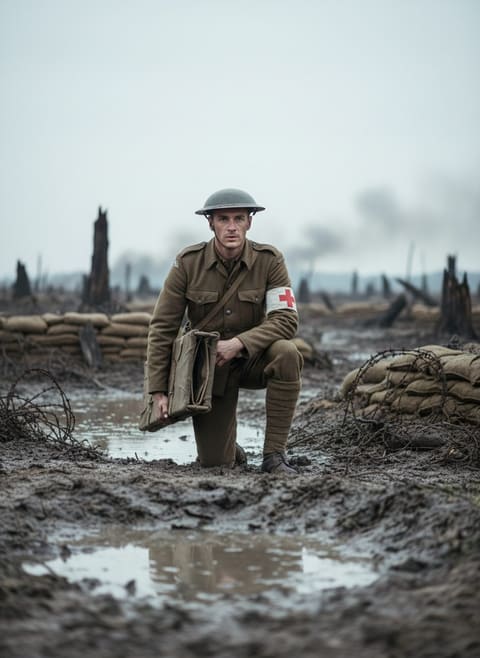
Arthur Martin-Leake was a man who had already distinguished himself as a hero, having been awarded the first Victoria Cross for his daring medical efforts during the Second Boer War. Yet, he found himself in France amidst the Great War, swathed once more in the chaos of combat, embodying a sense of duty that transcended orders or personal safety. On that day in 1917, with his red cross badge providing scant solace against a landscape of indiscriminate violence, Martin-Leake performed an act as noble as it was dangerous. With no weapon in hand and under no command, he crawled alone into no man's land to answer a call of humanity that his heart could not ignore.
The landscape of the Western Front was no ordinary arena of war. It was a living purgatory where life was measured in inches gained and where the fallen lay as anonymous markers of its harshness. In the damp and ragged terrain, the line between friend and foe often blurred. The British trenches stoically faced their German counterparts, each side a mirror to the other's suffering and determination. As a medic, Martin-Leake saw the war through a lens of life and death that perhaps soldiers with rifles did not. His was the battle to conquer the chasm of annihilation with patches of life-saving ministrations.
Read next: The Day a British Stretcher-Bearer Refused an Order to Save Lives
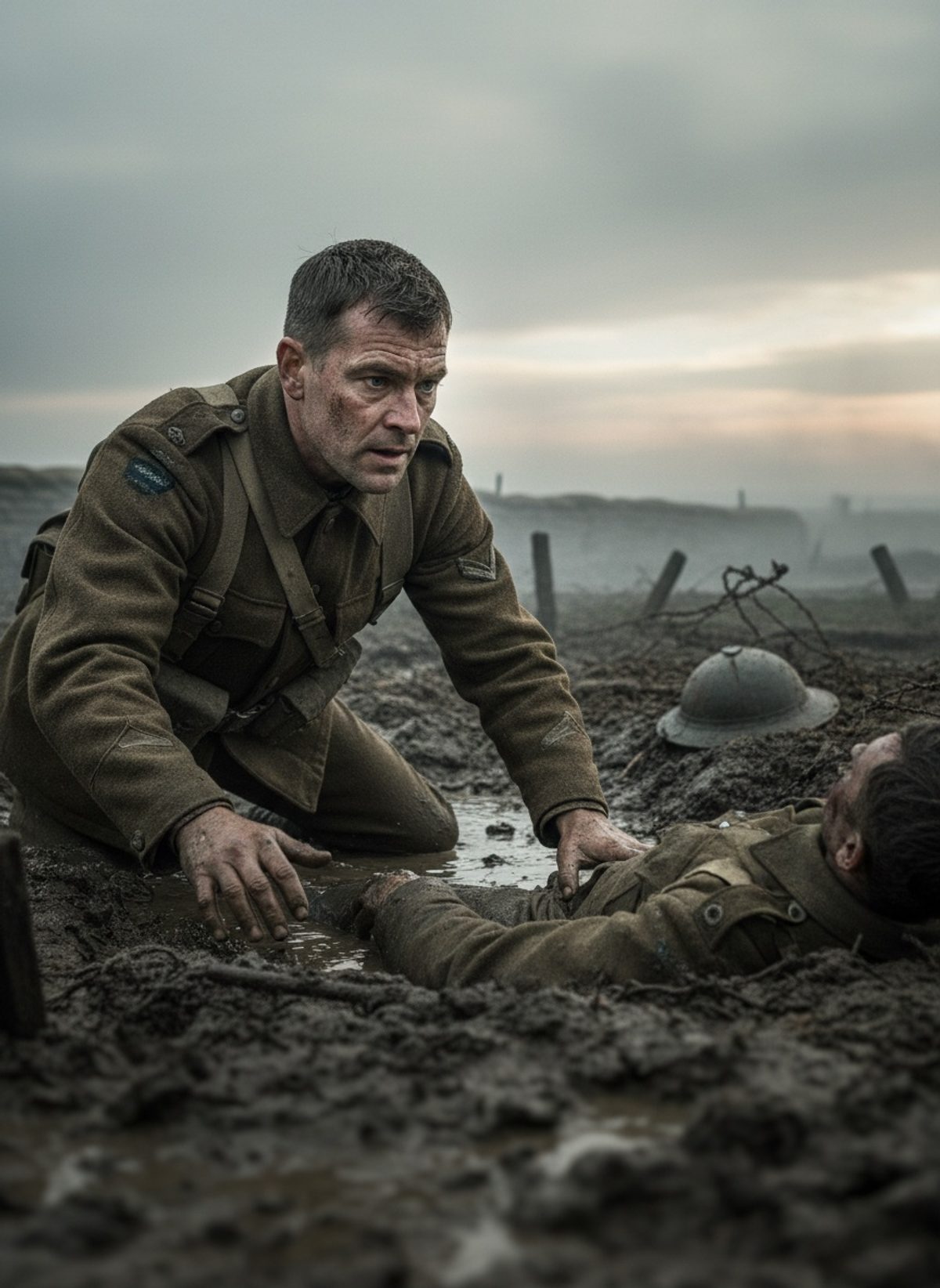
It was in this harrowing theatre that Martin-Leake spotted the outline of a German soldier, writhing in agony, tumbling between life and death. The soldier had been left behind, caught in the crossfire, a casualty forgotten by advance and retreat, destined to disappear beneath the shifting earth. Martin-Leake knew all too well what it meant to face death unshielded in the open, the danger multiplied by the very urgency of action. Yet something compelled him beyond reason, an imperative stronger than the orders that bound his compatriots in relative safety behind the trench walls.
He emerged from the muddy confines of the trench, kissed by the haunting quiet, the quaking line of danger ahead drawing him like a magnet. The landscape stretched out cruelly indifferent to the desperation of an individual's fight. Still, Martin-Leake advanced, driven by an unrelenting sense of duty that saw more in humanity than uniform. His progress was slow, his heart surely a hammer against his chest, ears straining for the whisper of hostility that could erupt into a cacophony of gunfire at any moment.
The journey across no man’s land was no simple feat. Each step was measured not just in feet, but in the calculated risk of exposure and the ticking clock of survival for the wounded man ahead. No doubt Martin-Leake must have felt the gaze of those in the trenches, perhaps incredulously watching one of their own risk life for the presumed enemy. But for Martin-Leake, there was no enemy in the broken body that lay bleeding into the soil; there was just a young man, a fellow human entangled in the same terror of war, deserving of life just as any of his own men.
Reaching the soldier, Martin-Leake set to work, hands steady despite the chaos surrounding him. His medical kit lacked the alchemy to transform wounds to wellness instantly, but what it could offer was comfort and the prospect of another sunrise. As he tended to the German soldier, perhaps the man’s groans and murmurs were the only testament they had against the howling wind and shifting clouds above. Martin-Leake’s sacrifice was voluntary; his reward, uncertain. Yet in those tense moments, there was a connection born from the fundamental threads of empathy and dignity, pricking through the veil of war.
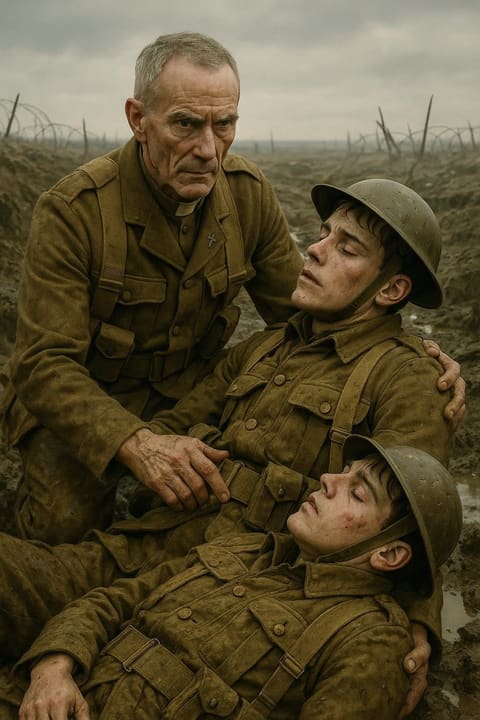
Read next: The Day a Army Chaplain Gave His Coat to a Dying Stranger
The ascent back into relative safety was yet another trial. Together, they achieved an unenviable form of camaraderie—one pushing forward, the other holding the frailest of ties back to life. Every muscle strain may have sung ode to glorious sacrifice or pointless folly. The rattling hum of fear must have marked every inch of their retreat, but Martin-Leake’s resolve did not break, nor did his care for the limp figure beside him falter. If in this mud-daubed, barbed-wire world there was glory, it was in such acts that put the heart above territorial conquest.
This episode on the Western Front was not a strategic coup or a turning point in history’s logistical maps. It didn’t redraw any lines on the globe or call for Churchillian praise in grand speeches. But it did exhibit the raw power of personal valor and unspoken solidarity, showcasing the humanity that persists even amidst the most dehumanizing conditions. Arthur Martin-Leake's daring rescue remains a remarkable footnote, a reminder that beyond the grit and bloodshed, individuals continued to recognize their shared leitmotifs of fear, hope, and compassion.
Why should such a tale matter in our broader understanding of history? Because it echoes a profound truth often drowned out by the clamor of battles and treaties: the whispered influence of individual choice. As bullets screamed and empires clashed, hearts like those of Martin-Leake's men struck quiet chords of reason and compassion. In that sense, no act is too small, no bravery insignificant amidst the grand narratives of history. The Victoria Crosses awarded to Martin-Leake acknowledged more than valor in face of enemy fire—they acknowledged the victory of humanity over inhumanity, a beacon of hope glimmering faintly across time’s vast and chaotic battlefield.