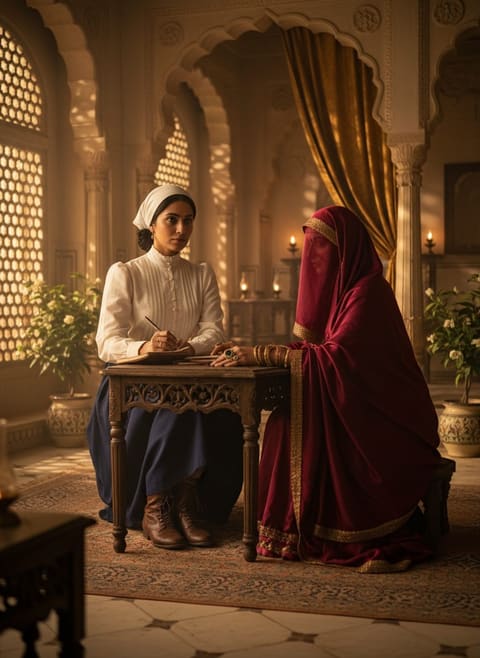
She was the first woman to sit the Bar Final at Oxford, yet Cornelia Sorabji was barred from practicing law in British courts. This only fueled her determination to challenge the structures that confined her to the shadows.
Breaking Through Purdah and Precedent
It was the dawn of the 20th century in India, and the atmosphere in Allahabad was charged with both the scents of an awakening nation and the staleness of its age-old traditions. In the center of this blend stood Cornelia Sorabji, armed with a legal brief and an indomitable spirit. Her destination was a purdah court—a place where women lived in seclusion behind a veil, their voices rarely heard in matters of law. Sorabji, denied the chance to argue in the British courts due to her gender, redirected her legal acumen to a deeply underserved population: the women ensnared within the zenanas. These secluded women, often widows or those with disputed inheritances, had little recourse or knowledge to assert their rights. Sorabji took it upon herself to be their advocate, venturing into spaces where male lawyers could not.
The case in 1904 was emblematic of the challenges she faced. Widows, such as the one she represented, commonly found themselves at the mercy of predatory relatives seeking to strip them of their lands and wealth. The purdah system, which kept these women out of public and social arenas, often resulted in their cases being handled without their presence or input, their fates decided in rooms they could never enter. But Sorabji had forged a unique path into these courts, earning the trust of the women she represented and the cautious respect of some within the judicial system.
Her entry into such hearings carried with it the unusual quiet of an outsider navigating foreign rules. She could argue cases, but not as a barrister; she had to rely on her knowledge of the law and ability to convey it to male attorneys who had never ventured behind the purdah. Yet her presence was felt powerfully. In this particular instance, her advocacy meant a widow retained her ancestral land, a victory not only legally but also in terms of social justice. This success was a testament to Sorabji's tenacity and her adeptness at weaving through the legal and cultural tapestries of colonial India.
Read next: When Nain Singh's Compass Beat the Roof of the World
The Education of an Advocate
Before Cornelia Sorabji could navigate these complex legal systems, she traversed a challenging educational landscape. Born in 1866 in the Bombay Presidency, she belonged to a family committed to education and social reform. Her father was a Christian convert, and her mother was a pioneering educator, founding the first girls' school in Poona. Such a background instilled in Sorabji an insatiable quest for learning and justice. Her brilliance soon found her at some of the best educational institutions of the time, culminating in her enrollment at Somerville College, Oxford.
At Oxford, Sorabji blazed trails as the first woman to sit the Bachelor of Civil Laws exam and the first Indian woman to study at the university. Her achievements in academia, however, did not shield her from the rigid barriers erected by societal norms. Returning to India, she faced the painful reality of being barred from practicing as a lawyer solely because she was a woman. This injustice, rather than deterring her, became a catalyst for her to redefine the conventional lawyer's role. She used her legal education to serve those whom the system neglected—women behind the purdah.
In the process, Sorabji became a pioneer in what could be termed 'paralegal work,' where she served the dual roles of advisor and advocate, even if unofficially recognized. Her journey was filled with frustration and sparks of hope, a depiction of a changing world where colonial infrastructure and tradition clashed incessantly. Yet, it was in these forgotten spaces—both physical and legal—that Sorabji carved out a legacy.
Read next: When Cornelia Sorabji Crossed the Zenana Wall, 1904
Legacy of Defiance
The case of the widow in Allahabad was not just an isolated win for Cornelia Sorabji; it was a testament to her broader impact. Sorabji's work created an avenue through which women's issues, primarily those trapped in the isolation of purdah, received attention and advocacy. She carried out her work tirelessly for nearly two decades, oscillating between various states of India and pushing against the boundaries both literal and figurative. By the time her career drew to a close in the 1930s, Sorabji had advocated for over 600 women, not only obtaining favorable legal outcomes but also slowly shifting perception on women's roles and rights within society.
Cornelia Sorabji's story is more than a tale of an individual overcoming personal and professional hurdles. It's a glimpse into an era of early feminist consciousness intersecting with the peculiar challenges of colonial rule. Her efforts to represent women in a patriarchal, purdah-mandated society opened doors, or at least provided glimpses through them, for greater equality and legal recognition of women's rights. Despite facing systemic limitations, her work subtly reshaped legal advocacy in India, paving the way for future generations of women lawyers and reformers.
This narrative matters today not only because it is a compelling account of social justice but also because it serves as a reminder of the power of resilience in confronting and dismantling entrenched social barriers. Cornelia Sorabji may not have wielded swords or commanded armies, but her legacy is carved into the history of the Indian women's movement, where law was her weapon, justice her ultimate victory, and her name, still echoing in the halls she once fought to penetrate.