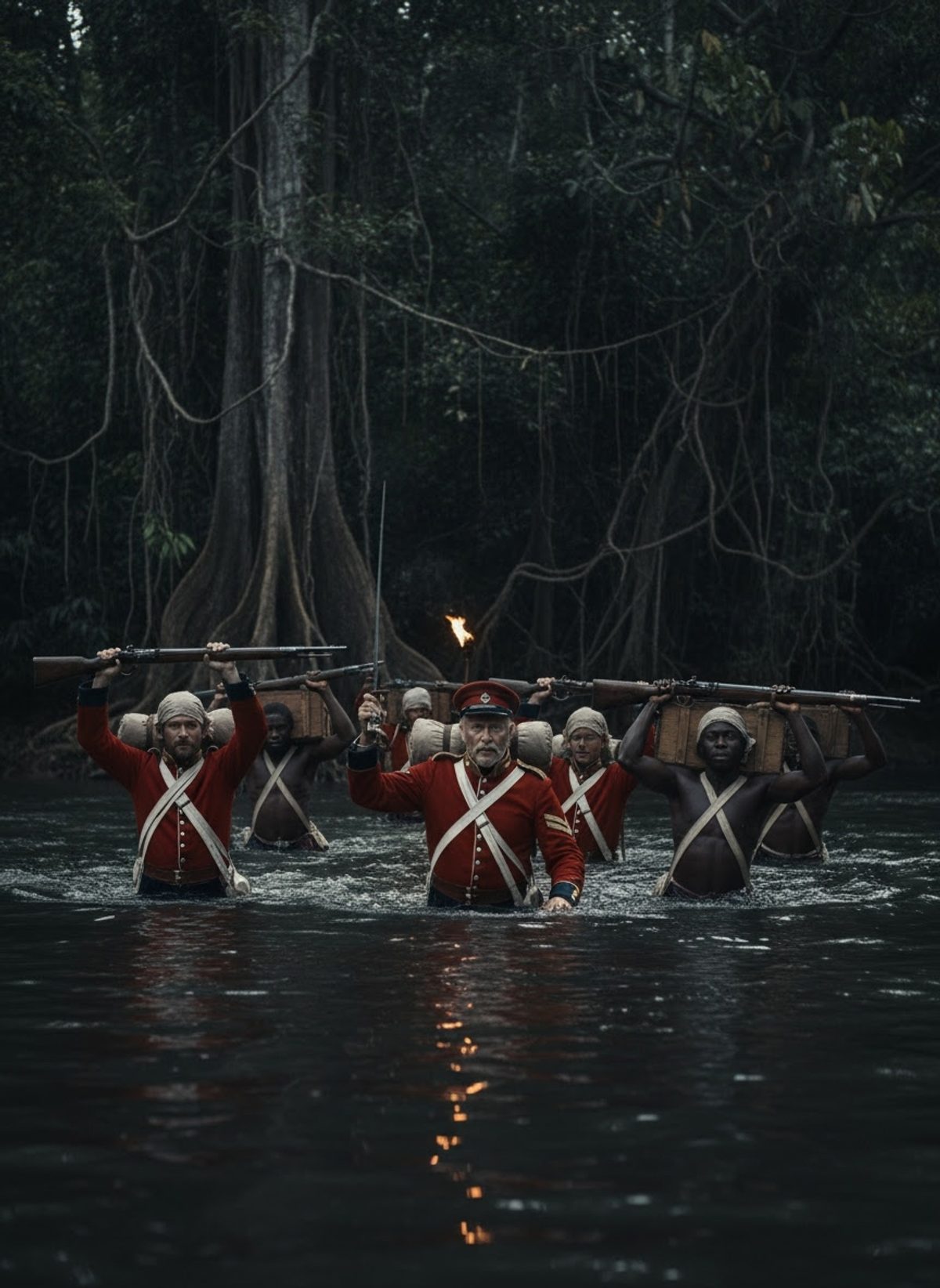
The British military had its fair share of daring exploits. Yet crossing the Pra River by night would push them to their limits.
The Dawn of a New Campaign
In January 1874, Major General Garnet Wolseley faced an audacious challenge. The Ashanti Empire had long held sway over the dense forests of the Gold Coast, their capital Kumasi standing as a fortress against any foreign encroachment. Previous European attempts to penetrate this resilient kingdom had faltered, undone by hostile terrain and fierce resistance.
Wolseley arrived with fresh tactics and a determined force trained for the demands of jungle warfare. His strategies reflected the West’s burgeoning interest in Africa’s wealth and resources—a relentless pursuit that would later be known as the Scramble for Africa. The Pra River was their first major hurdle; its banks teemed with unseen threats, both human and natural.
The general’s decision to cross under cover of darkness was nothing short of revolutionary. The jungle, already challenging by day, was an abyss at night, cloaked in whispers and shadows. Yet under Wolseley’s command, the men moved silently, the river’s current tugging at them as they waded across. Survival meant keeping calm amid the cacophony of night creatures, fear kept at bay by sheer determination.
Read next: When Frederick Russell Burnham Scouted the Ndebele Alone, 1896
Silent March Through Forbidden Forests
After crossing the Pra, Wolseley’s forces entered territory few Europeans had dared venture. The dense canopy above seemed to swallow the moonlight whole, leaving only intermittent glimpses of sky. Many soldiers had battled neither men nor military but the treacherous tropical illness. Malaria and fever were ever present, lurking in the humid air and every undistilled sip of water.
Their march through these woods became a race against time—and history. The Ashanti were meticulous warriors, adept at jungle combat, their scouts always ready. Wolseley knew evading detection was critical. Drill sergeants had ingrained in his men the discipline to make each step calculated and quiet. Yet as the inevitable dawn began painting the horizon, secrecy turned harder to maintain.
The environment seemed complicit with the Ashanti. Roots crept out like fingers across the path, thick vines pulled at uniforms, and unseen creatures echoed cries from the underbrush. Men carried not just their gear but the weight of expectation on their shoulders; success would reverberate far beyond their number, challenging the myth of Ashanti invincibility.
Fire and Fury in Kumasi
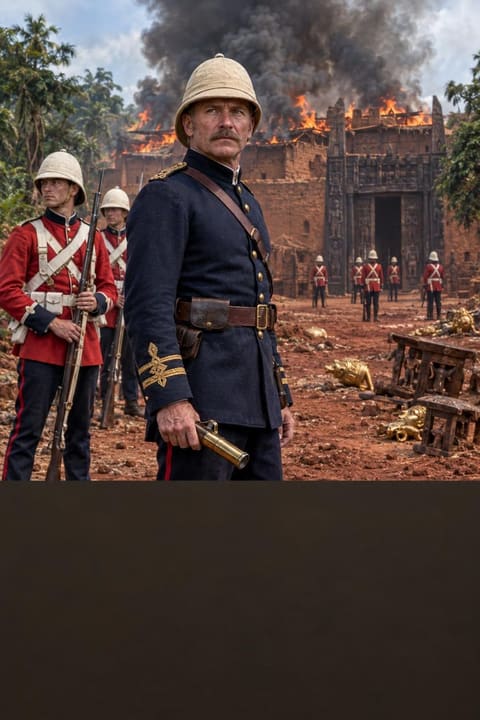
Three days after fording the river, Wolseley reached Kumasi. The assault on the Ashanti capital was swift and unyielding. For the first time, enemy fires lit the Ashanti’s grand city of clay and thatch, and the British advanced with a relentless march. Resolved to make an indelible mark, the army orchestrated a display of force unlike any seen before.
The task of subduing the Ashanti proved formidable. Yet Wolseley’s maneuvers inside Kumasi rallied his troops with unyielding focus. Buildings succumbed to flames, the fiery shadows casting a red glow over the resolute defenders. The capitulation of the Ashanti warriors not only signaled a pivotal victory but shattered a storied history of resistance.
Read next: When Samuel Crowther Baptised a King on the Niger, 1888
By burning Kumasi to ash, Wolseley left an indelible mark on the landscape—and history. This was a show of not just power but a new paradigm, where the might of the Empire seemed no less than the burning buildings that marked the skyline.
Echoes of an Empire's Heart
News of the audacious strike on Kumasi reverberated internationally, redefining perceptions of African resilience and European might. Wolseley’s success was hard-won, signifying a turning point in how the world understood the African interior. Despite the toll—a cost measured in lives and cultural displacement—the British victory spotlighted the era’s complex dynamics of conquest.
This episode was less about imperial glory than a message to the Ashanti and beyond. The age-old empire of the Ashanti, known for its formidable defense, now stood humbled in the face of calculated European incursion. The fire that consumed Kumasi signified eras colliding, leaving ashes from which new global sensibilities emerged.
Reflecting on Wolseley’s campaign offers insights into a transformative time. Imperial ambition drove men across formidable landscapes, redefining borders and solidifying power. The Ashanti would rebuild, but the scars of invasion left lasting changes—on a map, in records, and in memory. This intersection of courage and imperialism still lingers, a lesson written in the embers of an empire thought untouchable.