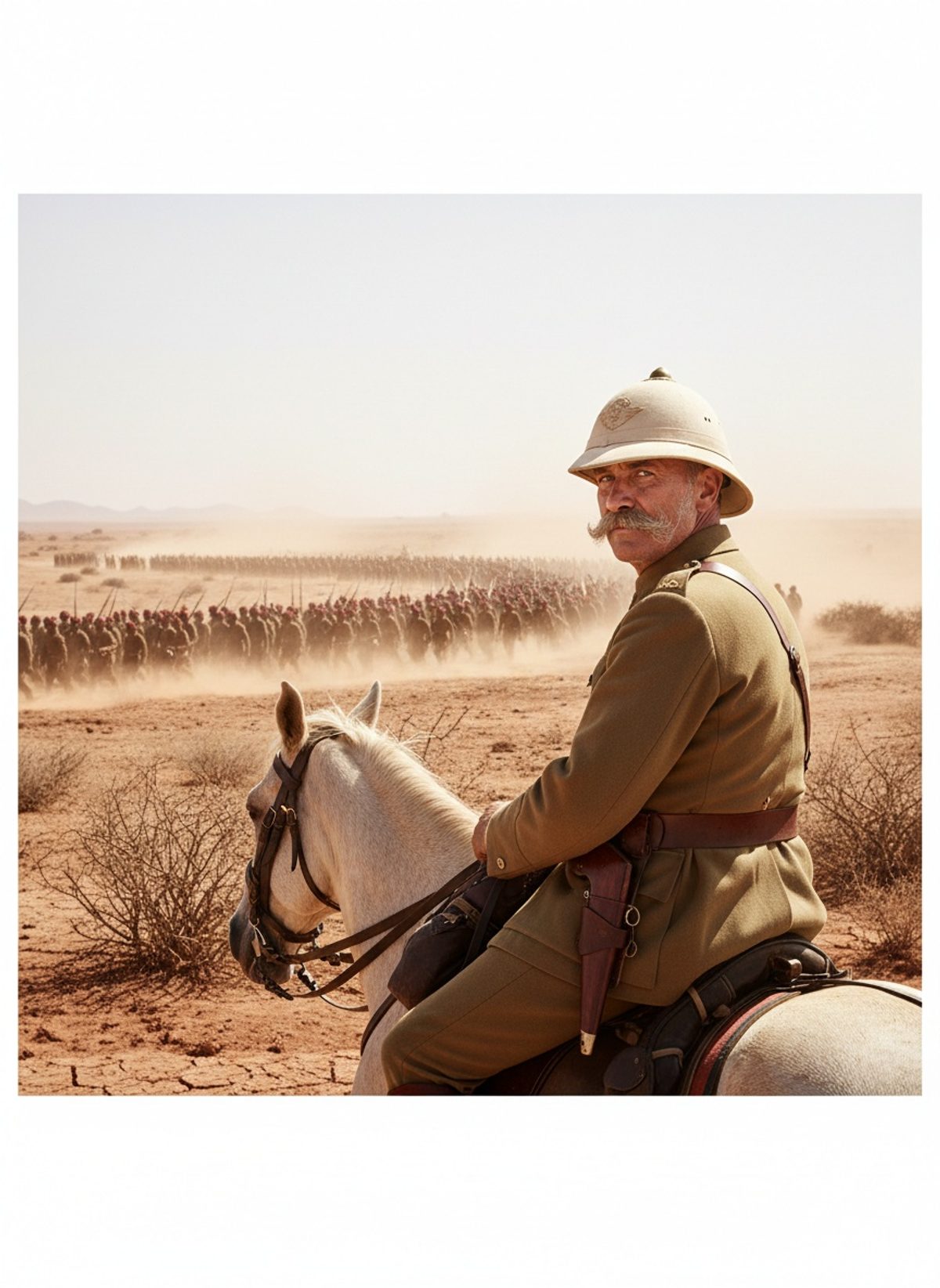
November 1883. The sands of the Kordofan desert swallowed sound and hope alike, leaving only a vast silence beneath a relentless sun.
The Desert March Begins
In the waning days of 1883, a procession of 10,000 men set forth from Egypt into the untamed wilds of Sudan. This vast army, considered the largest Egypt had ever sent to Sudan, was a testament to empire and ambition. At the heart of this military endeavor was William Hicks, a British officer tasked with an unenviable mission. Known to many simply as Hicks Pasha, he was intended as the savior of Egyptian control over the rebellious Sudanese territories. But as he took the reins of this ill-fated expedition, the desert itself seemed to foreshadow the epic tragedy about to unfold.
Hicks Pasha’s Gambit
Colonel William Hicks was no stranger to the trials of warfare. A veteran of many conflicts, his task now was to lead a contingent largely composed of conscripted Sudanese and Egyptian soldiers. Commanding such a force was a herculean challenge. Diversity in languages and culture, coupled with inadequate equipment and questionable morale, painted a difficult picture. Hicks was acutely aware of the odds stacked against him. Yet, the determination to quash the burgeoning Mahdist movement drove him onward.
The march into the desert was fraught with danger from the start. Supplies dwindled and the searing heat tested even the hardiest of the troops. Meanwhile, the Mahdi, Muhammad Ahmad, watched with calculated patience. His forces, hardened by years of guerrilla warfare and fervent belief in their cause, lay in wait, well aware of the terrain that served as both ally and weapon.
Read next: When Frederick Lugard Lit a Lamp in the Dark at Nikki, 1894
The Clash of Faiths and Gunpowder
Underestimating the Mahdi and his followers would prove a fatal error. The Mahdist fighters, driven by both religious zeal and deep-seated resentment of foreign rule, utilized the harsh environment to their advantage. They knew every dune, every shadow that could conceal their movements. As Hicks’ forces plunged deeper into Kordofan, they unwittingly walked into a trap that was as masterfully set as it was brutally sprung.
No contemporary blueprint could have mapped out the ferocity of the ensuing battle. Stories spoke of dust storms that blinded, and gunfire that mingled with the cries of men in their death throes. The British officer's strategies, rooted in European military doctrine, crumbled in the face of an enemy whose tactics were as fluid as the flowing sands. By the time the dust settled, none of Hicks’ men returned. The desert had claimed them, all.
The Silence of the Desert
The total annihilation of Hicks’ army was an event that sent ripples far beyond the African continent. News of the catastrophic loss reached London with a chilling sobriety. This spectacle of defeat jarred the imperial mindset, a blazing reminder of the complex dynamics at play in the Scramble for Africa. It posed questions about the limits of military interventions in lands where empire builders misjudged the contours of resistance shaped by culture, geography, and faith.
Read next: When Frederick Lugard Marched Into Buganda Alone, 1890
Back in Sudan, the Mahdists celebrated their victory as a divine endorsement of their cause. The clash had not just been a confrontation over territorial control; it was a collision of belief systems, a harbinger of the ebbs and flows that would continue to define colonial encounters on the continent.
Repercussions and Reflections
The defeat of Hicks Pasha was more than just a military debacle. It was a pivotal moment in the history of British imperialism in Africa. It forced Britain to reconsider its strategic positioning and approach towards Egypt and Sudan, eventually setting the stage for Gordon’s ill-fated defense of Khartoum. These events carved pathways that would lead to the further entrenchment of European powers on African soil, while also sowing seeds of resistance and rebellion that would echo through the coming decades.
In a world where Victorian imperial aspirations often went unchecked, the fateful 1883 march into the desert stands as a stark reminder of the complex interplay between ambition and hubris. It is a story not just of a failed military campaign, but of the enduring power of the desert to not only erase footprints but also to etch lasting lessons in the annals of human endeavor.