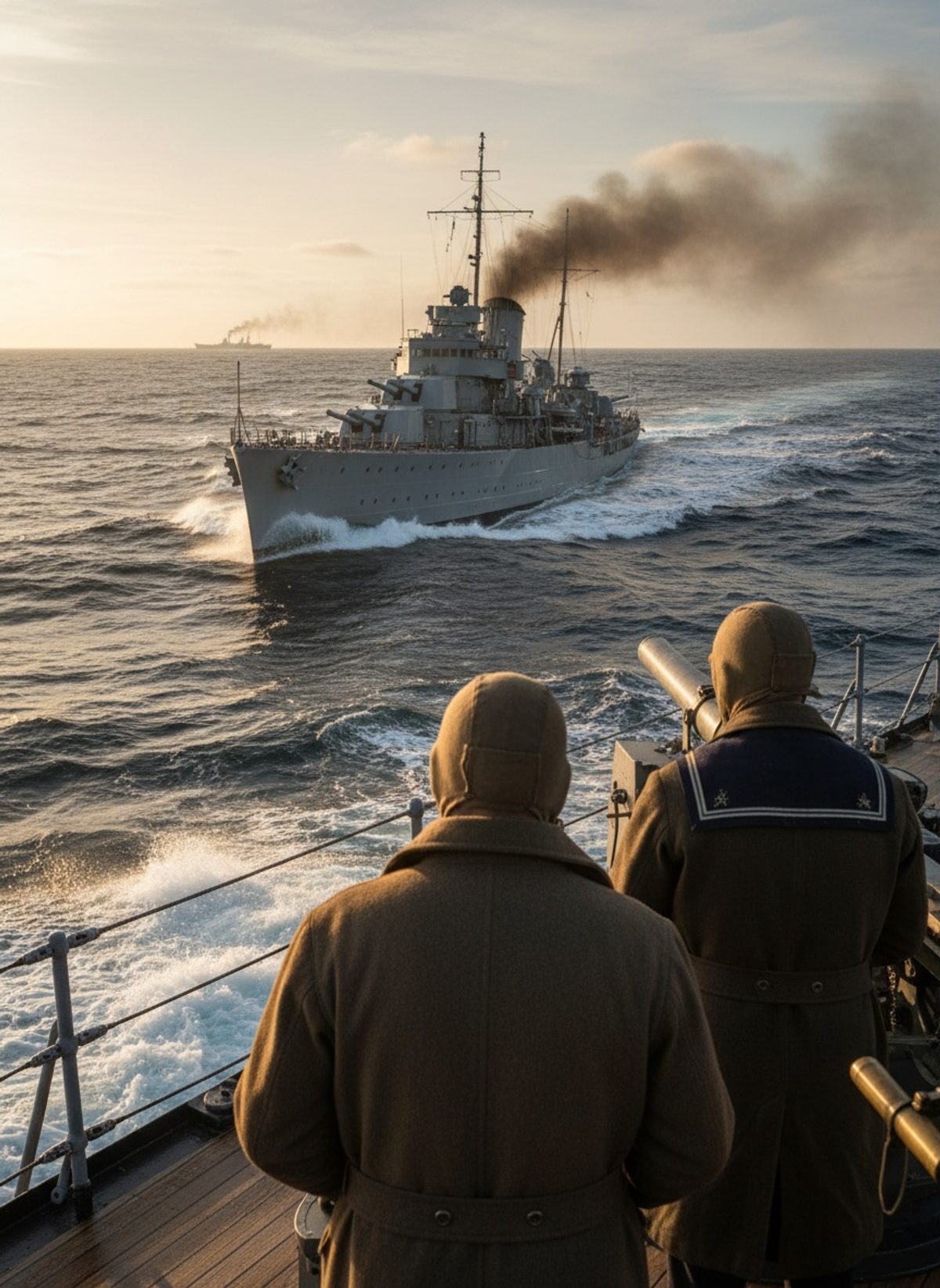
Three cruisers against a pocket battleship. Harwood attacked anyway. On 13 December 1939, in the South Atlantic off the estuary of the River Plate, a Royal Navy squadron fought the first British naval battle of the Second World War. Commodore Henry Harwood, commanding three cruisers, took on the German raider Admiral Graf Spee, which outgunned his squadron. Facing the pocket battleship's six 11-inch guns, Harwood split his force and attacked from two sides, so that the Germans would either have to divide their fire and reduce its effectiveness, or keep it on one opponent and let the other ships attack with less fear of return fire.
Harwood had worked out these tactics years before. During his period at the Royal Naval War College between 1934 and 1936, he had himself devised the British combat instructions for engaging a pocket battleship with a cruiser squadron. They specified an attack at once, day or night; by day the ships would attack as two units. His command was Force G, the South American Cruiser Squadron, and three of its ships were with him. The heavy cruiser HMS Exeter, under Captain Frederick Secker Bell, carried six 8-inch guns. The light cruisers HMS Ajax, his flagship, captained by Charles Woodhouse, and HMNZS Achilles, on loan to the New Zealand Division and captained by Edward Parry, each carried eight 6-inch guns. The fourth ship of the force, HMS Cumberland, was refitting in the Falkland Islands. Although outgunned, the British held the upper hand strategically: any raider returning to Germany would have to run the North Sea blockade and might expect to meet the Home Fleet. The British had only to damage her enough that she could not make the journey, and they could afford to risk a tactical defeat if it brought strategic victory.
After a raider-warning message from the merchantman Doric Star, sunk by Graf Spee off South Africa, Harwood suspected that the raider would strike next at the merchant shipping off the River Plate estuary, and his three cruisers rendezvoused there on 12 December. At 05:20 on 13 December they were steaming on a course of 060° at 14 knots. At 06:10 smoke was sighted to the north-west, and Harwood ordered Exeter to investigate. She swung out of line and at 06:16 signalled by lamp: “I think it is a pocket-battleship”. Captain Bell ordered Flag N hoisted to the yard arm: “Enemy in sight”. Graf Spee's captain, Hans Langsdorff, had at first suspected that the two light cruisers were destroyers protecting a merchant convoy; his reconnaissance aircraft was out of service, so he relied on his lookouts. He realised too late that he was facing three cruisers, and closed at 24 knots in the hope of engaging the steam-driven British ships before they could work up to full power. The British executed their battle plan: Exeter turned north-west, while Ajax and Achilles, operating together, turned north-east to spread Graf Spee's fire.
Graf Spee opened fire on Exeter at 19,000 yards with her six 283 mm (11.1-inch) guns at 06:18. Exeter replied at 06:20, Achilles at 06:21 and Ajax at 06:23. Graf Spee's gunfire was fairly accurate from her opening salvo, and her third salvo straddled Exeter. At 06:23 a shell burst just short of Exeter; its splinters killed the crews of the torpedo tubes, damaged her communications and wrecked her Walrus aircraft just as it was about to be launched for gunnery spotting. Three minutes later a direct hit put “B” turret and its two guns out of action, and shrapnel swept the bridge, killing or wounding everyone there except the captain and two others. With Captain Bell's communications wrecked, and those from the aft conning position also destroyed, the ship had to be steered via a chain of messengers for the rest of the battle. Meanwhile Ajax and Achilles closed to 13,000 yards and moved ahead of Graf Spee, and at 06:30 she split her main armament to engage them.
Read next: When Admiral Jervis Took Four Ships With Fifteen, 1797
Exeter fired two torpedoes from her starboard tubes, but both missed. At 06:38, as she turned to fire her port torpedoes, she took two more direct hits: one put “A” turret out of action, and the other entered the hull and started fires. Only “Y” turret was still in action, under local control, with her gunnery officer, Lieutenant-Commander Richard Jennings, on the roof shouting instructions to those inside. She had a 7° list, was flooding, and was being steered with her small boat's compass. Yet Exeter had dealt the decisive blow. One of her 8-inch shells had penetrated two decks before exploding in Graf Spee's funnel area, destroying her raw fuel processing system and leaving her with just 16 hours' fuel, not enough to return home. Graf Spee could not make repairs of that complexity under fire. Two thirds of her anti-aircraft guns had been knocked out, as well as one of her secondary turrets, and there were no friendly naval bases within reach. She could make only the neutral port of Montevideo.
Graf Spee hauled round towards the north-west and laid smoke, a course that brought her roughly parallel to Exeter. By 06:50 Exeter was listing heavily to starboard and taking water forward, yet she still steamed at full speed and fired with her one remaining turret. Forty minutes later, water from a near miss short-circuited the electrical system for that turret, and Captain Bell was forced to break off the action. That would have been the opportunity to finish off Exeter. Instead, the combined fire of Ajax and Achilles drew Langsdorff's attention as both ships closed on him. At 07:24 Ajax fired her torpedoes at a range of 4.5 miles, causing Graf Spee to turn away under a smoke screen, and a minute later a 283 mm shell put Ajax's “X” turret out of action and jammed “Y” turret. By 07:40 the light cruisers were running low on resources, and the British moved off to the east under a smokescreen. Harwood decided to shadow Graf Spee and try to attack at night, when he could use torpedoes and make better use of his advantages of speed and manoeuvrability. Captain Parry of Achilles wrote afterwards: “To this day I do not know why the Admiral Graf Spee did not dispose of us in the Ajax and the Achilles as soon as she had finished with the Exeter”.
The battle now turned into a pursuit, with Graf Spee heading for the River Plate estuary. Ajax and Achilles shadowed her for the rest of the day from about 15 miles, one on each side, and she dropped anchor at Montevideo, in neutral Uruguay, at about 00:10 on 14 December. There the 13th Hague Convention, which limited how long a belligerent warship could stay in a neutral port, came into play. Langsdorff asked the Uruguayan government for two weeks to make repairs, but he was told that his stay could not be extended beyond 72 hours. The British diplomat Eugen Millington-Drake also arranged for British and French merchant ships to leave Montevideo at intervals of 24 hours; a warship could not leave a neutral port until 24 hours after a merchant ship of its adversary had departed, so this kept Graf Spee in port and allowed more time for British forces to reach the area. Meanwhile the British broadcast a series of signals, on frequencies known to be intercepted by German intelligence, suggesting that an overwhelming force was being assembled, including the aircraft carrier Ark Royal and the battlecruiser Renown. In fact the two light cruisers had been joined only by Cumberland, which arrived at 22:00 on 14 December after steaming 1,014 nautical miles from the Falklands in 34 hours. The Germans were entirely deceived.
Read next: When Rick Jolly Ran a Hospital Beside Two Unexploded Bombs, 1982
Graf Spee had used two thirds of her 11-inch ammunition and had enough left for only about 20 more minutes of firing. Langsdorff consulted his command in Germany, whose orders permitted some options but not internment in Uruguay. On 17 December, four days after the battle, he chose to scuttle his ship in the River Plate estuary, to avoid unnecessary loss of life for no particular military advantage. His crew were taken to Buenos Aires, where Langsdorff took his own life on 19 December. He was buried there with full military honours, and several British officers attended.
The battle was a major victory for the British. Ajax and Achilles were still capable warships, and Exeter, badly damaged as she was, reached the Falkland Islands for emergency repairs. There were rumours that she would stay there until the end of the war, but Winston Churchill, then First Lord of the Admiralty, wrote: “We ought not readily to accept the non-repair during the war of Exeter.” She returned to Devonport for a 13-month refit. During the battle, 108 men had been killed on both sides, including 36 aboard Graf Spee. Three sailors killed aboard Achilles were buried in the British Cemetery in Montevideo, while those who died on Exeter were buried at sea. Harwood was highly praised for his performance in battle, though he was also criticised for a lack of initiative, mostly because Graf Spee had been allowed to escape. For New Zealand the battle had a particular significance: it was the first time the Flag of New Zealand was flown in battle, from Achilles.
Part 1 of 24: One Second World War story a day, 16 November to 9 December