The HMS Birkenhead's sinking may not be a household tale. Yet, it should echo in the halls of bravery and sacrifice. Off the coast of South Africa, in February 1852, this British troopship's final moments inscribed an indelible mark on maritime history.
The Rock and the Reckoning
Under the vast African night sky, the HMS Birkenhead surged forward, a microcosm of Victorian ambition and exploration. This noble ship, filled with optimism and raw recruits destined for distant battles, cleaved the unforgiving ocean waves until fate intervened.
In the dead of night, the ship struck an uncharted rock near Danger Point. The impact was sudden and cruel, tearing into the hull with merciless force. The terror that ensued was raw and visceral, an uncontrolled breach spilling water into the dark heart of the vessel. Alarm bells pierced the night, mingling with the frenzied cries of soldiers and sailors. The crew raced to gauge the damage, but any hope for salvation was quickly eclipsed by the cold certainty of disaster.
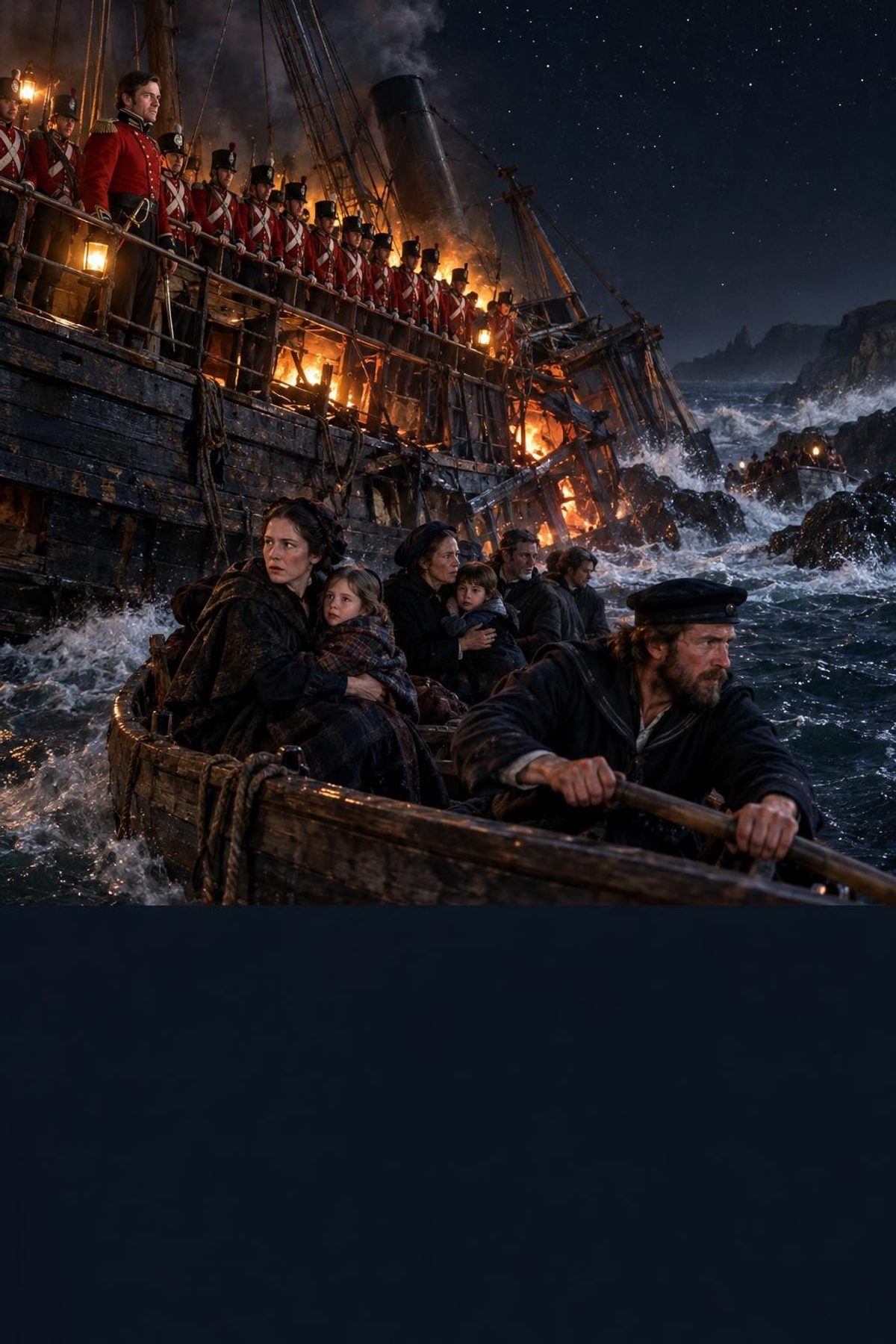
Many may imagine chaos in those moments, a frantic scramble for life, yet the true events stand as a powerful testament to human dignity. There were not enough lifeboats for all aboard; less than 200 people could be saved from a complement of nearly 700. Amidst this grim arithmetic, Lieutenant Colonel Alexander Seton made a pivotal decision. The priority was clear: safeguard the women and children, then face the inevitable.
Read next: When HMS Implacable Burned Herself Into History, 1949
The Muster on Deck
As the sea swallowed the ship, Seton ordered the men to muster on deck. A curious sense of calm descended—a stark contrast to the desperate situation. The command issued by Seton echoed through the night: the soldiers lined up with military precision, forming ranks like an unyielding bulwark against the cacophony of panic.
These soldiers, mostly young recruits still green to the regimented life, displayed a valor rarely witnessed. Their formation on the tilting deck served not only to maintain discipline but also to provide stability for those fleeing to safety. Within sight of salvation, yet tethered by honor, 480 men stood shoulder to shoulder, a stalwart line of courage amidst the chaos around them.
This act of resolute sacrifice coined the phrase "Birkenhead Drill," a harrowing but virtuous testament to the credo: "Women and children first." It immortalized the principle of selflessness at sea, echoing in every subsequent maritime legend.
The Accounts of Survival
Among those who escaped were poignant testimonies. Survivors recounted how soldiers stood like sentinels, silent and determined not to disrupt the loading of lifeboats. Their steadfastness allowed all the women and children to evacuate safely, the early lifeboats slipping away silently, silhouetted against the moonlit waves.
The raw courage did not end with the formation; as the ship continued its inexorable descent, these men faced their mortality. Some were claimed by the waves, while others leaped into the sea, amid shrieks of the drowning. Only in the cold embrace of water did these determined souls allow themselves to break ranks, hopes buoyed by the slim chance of swimming to shore.
Events recorded by survivors illuminate the stark humanity amidst tragedy. The ship's horses, bound for cavalry posts, were released into the water—a haunting procession of freedom within doom. Men clung to debris or swam for the distant shore, battling the very elements they had sought to master. Against all odds, some of these swimmers reached land, forever carrying the night’s ghosts within them.
Read next: When HMS Inflexible Stopped at Gibraltar and Changed the War
Beneath the Waves, Beyond the Horizon
The tale of the Birkenhead is more than a maritime tragedy; it's a somber reflection on principle and valor. As historians unfurl the past’s scroll, this episode reminds us of the costs borne by duty, compelling gratitude for sacrifices that ripple through time.
The century that followed would see numerous evolutions in ship safety, yet each advancement was quietly inked with the memory of that night. Commemorated in naval lore, the essence of these soldiers' sacrifice perseveres—a principle echoing through battles, and disasters, reinforcing the timeless creed of prioritizing the most vulnerable.
Today, as tides wash over the resting place of HMS Birkenhead, its story resonates as an emblem of steadfast duty, standing firm to preserve the innocent. The wreck, though frozen in eternity, continues to surface, not merely in memory, but in the foundational codes that guide maritime ethics.
In a world enthralled by fleeting celebrity and transient icons, the men of the Birkenhead silently remind us of honor encapsulated in sacrifice. These ranks, though claimed by the sea, revealed a strength unyielding to fear or chaos, a shared humanity binding the living shore to the undulating depths. Their silence was their legacy, immortalized not by monument or medal, but by the enduring reverence of those they chose to save.