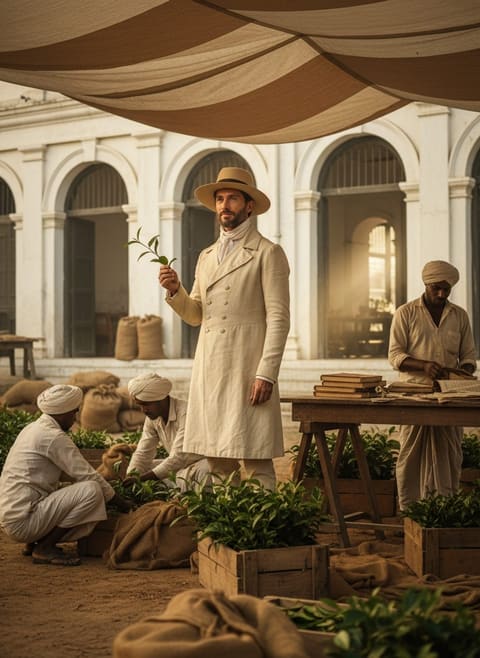
William Jardine is a name lost to many. Yet, his impact on Asia ripples through history.
The Healing Hands of Ambition
In 1802, a young William Jardine embarked on a journey that began not with trade but with the promise of healing. As a freshly minted surgeon aboard an East India Company ship, Jardine stepped into a world teetering between tradition and transformation. Canton, now known as Guangzhou, was a bustling nexus of commerce. It lay at the heart of China's coastal trade, a tightly controlled marketplace where foreign merchants sought the exotic silks and fragrant teas that had mesmerized the Western world. Jardine did not enter this world as a trader, yet the intricate choreography of trade he observed ignited a spark within him.
This Scottish surgeon was no ordinary man, driven not only by a thirst for adventure but by the lure of infinite possibility that lay inside Canton's bustling harbors. With a medical kit in hand and an iron will, Jardine's encounter with the chaotic negotiation floors and hazy opium rooms likely kindled a new ambition. As his role shifted from surgeon to entrepreneur, Jardine's keen insight into human anatomy became his blueprint for dissecting and reshaping the anatomy of trade networks, positioning him at the precipice of two worlds.
The Rise of a Trader
The early 19th century was a turbulent time for trade, especially in the Far East. Westerners craved Chinese goods, but the Qing Dynasty's policies limited their access. The shift from scalpel to commerce came naturally to Jardine, whose precise business acumen and keen understanding of human need were as sharp as any surgical tool. By 1834, Jardine had crafted a colossal force within the tumultuous waters of trade, establishing what would become the largest trading house in Asia. His colossal endeavor, built from scratch, was unmatched in ambition and execution.
Read next: When Nathan Mayer Rothschild Cornered the London Market, 1815
The Pearl River Delta, a throbbing artery of commerce, became the operational heart of Jardine's burgeoning empire. His company, eventually known as Jardine Matheson & Co., deftly navigated the complex web of shipping routes and trade regulations. With an unyielding appetite for expansion, Jardine widened his reach. He traded everything from silks to spices, from textiles to tea, but it was opium that poured liquid gold into his coffers. Jardine didn't merely build a company; he established dominion over the maritime networks that fed the insatiable western demand.
Breaking Open the Gates
The year 1834 marked a turning point. The British Parliament ended the East India Company's trading monopoly in China, thrusting the doors wide open for private traders like Jardine to carve their paths. However, Jardine was not content to passively stand by as this new era unfolded. His vision extended beyond the horizon of immediate profitability. He saw an opportunity to redefine commerce entirely — a globalization pioneer long before the term existed.
Canton's gates were ajar, not opened, held firmly by stringent Chinese control. Jardine sought to kick them wide. In meetings shrouded by the thick aroma of opium and the whisper of silk, Jardine positioned himself as the linchpin of the trade world. His maneuvers in the trading houses of the Pearl River Delta were more than business strategies; they were bold moves on a geopolitical chessboard. Jardine's empire thrived on his ability to read the winds of fortune, anticipating shifts in policy and preference before his competitors even raised their sails.
Read next: When Thomas Lipton Walked Into Ceylon and Changed Tea Forever
The Echo of Jardine's Ships
Jardine's operations didn’t just ripple through Asia — they sent waves crashing onto the shores of history. His influence was a potent force, one that would eventually nudge China into revising its strict trade policies. Jardine's daring pushed Western expectations and Chinese resistance to their limits, contributing to the tensions that would explode into the Opium Wars. The commodification of conflict, an unintended consequence of commerce fueled by Jardine's ambitions, reshaped China’s interactions with the world and ushered in an era of unequal treaties that would leave lasting scars.
Though Jardine’s triumphs were born from the grit and shadows of opium dens, his legacy extends beyond mere commodity exchange. He catalyzed a transformation in international trade practices, setting parameters that would define global economics for centuries. Jardine Matheson & Co., recognized as the embodiment of innovation and aggressive expansion, would become a bellwether for market capitalism, its roots were planted deep in the paradoxically rich soil of necessity and desire.
The story of William Jardine is a compact epic of ambition over adversity, where a man's insatiable appetite for conquest opened doors both literal and metaphorical. It’s a narrative that reminds us of the paradox inherent in progress: the darker the shadows, the more starkly the light seems to shine. As Canton’s gates swung ajar, so too did the portals of modern commerce, forever altered by a Scottish surgeon who dared redefine the boundaries between healer and trader, East and West.