The air in Stuttgart that August day in 1907 was alive with anticipation as delegates from around the world gathered under a sky of soft, gauzy clouds. The International Socialist Congress, a gathering of voices advocating for social and political change, was in full swing. The rhythmic hum of different languages filled the air, creating a symphony of ideas and hopes echoing in the majestic hall where the congress convened. It was here, amidst an assembly of fervent reformers and revolutionaries, that the status quo would indeed be challenged. The air was as tangible with promise as the steadfast gaze of a woman who had traveled far to carry a message that would catalyze change. Her name was Bhikaji Cama, and she was about to do what no Indian had dared before on foreign soil.
Bhikaji Rustom Cama, a Parsi woman from Bombay, stood resolute, her presence commanding yet serene in a sea of impassioned faces. She had endured years of exile from her homeland, a punishment meted out by the British Empire to silence her unwavering voice calling for India's independence. Yet here, thousands of miles from home, the Empire’s grip felt distant. Stuttgart offered a momentary sanctuary for the convicted yet unbroken advocate.
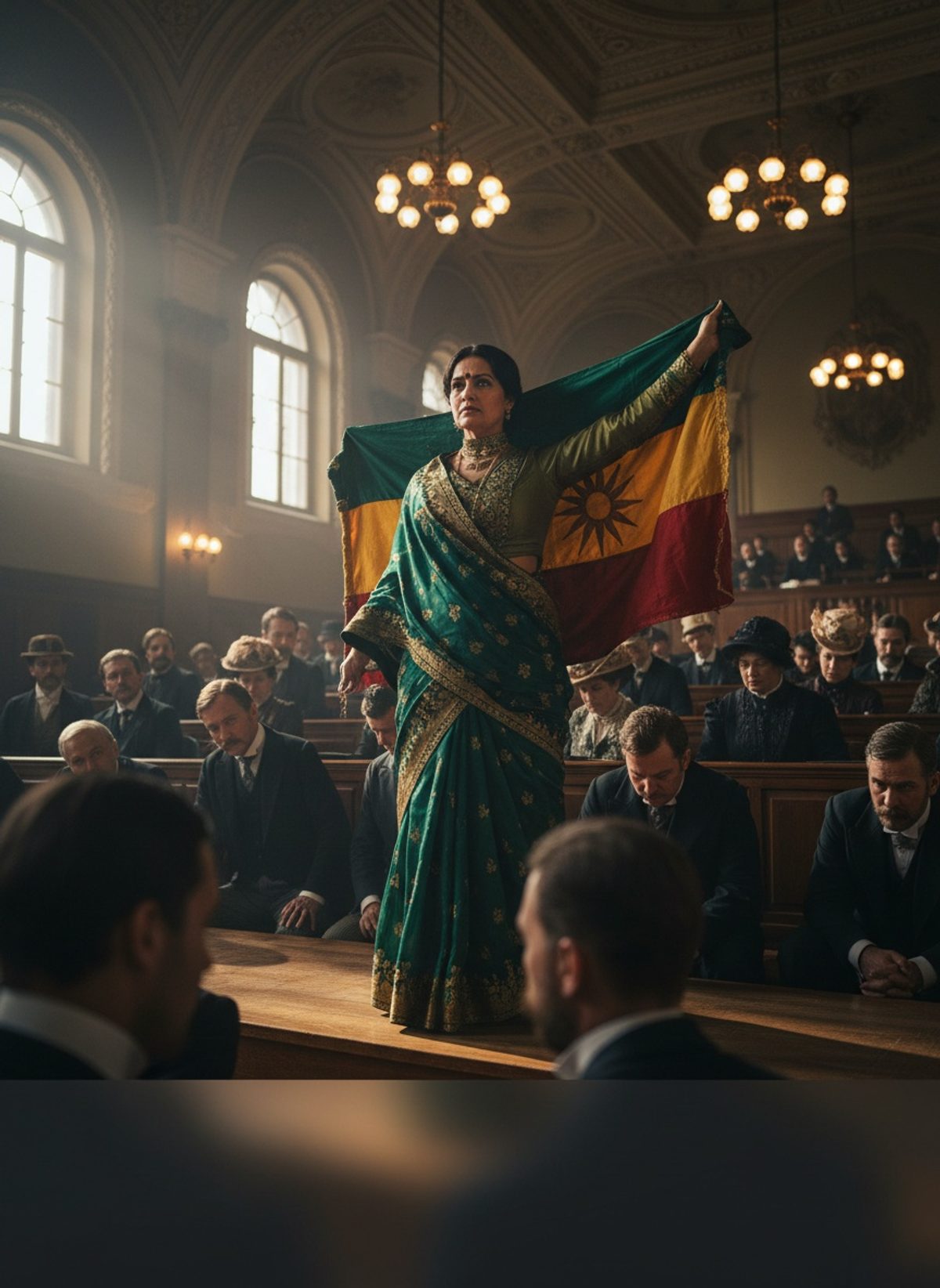
With purposeful hands, she unrolled a banner — a hand-sewn flag that was more than just fabric. It was a symbol, vibrant with the colors of green and gold, carefully stitched to represent a future unshackled by colonial rule. The crowd roared, an enthusiastic chorus that transformed Europe’s distant land into fertile ground for her revolutionary declaration. The flag was India's unwritten anthem, a promise of liberty echoed in the embrace of her fellow freedom-seekers.
The journey of Bhikaji Cama to this pivotal moment was as remarkable as the act itself. In the context of the early 20th-century political landscape, women were still fighting for their voices to be heard, and Indian nationalists were scattered, struggling to organize under the watchful eyes of their colonial rulers. Cama, born into a prosperous family in Bombay, used her education and privilege not as a shelter but as a weapon against oppression. Her activism began in India but flourished abroad, where censorship and restricted movement were meant to contain her zeal.
Read next: When Wat Tyler Faced the King in Smithfield, 1381
As she unfurled the banner, Bhikaji did more than just display colors; she wove a narrative of resistance that resonated deeply with the attendees of the congress. Each thread of the flag represented a piece of India's story, a testament to the struggles endured, and the battles fought since the inception of colonial rule. The congress, a platform for the marginalized and the misrepresented, amplified her voice far beyond the confines of the hall, echoing into the minds of many who sought similar liberation from imperial stakeholders around the world.
Cama's selection of Stuttgart was no mere coincidence. The city, a hub of industrial progress and social dialogue, provided an appropriate stage for this clarion call. The International Socialist Congress was a congregation of minds united over change, and here, her message found both an audience and allies. Unlike the hostile environment of British India, characterized by censorship and punitive measures, the congress was an echo chamber for ideals contrary to imperial interests.
Standing before the delegates, Bhikaji Cama carried an air of defiance, her voice unwavering as she spoke of a land rich in culture yet impoverished by subjugation. Her address was a heartfelt plea wrapped in a call to action, an appeal not just for support but for solidarity. In unfurling the flag, Cama had given a face to India's aspirations for independence, binding the struggle of her homeland to an emerging global discourse on freedom and self-determination.
Beyond the immediate shockwaves her act sent through the congress, Cama's chosen canvas — the first flag of India — would be immortalized in the storied tapestry of history. Though different in design and color from the tricolor that eventually became free India’s national flag, it shared a similar spirit of defiance and determination. Her design was a precursor to the myriad calls for independence that eventually coalesced into a full-fledged freedom movement.
Read next: When Disguise Carried a Fugitive Through Empire's Heart, 1876
The aftermath of her speech and her flag's unveiling reverberated far beyond the conference hall. For Cama, it marked a defining moment in her life's work, a culmination of years spent cultivating support for India’s cause across Europe and America. It was a reminder to the British Empire that the seeds of resistance, once sown, could traverse borders and grow unimpeded by geographical constraints.
In the years that followed, Cama's influence extended beyond her own activism. She became a source of inspiration for future generations of Indian nationalists, a testament to the power of a single act of resistance to ignite a movement. Her symbolic gesture in Stuttgart helped galvanize support for the cause back home and quietly educated the international community on the oppressive realities of colonialism.
As the Congress attendees filed out of the hall, the vision of India’s potential emancipation lingered in their minds, a vignette authored by Cama's courage. The significance of that day in Stuttgart lived on, igniting a flame of recognition that the Indian struggle for independence was now tangibly represented not just by its diaspora but by a symbol heralded on an international stage.
Bhikaji Cama’s defiant unveiling of India’s flag at Stuttgart serves as more than a historical footnote. It is a luminous reminder of the resilience required to challenge imperial narratives and a resonant assertion of the right to self-determination. Her act was a bold preamble to the struggles and triumphs that would follow, echoing across decades to remind us that freedom’s journey often starts with a single, courageous step onto a world stage.