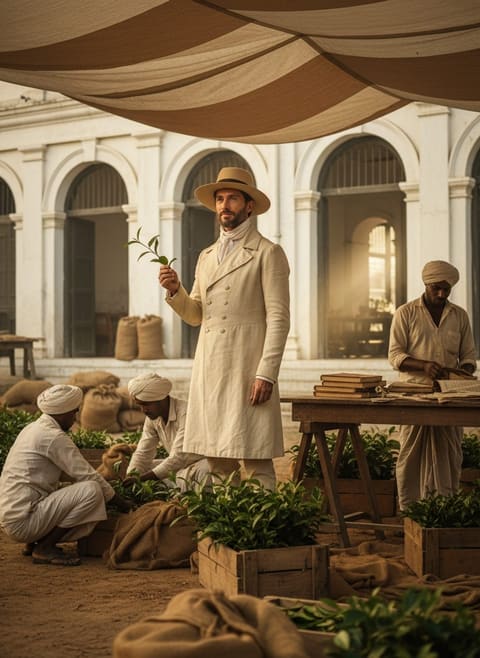
The tea leaves' journey across the seas was seamless. However, secrets brewed their own tumultuous path. In 1848, a Scottish botanist named Robert Fortune dared to unravel China's closely guarded tea secrets, changing the fate of nations.
The Empire of Leaves
For centuries, China reigned supreme as the sole sovereign of tea. This aromatic treasure held a rich cultural and economic heritage, firmly rooted in the lush hills of Fujian and Zhejiang provinces. Tea wasn't merely a beverage; it was an emblem of an empire’s grandeur, with its secrets as securely kept as the Great Wall itself. The Qing dynasty, understanding tea’s pivotal role, ensured that its cultivation and processing techniques were shrouded in mystery, known only to a privileged few.
Meanwhile, across the seas, the British were facing a conundrum. The East India Company (EIC), which once accounted for half of the world's trade, was spending a fortune importing tea. Britain's insatiable demand for tea weighed heavily on its economy. The country was paying dearly for a commodity it couldn’t cultivate on its own shores. The cool and damp British climate was far from conducive for tea plantations. For Britain, tea represented both a cultural staple and a vexing expense.
The EIC, synonymous with British trade domination, saw an opportunity in Fortune's botanical prowess. Established in 1600, the company wielded monstrous influence across Asia, yet the lush valleys of China presented a formidable challenge. Robert Fortune was commissioned as their agent to infiltrate China's guarded tea gardens, a mission shrouded in danger and intrigue.
Read next: When Nathan Mayer Rothschild Cornered the London Market, 1815
The Master of Disguise
Robert Fortune was not an ordinary botanist. His spirit of adventure matched his passion for plants. When tasked with acculturating himself into the intricate tapestry of Chinese society, Fortune didn't shy away. Armed with a fake pigtail, the traditional Chinese queue, and dressed in authentic Chinese attire, he transformed into a Chinese merchant. His disguise was as meticulous as his botanical studies, allowing him to blend seamlessly into the world's largest tea empire.
Fortune’s voyage took him through the heart of China, traversing territories that were forbidden to foreigners. Each step he took was fraught with danger. The Qing dynasty was not lenient towards spies who dared to pry into their verdant secrets. Fortune's journey was akin to walking on a knife's edge—one misstep could lead to dire consequences. Yet his botanical passion eclipsed his fears.
Not only did Fortune excel at maintaining his disguise, but he also mastered the art of deception. He employed local guides who believed in his false identity, enabling him to reach places in China where no westerner had trodden. His notebooks brimmed with rich cultural observations, shedding light on lesser-known Chinese practices that had previously escaped European understanding. Here lay a story of intelligence meeting bravery, where a botanist’s humble mission stood on par with any spy thriller.
Sowing Seeds of Change
Fortune’s greatest achievement, however, was not merely his successful infiltration. It was the smuggling of 20,000 tea plants and seedlings out of China's hidden gardens, a feat that required cunning and careful planning. He chose healthy plants and seeds, packed meticulously in Wardian cases—a revolutionary invention for transporting plants long distances. These cases were essentially miniature greenhouses, providing the vital conditions needed to keep the plants alive during their sea voyage to British-controlled India.
Fortune's mission extended beyond mere botany; it was an operation that resembled a covert intelligence task. The stakes were immense, involving not just flora but economic dominance. Once the boat's sails caught the trade winds, each petal carried the potential to unravel China's tea monopoly, setting the stage for a botanical shift of power.
Read next: When Thomas Lipton Walked Into Ceylon and Changed Tea Forever
In India, under British control, these seedlings found a new home. The East India Company aimed to replicate China's success in their own newly planted tea gardens in Darjeeling and Assam. Here, the secrets Fortune had unearthed would sprout into a burgeoning tea industry. No longer would Britain rely on costly Chinese imports; instead, it would cultivate its own empire of leaves, brewed from the seeds of Fortune's daring exploits.
Brewing a New World Order
The impact of Robert Fortune’s expedition was akin to a commercial revolution. By curtailing China’s tea grip, Fortune unwittingly seeded the global proliferation of tea. What was once an exclusive Chinese domain became a major commodity in British possessions like India, Sri Lanka, and later, Africa. The East India Company's mastery of tea ensured the drink became an integral part of British cultural identity, intertwined with the image of Victorian society.
The tale of Robert Fortune serves as a reminder of the complexities intertwined in the empire's hunger for economic supremacy, and the lengths to which powers would go to maintain leverage. His journey was not just a venture into the heart of Qing China, it was an audacious exploit that altered the course of tea trade worldwide. In hindsight, the story raises the question of how far we choose to stretch ethical boundaries in pursuit of knowledge and power.
Tea, today, is a global symbol of tranquillity, yet its peaceful demeanour belies its tumultuous past. As you sip your next cup, consider the journey of those leaves—a journey kickstarted by one man's bold stride into forbidden lands, reshaping economies, and cultures ever since.