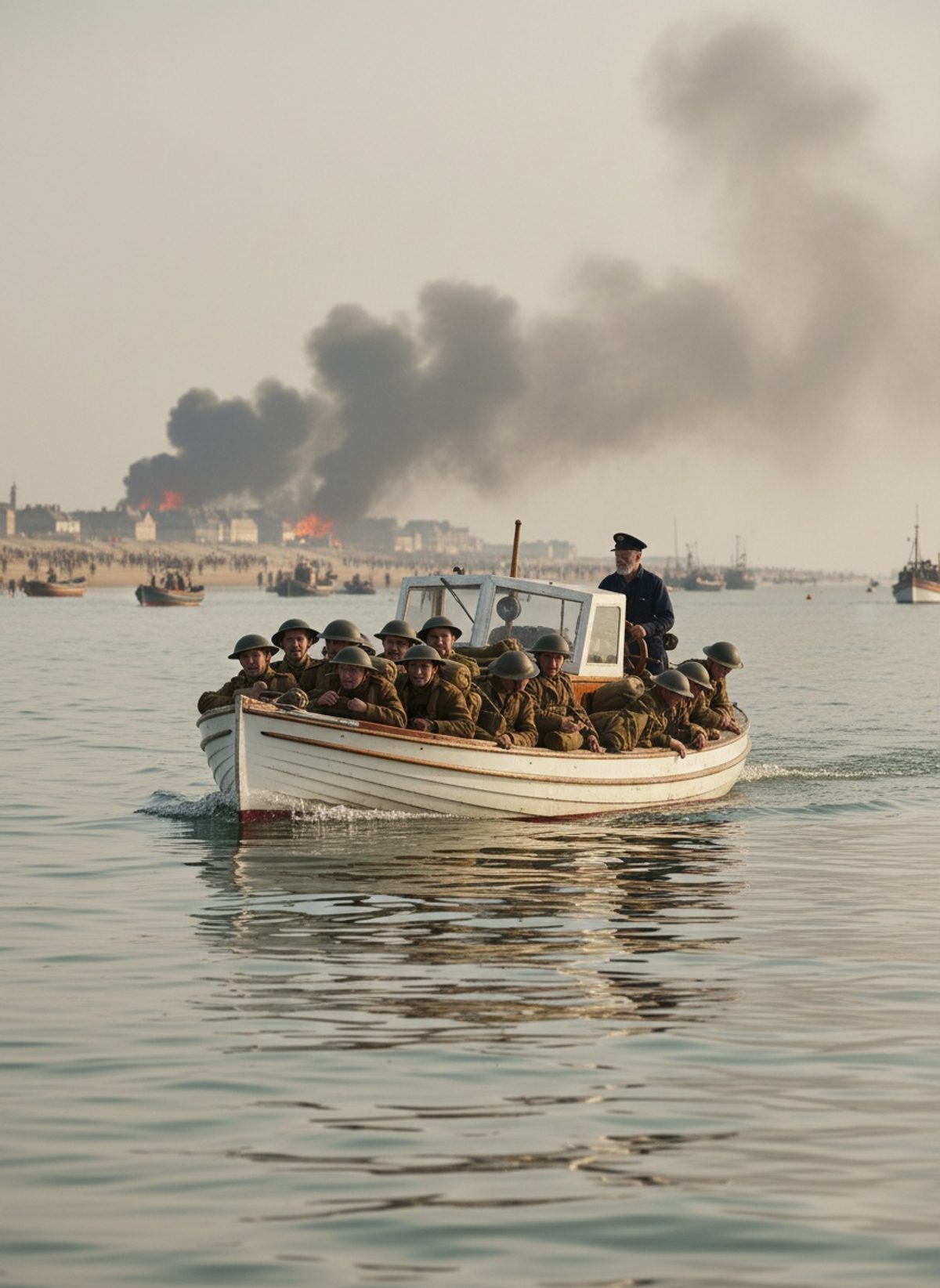
In 1940 the motor yacht Sundowner crossed the English Channel to help in the Dunkirk evacuation. Her owner and skipper was Commander Charles Lightoller, who had retired from seafaring in 1920. Twenty-eight years earlier he had been the second officer of the RMS Titanic, and the most senior member of her crew to survive the disaster. Rather than allow the Admiralty to requisition his yacht, Lightoller, then 66, sailed her to Dunkirk himself.
Lightoller had gone to sea at 13, beginning a four-year apprenticeship in the barque Primrose Hill. On his second voyage, in the Holt Hill, a storm in the Indian Ocean in November 1889 drove the ship aground on an uninhabited island now called Île Saint-Paul. He later nearly died of malaria on the West African coast, went to the Yukon to prospect for gold in the Klondike, and served under Captain Edward Smith in the White Star liner Majestic before becoming an officer in the line's flagship, Oceanic. On 20 March 1912 he boarded the RMS Titanic in Belfast as first officer for her sea trials, but when Captain Smith brought in Henry Wilde as chief officer, Lightoller became second officer for the maiden voyage. On 14 April he had the watch until 10 p.m. At 9:00 Smith conferred with him on the bridge, and they agreed that they should be able to see an iceberg with plenty of time to avoid it. Lightoller had the crow's nest telephoned twice to make sure the lookouts would keep a sharp lookout for "small ice and growlers". Murdoch relieved him at 10 p.m., and he was in bed, awake, when he felt the collision. In charge of lowering the lifeboats on the port side, he interpreted Smith's order as "women and children only" and enforced it strictly. The only adult male passenger he allowed into the boats there was Major Arthur Peuchen, a yachtsman, because there were few seamen available to help command one of the lowering lifeboats. Lightoller went down with the ship and survived the night on the overturned Collapsible B with several others, taking charge of the roughly 30 survivors on it. At dawn lifeboats Nos. 4 and 12 rescued them, and he was the last survivor to be taken aboard the Carpathia.
In the First World War Lightoller commanded the torpedo boat HMTB 117 and then the destroyers HMS Falcon and HMS Garry, and he was twice decorated for gallantry, first with the Distinguished Service Cross for engaging the Zeppelin L31 in a night battle. He retired from seafaring in 1920 and bought the motor yacht Sundowner in 1929. In early 1939 the Admiralty commissioned him to use her to tour the German coast and photograph German naval installations. Germany invaded Belgium, the Netherlands and France on 10 May 1940, and by 21 May German forces had trapped the British Expeditionary Force, the remains of the Belgian forces and three French field armies along the northern coast of France. The BEF's commander, General Viscount Gort, saw evacuation across the Channel as the best course of action and began planning a withdrawal to Dunkirk, the closest good port. The evacuation, Operation Dynamo, was planned by Vice Admiral Bertram Ramsay from the naval headquarters below Dover Castle, and Churchill ordered it to begin just before 19:00 on 26 May.
Admiralty officers combed nearby boatyards for small craft that could ferry men from the beaches to larger ships, and an emergency call went out for more help. Agents of the Ministry of Shipping, with a naval officer, scoured the Thames for likely vessels, and some boats were requisitioned without the owner's knowledge or consent. Lightoller would not let the Admiralty requisition Sundowner. He sailed her to Dunkirk himself.
Read next: The Night Britain Raided France Three Weeks After Dunkirk
With Lightoller on the crossing were his eldest son Roger and a young Sea Scout named Gerald Ashcroft. Sundowner was licensed to carry 21 passengers. Lightoller and his crew brought home 127 British servicemen in her.
The first of the little ships had arrived at Dunkirk on 28 May. The wide sand beaches meant that large vessels could not get anywhere near the shore, and even small craft had to stop about 100 yards from the waterline and wait for the soldiers to wade out; many waited for hours in shoulder-deep water. On 27 May the Luftwaffe had heavily bombed the town and the docks, and with the water supply knocked out, the fires could not be put out. In most areas on the beaches, soldiers queued up with their units and waited their turn to leave. Unknown to Lightoller, his second son, Trevor, a second lieutenant with the 3rd Division, had already been evacuated 48 hours before Sundowner reached Dunkirk.
On the return journey Sundowner came under attack from enemy aircraft. Lightoller evaded their fire using a technique described to him by his youngest son, Brian, an RAF pilot who had been killed in action on 4 September 1939, on the first night of Britain's entry into the war. Gerald Ashcroft later recalled: “We attracted the attention of a Stuka dive bomber. Commander Lightoller stood up in the bow and I stood alongside the wheelhouse. Commander Lightoller kept his eye on the Stuka till the last second – then he sang out to me ‘Hard a port!’ and I sang out to Roger and we turned very sharply. The bomb landed on our starboard side.”
Sundowner was one of a hastily assembled fleet of over 800 vessels. Many troops embarked from the harbour's protective mole onto destroyers, which could carry about 900 men a trip, and onto civilian merchant ships. Others were ferried out by what became known as the Little Ships of Dunkirk, a flotilla of hundreds of merchant marine boats, fishing boats, pleasure craft, yachts and lifeboats called into service from Britain. By 31 May nearly four hundred small craft were voluntarily taking part, and because of a shortage of personnel many crossed the Channel with civilian crews.
The evacuation was costly. Six British and three French destroyers were sunk, along with nine other major vessels, and over 200 British and Allied sea craft were lost. Over 3,500 RAF sorties were flown in support of Operation Dynamo, although most of the dogfights took place far from the beaches. Soldiers being bombed and strafed while awaiting transport were for the most part unaware of the RAF's efforts to protect them.
Read next: The Night 115 Men Crossed the Channel to Hit Back
On the first day only 7,669 soldiers were evacuated, but by the end of the eighth day 338,226 had been rescued. In the House of Commons on 4 June, Churchill hailed their rescue as a “miracle of deliverance”, but reminded the country that “we must be very careful not to assign to this deliverance the attributes of a victory. Wars are not won by evacuations.”
Lightoller continued to serve with the Small Vessels Pool until 1946. He commanded a small armed vessel patrolling the River Blackwater in Essex during the invasion scare of 1940–41, then ferried arms and ammunition for the Royal Army Service Corps until the end of the war, and was mentioned in despatches in December 1944. His eldest son, Roger, who had crewed Sundowner at Dunkirk, served in the Royal Navy and was killed in March 1945 during the Granville raid while commanding a motor torpedo boat.
After the war Lightoller managed a small boatyard in Twickenham, Richmond Slipways, which built motor launches for the river police. He died of chronic heart disease on 8 December 1952, aged 78, during London's Great Smog. The character Mr Dawson, played by Mark Rylance in the 2017 film Dunkirk, was inspired by him.
Part 3 of 24: One Second World War story a day, 16 November to 9 December