Lieutenant Commander Gerard Broadmead Roope was a 35-year-old Royal Navy officer when he fought his last action. Born on 13 March 1905 at Hillbrook, Trull, near Taunton in Somerset, he was educated from the age of 13 at the Royal Naval Colleges at Osborne and Dartmouth, and on 15 January 1923 was appointed a midshipman in the battleship Revenge. He served as a sub-lieutenant in Concord and Caledon and as a lieutenant in Marlborough, before taking command of the G-class destroyer HMS Glowworm on 22 July 1938.
Glowworm, completed in January 1936, displaced 1,350 tons and carried four 4.7-inch guns. She was the test ship for the new quintuple torpedo tube mounts. During the Spanish Civil War she patrolled Spanish waters, enforcing the arms blockade imposed by Britain and France, and after the Second World War began she carried out convoy escort duties and anti-submarine patrols. In March 1940 she was transferred to the Home Fleet. Her peacetime complement was 137 officers and men; by April 1940 it was 149. On 5 April she sailed as part of the escort of the battlecruiser Renown, covering Operation Wilfred, the laying of mines in Norwegian waters.
On 7 April Glowworm was detached from the force to search for a man lost overboard. On the morning of 8 April, on her way to rejoin Renown, she met the German destroyers Z11 Bernd von Arnim and Z18 Hans Lüdemann in thick fog before 8 a.m. They were part of a German naval detachment, led by the heavy cruiser Admiral Hipper, on its way to land troops at Trondheim as part of Operation Weserübung, the German invasion of Norway.
Glowworm opened fire, and after one of the German ships was hit, both broke off and headed north. The German destroyers signalled for help. Roope was aware that they were trying to draw him towards German capital ships, but he gave chase. The call was answered by Admiral Hipper, which spotted Glowworm at 09:50. The cruiser displaced 14,000 tons. Roope alerted the Home Fleet, and his enemy report was received by the battlecruiser Renown.
Read next: The Day a One-Legged Captain Refused to Strike His Colours
Hipper had difficulty distinguishing Glowworm from von Arnim, but eight minutes later she opened fire with her 8-inch main armament at 9,200 yards, and Glowworm was hit by her fourth salvo. She made smoke and turned into it, but the cruiser's radar-directed guns were not affected by the smoke, and when the destroyer emerged the range was short enough for Hipper's 4.1-inch guns to open fire as well. Glowworm's radio room, bridge and forward 4.7-inch gun were destroyed, and she took more hits in the engine room, the captain's day cabin and the mast. As the mast fell it short-circuited the wiring, and the ship's siren turned on. According to the Victoria Cross citation, the heavy sea meant that Glowworm could not shadow the enemy, so Roope decided to attack with torpedoes and then close in to inflict as much damage as possible.
At 10:10 Roope fired five torpedoes from one mounting at a range of 800 metres. They missed, because Hipper's captain, Hellmuth Heye, had kept his bow pointed at Glowworm to minimise the risk from torpedoes. Glowworm fell back through her smokescreen to buy time to get her second torpedo mount working, but Heye followed her to finish her off before she could fire the rest of her torpedoes.
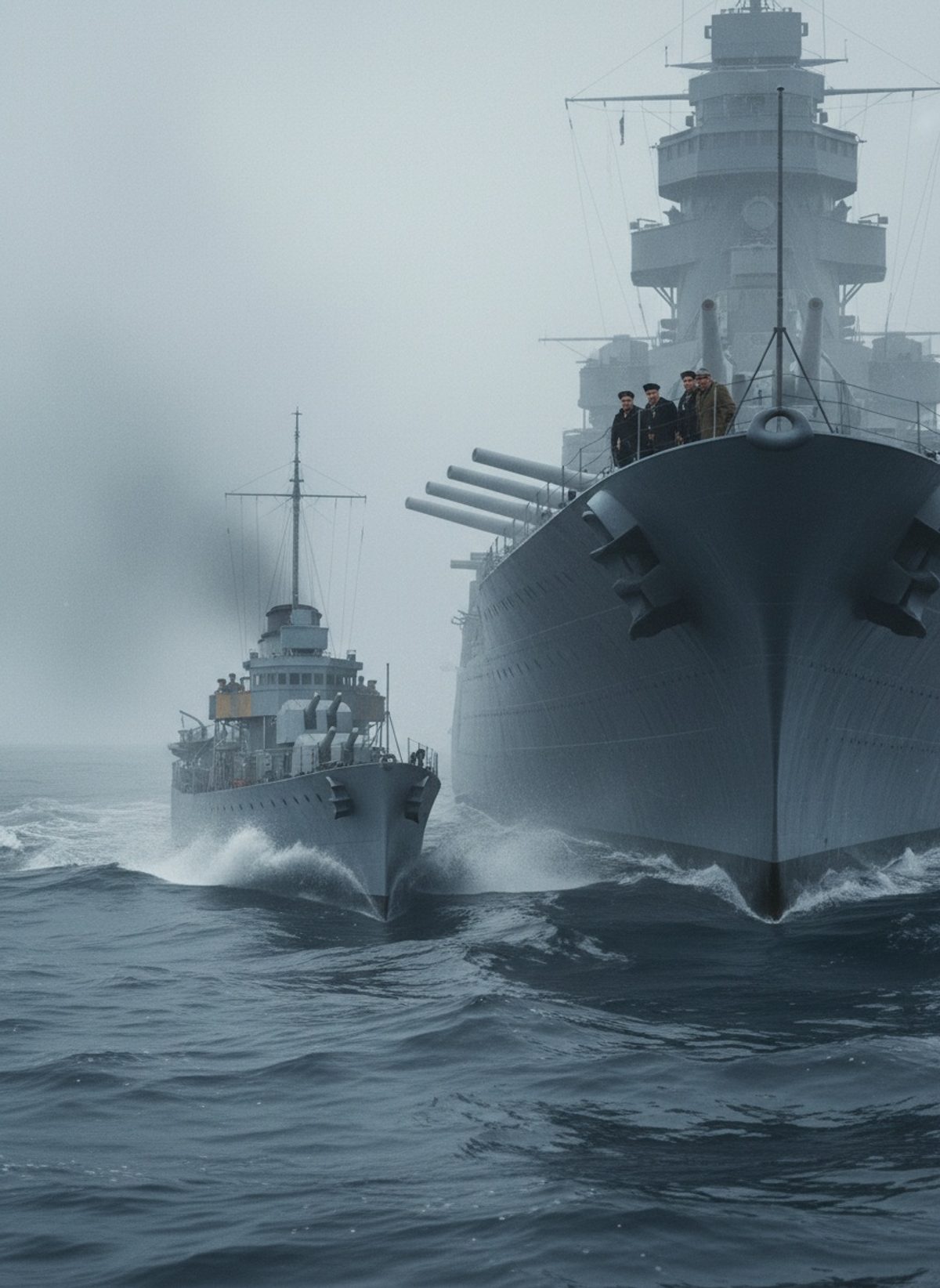
The two ships were very close when Hipper emerged from the smoke. Roope ordered a hard turn to starboard to ram the cruiser. Hipper was slow to answer her helm, and Glowworm struck her just abaft the anchor. The collision broke off Glowworm's bow, and the rest of the ship scraped along Hipper's side, gouging several holes in the cruiser's hull and destroying her forward starboard torpedo mounting. One of Hipper's sailors was lost overboard.
Admiral Hipper was not unscathed. She took on some 500 tons of water before the leaks could be isolated, but she was not seriously damaged. According to the Victoria Cross citation, as Glowworm drew away she opened fire again and scored one hit at a range of 400 yards. She was on fire when she drifted clear, and Roope gave the order to abandon ship. Her boilers exploded at 10:24, taking 109 of her crew with her, and she sank.
Read next: When Harwood's Three Cruisers Took On the Graf Spee, 1939
Admiral Hipper hove to and began to rescue survivors. Forty British sailors were recovered, although at least six later died of their wounds. The citation records that Hipper stayed hove to for at least an hour picking up survivors, but that the loss of life was heavy: only 31 of Glowworm's complement of 149 were saved. The German sailor lost overboard from Hipper was not found. The senior surviving officer, Lieutenant Ramsay, told his rescuers that neither the helm nor the emergency steering was manned when the ships collided.
Roope did not survive the ordeal. He drowned when he could no longer hang on to a rope while being pulled up the side of the cruiser. Captain Heye wrote to the British authorities through the Red Cross, recommending the Victoria Cross for his opponent's courage in engaging a vastly superior warship. Roope was posthumously awarded the Victoria Cross, an award justified in part by Heye's recommendation. He became the first VC recipient of the Second World War, although the award was not gazetted until July 1945, after the war in Europe had ended, and Lieutenant Ramsay was awarded the DSO. There were only two other occasions in the Second World War when a VC was awarded at the recommendation of the opponent.
The citation, published in July 1945, said the Victoria Cross was bestowed “in recognition of the great valour of the Commanding Officer who, after fighting off a superior force of destroyers, sought out and reported a powerful enemy unit, and then fought his ship to the end against overwhelming odds, finally ramming the enemy with supreme coolness and skill.” The award was presented to his widow on 12 February 1946.
Part 2 of 24: One Second World War story a day, 16 November to 9 December