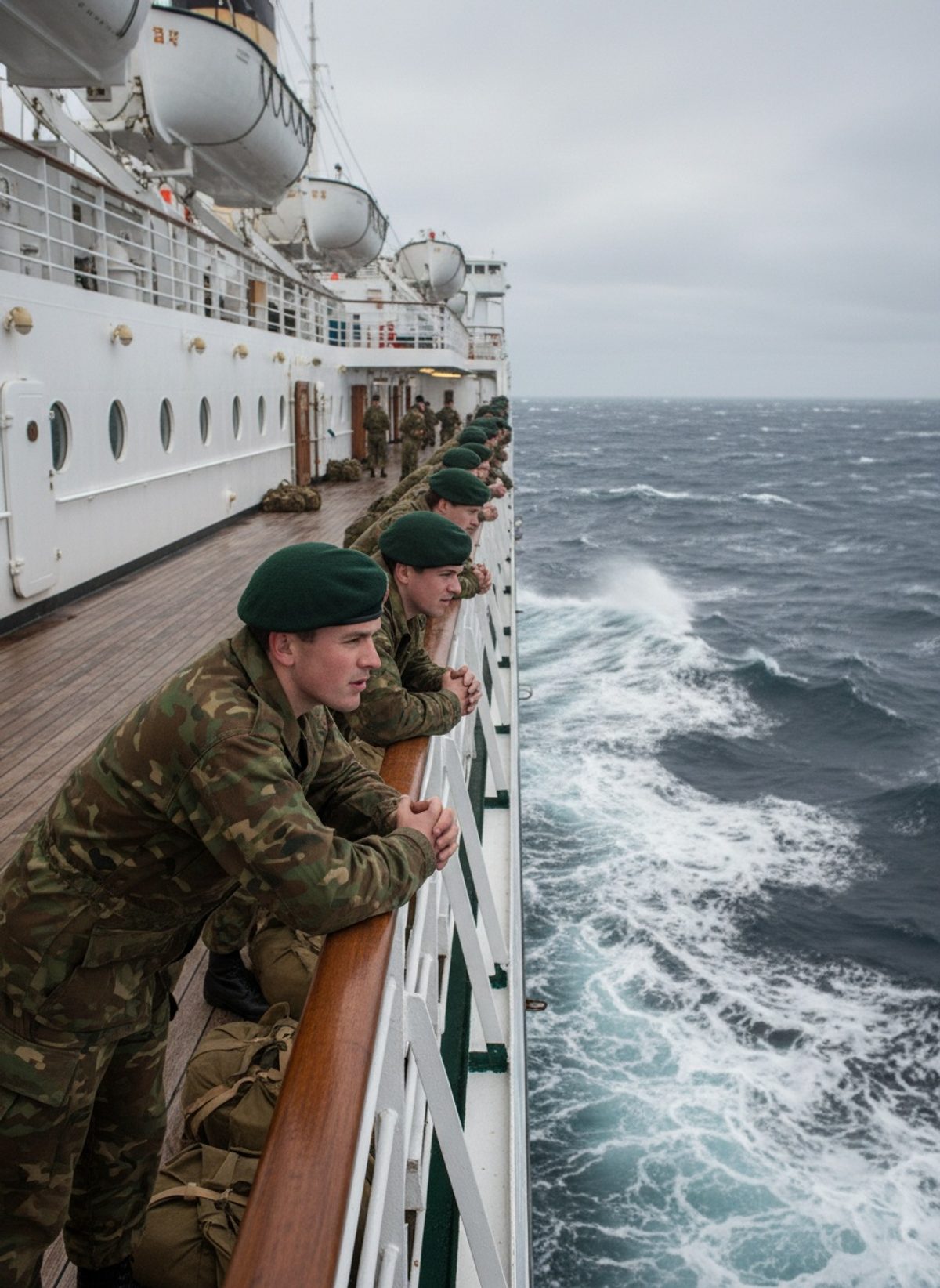
The SS Canberra was an ocean liner, a symbol of cruise luxury, and an ambassador of leisure across the world's seas. Yet, come 1982, she bore the burden of delivering men to war. Her passengers exchanged cocktails and sunbathing for rations and rifles. In this unlikely transformation, the Canberra became the Great White Whale, ferrying 3 Commando Brigade into the heart of the Falklands War.
Built in 1961 by the hands that forged the Titanic's sister ships, Canberra was Harland and Wolff's final ocean liner, a reflection of grandeur and nautical prowess. She traversed seas with grace, a gleaming figure cutting through the waves, too big for Tilbury and primly anchored in Southampton. Her usual route was a sunlit path stretching from the UK to Australia, a voyage painted with horizons of sunrises and tropical ports.
By Easter 1982, Canberra began her journey into history not as a cruise liner, but as a military vessel. The Argentine invasion of the Falkland Islands on 2 April 1982 forced Great Britain to muster an unexpected offensive. Amidst the flurry of strategic imperatives, Canberra was requisitioned, a reluctant leviathan drawn into the fray. At Gibraltar, her captain, Dennis Scott-Masson, was informed of this drastic alteration. Canberra's vacationers were disembarked, and her decks were soon thrumming with preparations for war.
The conversion of this proud cruise ship into an operational troopship was a near overnight transformation in Southampton. Her plush amenities gave way to the pragmatic necessities of war. The lifeboats, nested within her unique recessed hull, were not for leisure but potential salvation. On 9 April, Canberra set forth on a voyage unlike any she had undertaken—the voyage to conflict.
Read next: Built for Nelson's Navy. Sunk by the Luftwaffe.
Through the early days of May, as the ocean rolled beneath her keel, Canberra and her complement witnessed sights typical only of wartime. On 9 May, HMS Ardent danced deftly beside her, treating those aboard to a grim display of pyrotechnic prowess with a gunnery demonstration that signaled both a spectacle and an omen—Ardent herself would be lost within weeks, a symbol of the conflict's perilous stakes.
By 21 May, with her engines humming, the Great White Whale anchored in the cold embrace of San Carlos Water, the windy ribbon around which the Falklands swirled. Such was Canberra's stature that her visibility seemed an open invitation to the Argentine Air Force. Her bright presence was a peculiar paradox. She was a prey encased in an irony—unmissable, but ultimately untouched.
After the war, Argentine pilots said they had been told not to hit Canberra, having mistaken her for a hospital ship; hospital ships must be painted white, as Canberra always was, but must also fly a Red Cross flag, which she did not. Despite her natural target profile, the absence of attacks remains debated. Were Argentine pilots cautious, mistaking her for a hospital ship due to her pigmentation? Or did they simply reserve their limited firepower for the armed grey warships, deemed more formidable threats? Whatever the calculus, Canberra was not contested.
Following the primary landings at San Carlos, Canberra demonstrated a logistic fealty to her cause. Southward to South Georgia she sailed next, where another logistical ballet unfolded—3,000 troops moved from the luxurious decks of QE2, a fellow liner turned troopship, to the practical halls of Canberra. By 2 June, the newly embarked soldiers were deposited into the theatre of action, greeted by the Martian landscape of the Falklands, where courage and resolve would be their true allies.
As the war contracted into cessation, Canberra's duty shifted from harbinger of force to bearer of peace. She ferried Argentine prisoners of war back to Puerto Madryn, transforming her passage from one of war to a tendered promise of return. Her silhouettes against the dawn at this juncture spoke not only of duty fulfilled but an emblem of hope reignited.
On 11 July 1982, in a triumph eclipsing previous receptions, Canberra returned to Southampton, navigating an ocean awash with dual memories of festivity and conflict. Her arrival was met with a public outpouring of gratitude and reverence, her captain, Scott-Masson, hailed with honors befitting his and his ship's service—a CBE, and a special relation to the crown as an aide-de-camp to the Queen.
In peacetime, Canberra's reputation soared again, her name synonymous with valiance as well as luxury. The warmth of her voyages henceforth was enriched by tales of strength. Though refit again for peacetime voyages, the echoes of 1982 lingered for her passengers—the ship's dual soul was a story remembered and revered. Ticket sales soared as she became a pilgrimage of nostalgia for Britons who cherished both ship and sovereignty.
Read next: When 4,000 Men Came Ashore at San Carlos and Held Bomb Alley, 1982
Canberra's end was not via torpedoes or bombs but the inexorable passage of time and cost-efficiency. By 1997, she had succumbed to age and economic realities, reflecting the harsh truth that glory is fleeting and timelessness, a pursuit not easily fulfilled. Her sale for scrapping concluded her cruises, yet even in dismantlement, Canberra defied the elements of rapid obsolescence. Her hull, stubborn and resolute, took nearly a year for dismantlers to conquer.
In Gerard Kenny's tribute, "Farewell Canberra," the ship was immortalized in melody. Its verses resonated with the melancholic pride of her veteran travelers, echoing within both ship and continent—a final cord that transcended decks and seas. These words endure in chorus, memories of that white whale—a vessel that bore men to war and back, a saga blending the mundane with the grand. She serves as an eternal reminder of transformation, endurance, and the sea's boundless bonds connecting humanity. The history of the SS Canberra is as much a ship's story as it is a reminder of the human spirit's ability to adapt and persevere under the most extraordinary circumstances. The Great White Whale’s legacy thrives not merely in books or films, but in the memories and stories she ferried across time, navigating not just oceans, but history itself.
Last week, British paratroopers rehearsed a landing on the same islands Canberra's troops came ashore on.
Part 7 of 24: One Falklands story a day until Remembrance Sunday