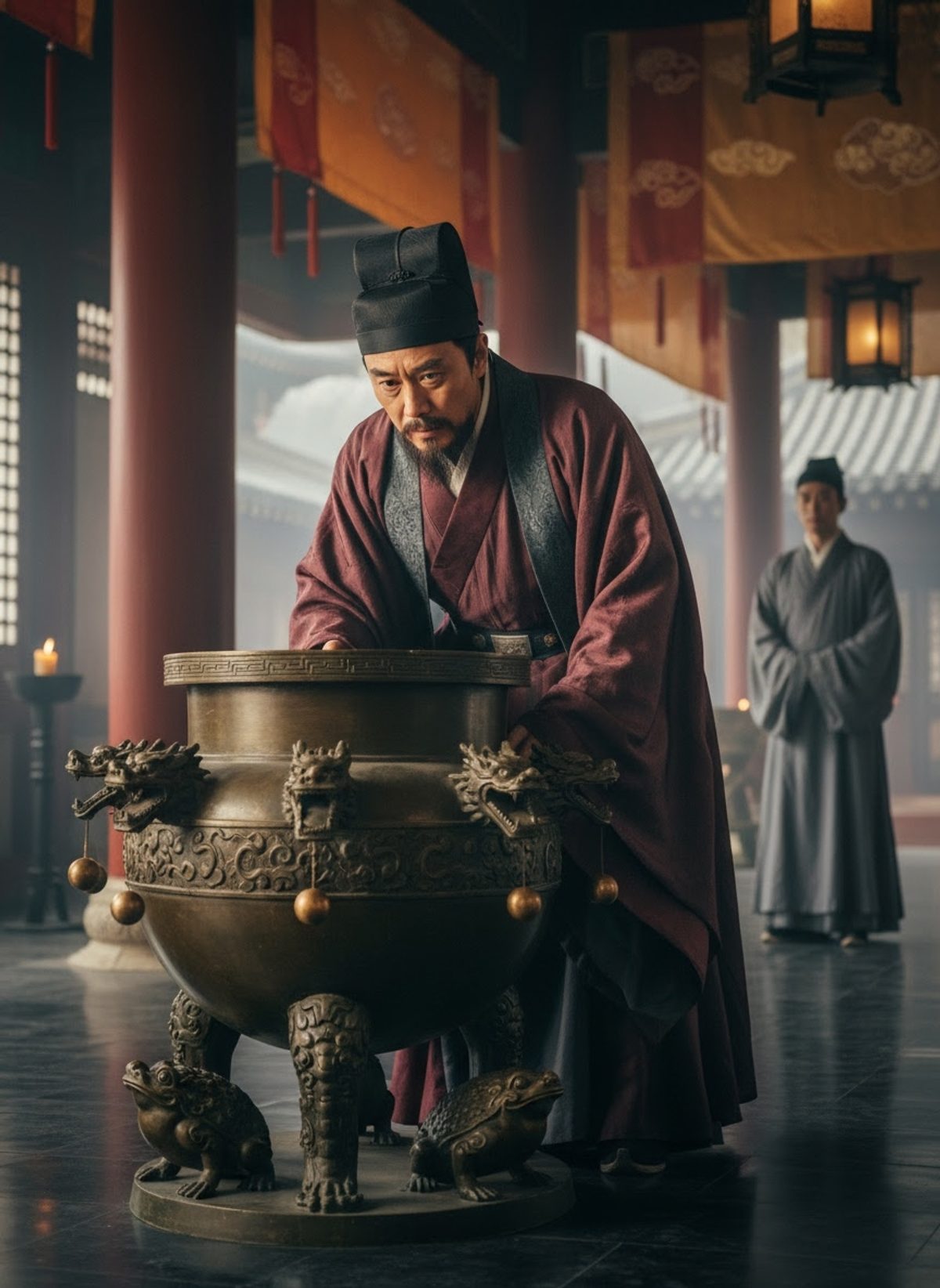
The vast, echoing halls of the Eastern Han court shimmered in the midday light, the high ceilings laced with elegant depictions of the celestial order. Outside, the day was clear, a gentle breeze teasing the banners that lined the imperial compound. Inside, courtiers whispered about the latest invention brought in by the palace's resident genius, Zhang Heng.
His contraption — a bronze urn festooned with intricate designs — stood silent and enigmatic in the center of the hall. Few took it seriously. After all, Zhang claimed it would announce the arrival of tremors, an idea far removed from the immediate concerns of governance.
The Polymath's Masterpiece
Born in AD 78 in the town of Xi'e, Zhang Heng’s brilliance was apparent from an early age. His journey took him to the heart of intellectual life in Luoyang and Chang’an, where he gained mastery over a diverse array of fields, from mathematics to poetry.
Yet it was his application of mechanics to solve the mysteries of the natural world that truly set him apart. By 132 AD, he held several prestigious posts, including that of Chief Astronomer and Palace Attendant. Zhang's innovations in hydraulic engineering and astronomy were renowned, but it was his invention of the world's first seismoscope that captured the imagination.
Read next: Gao Lishi Refused to Betray the Emperor Who Exiled Him
This bronze marvel, unlike anything seen before, was equipped with eight dragon heads, each facing a cardinal direction. Below each dragon’s mouth sat a toad, ready to catch the jade ball the dragon would release in response to a seismic event. Skeptical courtiers might have scoffed, but Zhang Heng's grasp of celestial mechanics and the Earth's forces was unparalleled.
The Moment of Proof
Then, on a day when the palace seemed steeped in tranquility, a sudden metallic clink resonated through the hall. One of the dragons had spat its ball, indicating an earthquake in the west. Courtiers exchanged dubious glances, some suspecting a flaw in the machine or even foul play.
It took three days for the riders dispatched to the western reaches of the empire to verify the occurrence of a massive earthquake over 400 miles away. Upon their return, they brought confirmation: Zhang’s seismoscope had worked, predicting what no human could sense within the palace grounds.
The court buzzed with newfound respect for Zhang Heng. While the theoretical underpinnings of his device eluded many, the practicality was undeniable. He had demonstrated an ability to perceive the Earth’s shifts with a precision that was nothing short of revolutionary.
Inside the Seismoscope
Delving into the mechanics of Zhang’s invention, one finds a keen understanding of the forces at play beneath the Earth's surface. The design was deceptively simple yet brilliantly effective. When seismic waves traveled through the earth, they caused the pendulum inside the urn to sway.
Read next: Sima Qian Wrote China's Greatest History From a Prison Cell
This triggered a mechanism whereby a ball was released from the corresponding dragon head, indicating the direction of the quake. No such mechanism was seen in the West for another 1,700 years. Zhang Heng’s creation was not only a seismoscope but a symbol of the advanced state of Han scientific inquiry.
Zhang’s achievement reflects the Han Dynasty's broader engagement with technology and science. This era, lasting from 206 BC to 220 AD, was marked by significant innovation and the flourishing of intellectual pursuits. Zhang Heng was aligned with this ethos, pushing the boundaries of what was thought possible, and grounding his approach in empirical observation and logical deduction.
A Visionary's Legacy
The impact of Zhang Heng’s seismoscope resonated far beyond the Han court. It demonstrated the potential of scientific inquiry to subtly shape the geopolitical landscape by predicting natural disasters. This foresight enabled better preparation and allocation of resources, mitigating the potential impacts of earthquakes. Though Zhang faced political opposition and intrigue — choosing at one point to retire to the Hejian Kingdom — his legacy persevered, solidified by his contributions to the understanding of both the cosmos and the Earth.
Fast forward to today, and Zhang Heng's work remains a beacon of ancient ingenuity, reminding us that even in times long past, minds were probing the unseen to seek understanding and safety in an unpredictable world. His combination of artistry and science helped lay the groundwork for subsequent innovations in seismology and represents a timeless reminder: while technology advances, it is the vision and curiosity of individuals like Zhang Heng that propel humanity forward.