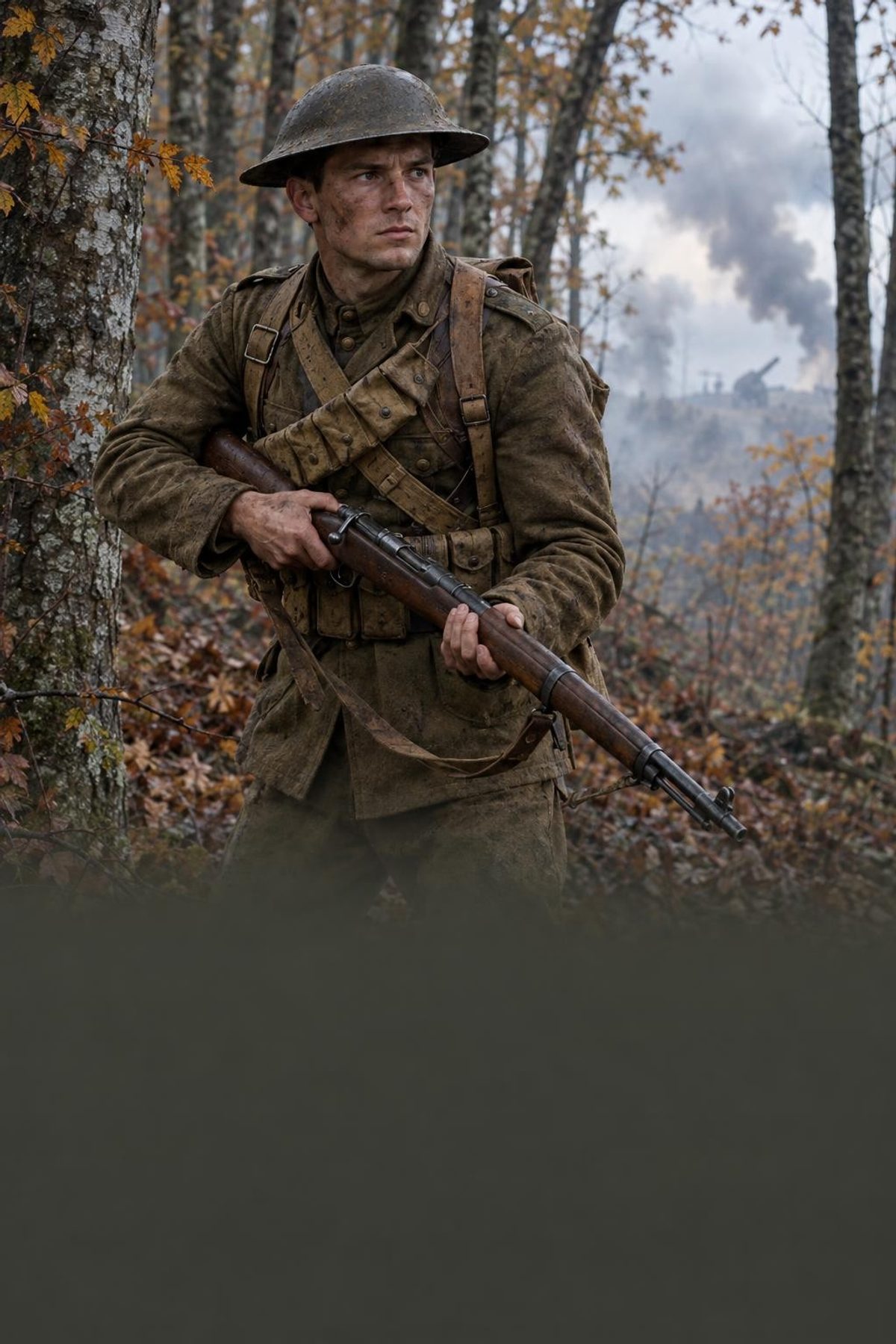
The dirt was still fresh under Alvin York's fingernails as he lay prone, the ground trembling under relentless machine-gun fire. The air was thick with smoke, punctuated by the sharp crack of gunfire and the desperate cries of the wounded.
Here, in the dense maze of the Argonne Forest on October 8, 1918, surrounded by an overwhelming chorus of German rifles, York found himself at the crossroads of destiny—a humble farmer's son thrust into a situation that would test the very limits of his conviction and courage.
The Reluctant Warrior
In the quiet, rolling hills of Pall Mall, Tennessee, Alvin Cullum York was born on December 13, 1887. To those who knew him, York was a product of his environment—rugged, unpretentious, a man of the earth. Raised among eleven siblings, York's early life was one of simplicity and struggle.
His father worked as a blacksmith, a trade York would later follow, balancing the responsibilities of work and family on his broad shoulders. Despite these challenges, or perhaps because of them, York was known for his rowdy disposition in his youth, a penchant for fistfights fueled by alcohol after his father's untimely death left a void in his family.
Read next: Wesley Autrey Jumped Onto Subway Tracks to Shield a Stranger
Yet, in 1914, York experienced what many would later describe as a profound transformation. After a religious conversion, he turned away from violence, embracing the pacifist teachings of the Church of Christ in Christian Union.
This newfound faith became a cornerstone of York's life, a belief he clung to when drafted into the army during World War I. He initially filed for conscientious objector status, citing his religious belief against killing, marking on his draft card poignantly, "Don't want to fight." However, the U.S. Army overruled his objection, enlisting him in the ranks of the 82nd Division as the world spiraled deeper into conflict.
Under the unforgiving sun of a French battlefield, York wrestled with his conscience, struggling to reconcile his pacifist convictions with the duties of a soldier in the Great War. Through counsel and reflection, he came to believe that service was not only compatible with his faith but a necessary stance against tyranny. It was with this resolve that York stepped into the muddy trenches of France, a reluctant warrior seeking peace through victory.
A Moment of Extraordinary Valor
The Meuse-Argonne Offensive was one of the bloodiest encounters of World War I, a grueling campaign against entrenched German defenses. York's battalion faced a daunting task: breach the formidable Hindenburg Line and force the enemy to surrender. On that fateful October day, York, then a Private First Class, found himself with a detail of 17 men charged with eliminating a nest of German machine guns crippling the American advance.
The mission rapidly turned into a desperate fight for survival. Ambushed by German forces, six Americans fell, and three more lay wounded. Lifelong instincts honed by hunting in the forests of Tennessee kicked in as York opened fire, his expert marksmanship guiding bullets with deadly precision. Crawling through mud and death, he silenced one machine gun after another, all the while deftly dodging enemy fire, as if guided by an unseen hand.
The crux of York's valor came when a German officer, firing at him point-blank with a Luger pistol, inexplicably missed every shot. As the officer's last bullet echoed in the clearing before fading into silence, he offered his surrender to York. Seizing the initiative, York directed his surviving companions to guard the captured soldiers as they marched toward the American lines, an implausible procession of prisoners, all subdued by the steely resolve and singular courage of one man.
The Quiet Hero
The aftermath of York's actions was a national sensation. Recognized with the Medal of Honor, his story spread rapidly, capturing the imagination of a war-weary public. York was no stranger to commendation, receiving decorations from France, Italy, and Montenegro for his astonishing feat. He epitomized an era's ideals of heroism, not as a battle-hardened veteran but as an everyman called to act in extraordinary circumstances.
Read next: Jose Abad Santos Refused to Collaborate and Faced the Firing Squad
Yet, despite his newfound fame, York sought to return to a life of quiet humility. After Armistice Day, Tennessee businessmen purchased a farm for York and his new wife, Gracie Williams, hoping to ensure their future beyond the war's shadow.
York turned to better the lives of others, founding a charitable organization with the mission of improving education in rural Tennessee. In the 1930s and 1940s, he continued his service in a different capacity, overseeing projects with the Civilian Conservation Corps, leaving a tangible legacy through infrastructure at Cumberland Mountain State Park.
York's story resonated beyond the fabric of history, immortalized in the 1941 film *Sergeant York*. With Gary Cooper's portrayal earning an Academy Award, the film boosted American morale as the nation prepared to enter another global conflict. York, bedridden with health issues in later years, remained a symbol of quiet dignity until his passing in 1964, resting at Wolf River Cemetery, honored yet humble to the end.
So what makes Alvin York's story matter? It is a portrait of an average person thrust into a maelstrom, struggling with the moral complexities of warfare and emerging as a beacon of courage and integrity.
His narrative reminds us that heroism often lies in reluctant hands, and greatness can be born from an unwavering conviction in the face of insurmountable odds. In York’s story, we find the enduring humanity of a man driven not by fame, but by the duty to protect and uplift—a legacy that echoes far beyond the Argonne's fallen leaves.