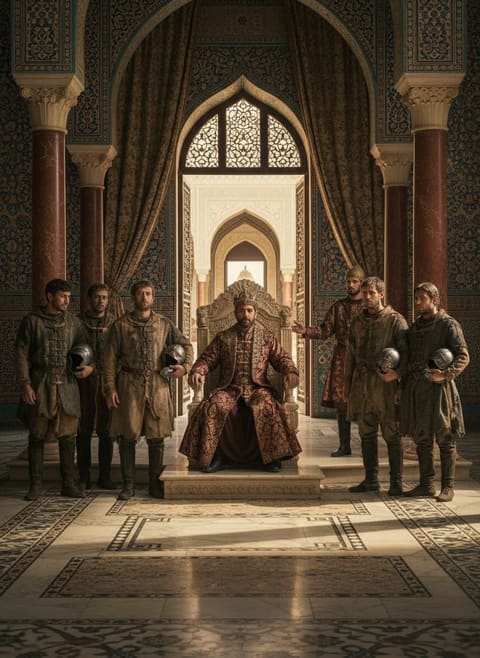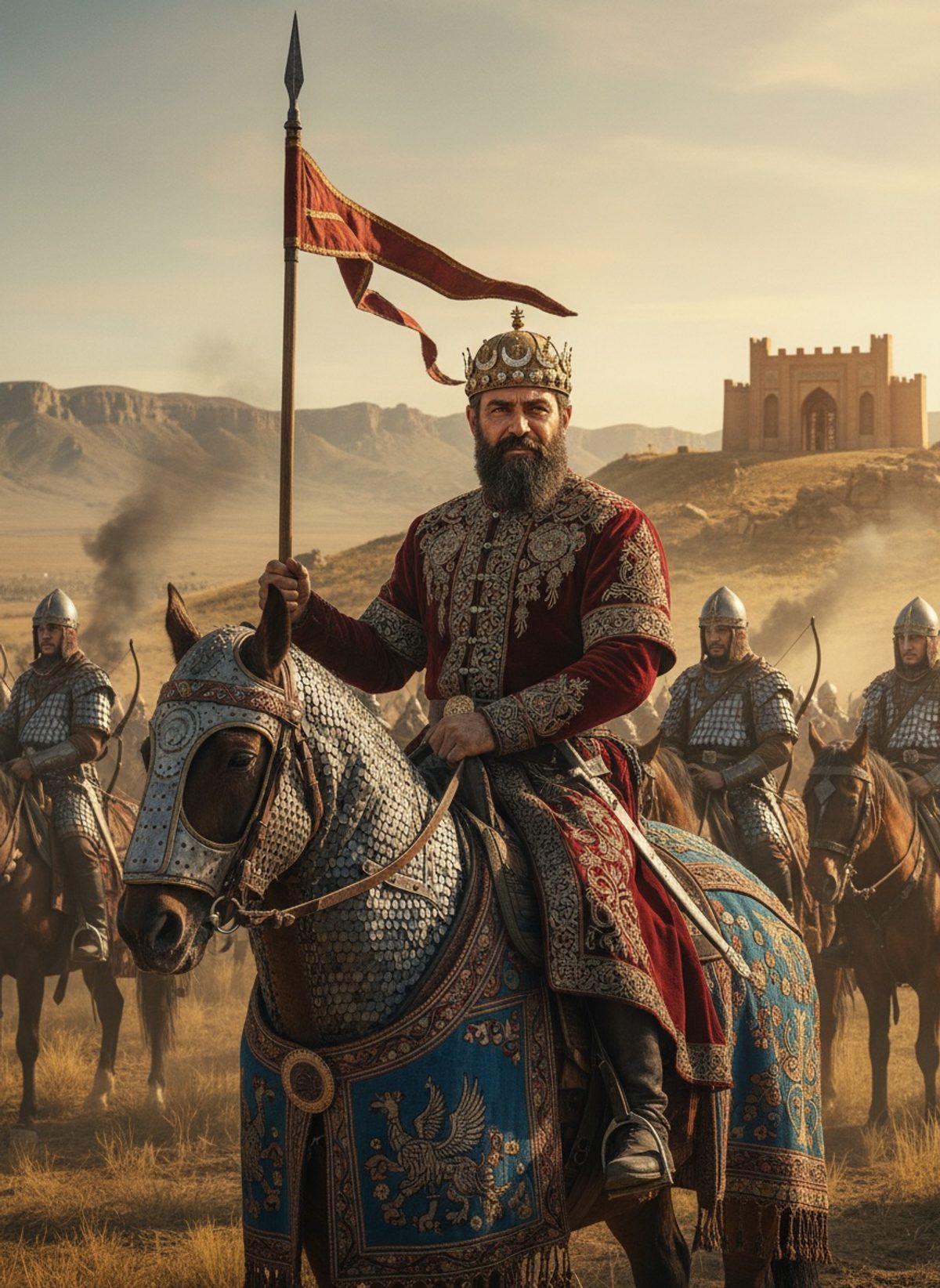
The Hormozdgan plain stretched pale and dusty beneath the relentless sun, a vast arena of grit and determination where destiny was set to unravel. Flanked by the bare hills of Persian land, the air thickened with anticipation.
Here, the roots of a waning Parthian Empire clung to power, but beneath the troops gathered on this battlefield swelled an undercurrent of change. It was April 28, 224 AD, and the horizon trembled with the thunder of hooves and the clamor of arms as one man emerged as the harbinger of a new era.
The Rise of Ardashir I
Born within the rugged landscapes of Istakhr, in the province of Persis, Ardashir I began life steeped in the complexities of ambition and lineage. According to historical accounts, such as al-Tabari’s “History of the Prophets and Kings,” Ardashir was related through his father, the ambitious Papak, and possibly through maternal connections to ancient Persian nobility.
His upbringing was marked by power struggles and the seismic shifts of fragile allegiances. Endowed with a vision for reclaiming Persian greatness, Ardashir set his sights beyond the confines of local governance.
Read next: Kartir Carved His Name in Stone. The King Obeyed.
Ardashir’s ascent to power began with family upheavals. Papak, a key player in local politics, had ousted the Persian ruler Gochihr, installing Shapur, his favored son. However, fate twisted: both Papak and Shapur died unexpectedly, and Ardashir seized the reins of power, determined to forge his path. With the pounding of his heart echoing through the valleys of his homeland, Ardashir’s ambitions swelled beyond Pars, threatening to sweep away the decaying edifice of Parthian rule.
As he consolidated power, Ardashir’s audacity crystallized into a formidable challenge to Parthian dominance. The aging Parthian Empire, weary after four centuries of rule, found itself vulnerable to the emergence of this determined adversary.
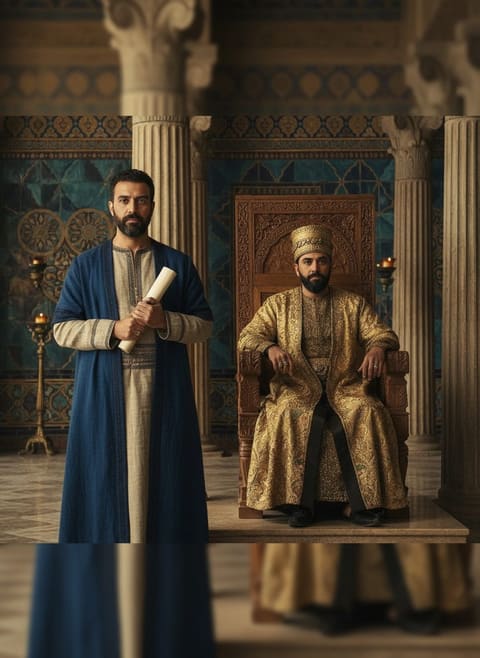
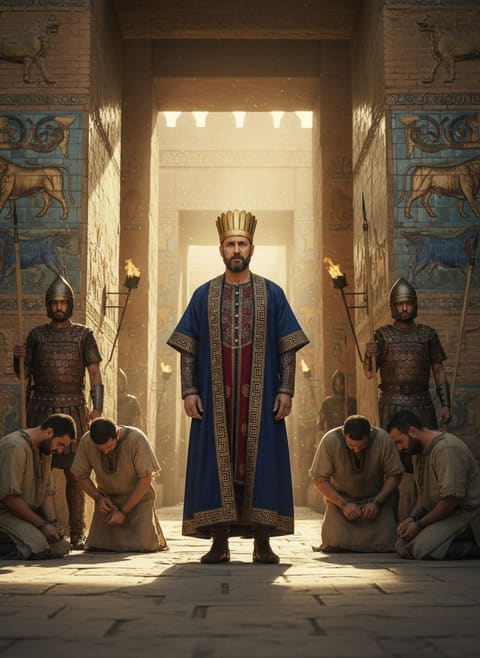
Invoking the divine right to rule, Ardashir proclaimed himself a descendant of the ancient Achaemenid rulers, enshrouding his quest in the sacred aura of legitimacy. His title "King of Kings" was not merely a declaration of supremacy but an invocation of Persia’s imperial past, a call to restore its former glory.
In 224 AD, the armies of Ardashir and Artabanus IV, the last Parthian King, converged on the Hormozdgan plain. Ardashir’s forces, inspired by their leader’s sweeping vision, fought fiercely. The outcome was unequivocal. Artabanus fell in the throes of battle, his defeat marking the end of an era and the birth of another. Ardashir I, through blood and battle, lit the torch of the Sassanid Empire, a beacon set to guide Persia for four centuries.
Forging the Neo-Persian Empire
With the Parthian yoke cast aside, Ardashir I pivoted towards laying the foundations of an enduring legacy. Whereas the scepter of the Parthians had faltered, Ardashir’s strategic acumen saw him weave together an intricate tapestry of governance, language, and culture that defined the Sassanid era. He was not merely content with ruling — he envisioned an empire unified in purpose, a realm he referred to as Ērānšahr, "the realm of the Iranians."
As a canny leader, Ardashir recognized the power of religion in cementing his rule. He revived Zoroastrianism, aligning statecraft with spiritual doctrine to provide his empire with a unifying ideology that transcended tribal loyalties. This revitalization not only reinforced his legitimacy but also facilitated administrative cohesion across diverse provinces. Temples sprang up across the empire, each a testament to the syncretic prowess of Zoroastrian ritual and Sassanid statehood.
The Sassanid monarch’s reach extended beyond administration and spirituality into artistry. Ardashir adorned his realm with physical imprints that would endure through the ages. He carved his triumphs into stone, immortalizing his victories in petroglyphs at Firuzabad, Naqsh-e Rajab, and the illustrious Naqsh-e Rustam. Each artifact served not only as a memorial to his conquests but as a guidepost in the constellation of his authority, celebrated and recorded for posterity.
Read next: Shapur I Captured a Roman Emperor. Then Showed Mercy.
Ardashir’s rise from a local ruler to a sovereign of empires was not merely a political revolution but an existential reimagining of what Persian greatness could achieve. He single-handedly bridged the gap between myth and reality, casting himself as not just a ruler but a successor to ancient grandeur. His dogged determination resurrected the spirit of a nation and laid the groundwork for what scholars frequently term the "Second Persian Empire".
The Enduring Legacy of Ardashir I
The echoes of Ardashir's deeds reverberated well beyond the plain of Hormozdgan, resounding through the annals of history as inspirations and warnings alike. He had not only defeated a dynasty but awakened the dormant force of a civilization ready to reconcile with its storied past while looking boldly towards the future.
As centuries unfolded, the Sassanian Empire crystallized into a dominant global power, navigating the complex currents of trade, culture, and conflict that characterized the ancient world. This empire emerged as a paragon of Persian prowess, bridging East and West not only through militaristic might but through a flourishing of artistry, architecture, and intellectual exchange which left an indelible mark on history.
The fall of the Parthians and the subsequent establishment of the Sassanid Empire under Ardashir I were not mere events etched into the corridors of time. They were dynamic catalysts that compelled a world to reckon with the durability of human ambition—an ambition rooted in the soil of Persia, pushing continually towards the light of cultural luminosity.
In a singular life spun of legendary lineage and unyielding determination, Ardashir I sculpted a new chapter in the vast chronicle of ancient Persia, one that continues to resonate with the perseverance and ingenuity intrinsic to human history itself.