Nehemiah was trusted not for his battle prowess, but for his steadfast faith. The man who would oversee the rebuilding of Jerusalem's walls was a cupbearer, not a warrior.
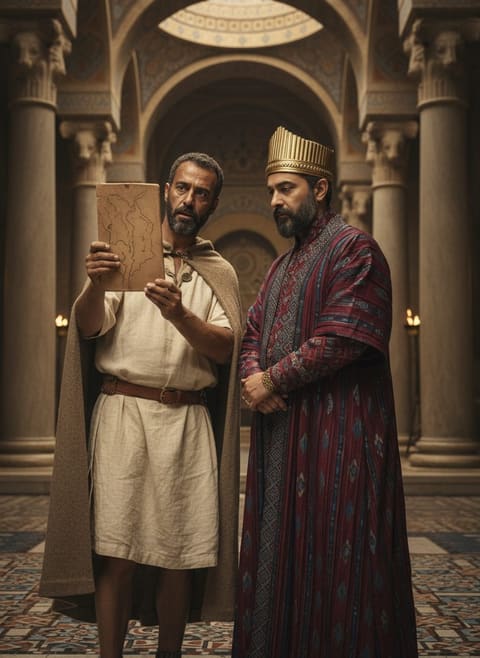
It's a late year in the rule of Artaxerxes I, 445 BC to be precise. Within the magnificent courts of the Achaemenid Empire, Nehemiah held a position of great trust as cupbearer to the king, a role that demanded proximity to the sovereign and offered substantial influence. Shrouded in the opulence of the Persian court, amidst opulent draperies and luxurious banquets, Nehemiah's concerns lay far from his immediate duties. His heart ached for a city hundreds of miles away, where generations of his ancestors had once thrived. Word reached Susa, the center of Achaemenid power, of the crumbling walls of Jerusalem, the spiritual nexus of his people. This trusted servant, eyes cast downwards, shed tears over this news. But unlike many whose despair leads to inaction, Nehemiah's sadness transformed into resolve.
Nehemiah approached Artaxerxes with a boldness that belied his status. Pleading not for riches or status, he sought only permission to journey back to Judea, to aid in the reconstruction efforts. His request was both simple and profound: a letter granting safe passage and resources to rebuild the city. Nehemiah's plea was not for himself but for his beleaguered brethren. To the surprise of all, Artaxerxes did more than assent to Nehemiah's modest request. He not only granted the official documents needed for safe passage through regions hostile or otherwise, but he also provided timber from the king's forests and an armed escort, to ensure Nehemiah’s mission reached its completion.
It is instructive to consider the layers within which Nehemiah operated. As the drinks-bearer, he was bound by confidentiality and trust, yet his heart lay tethered to a land not his own by birth but by spiritual inheritance. His dual loyalties, both to the Persian king and to the Jewish people, make his actions all the more remarkable. Setting forth into the vast landscapes that formed the Persian Empire, Nehemiah embodied the intersection of two worlds, one modern and cosmopolitan, the other ancient and divinely promised.
Read next: He Ordered the Prisoners Fed. Then He Set Them Free.
The journey itself was a scene of contrast. The parade of soldiers, varying in tongue and dress, moved in disciplined unison flanked by sun-seared sands. It was a crossing of legendary proportions—vast and arid deserts where the sun reigned without mercy. Nehemiah, determined, clutched not only the imperial edicts but, metaphorically, the collective hope of his nation. His mission was one of unity, a physical return entwined with a symbolic reunion of his people with their identity.
Upon his arrival at Jerusalem, Nehemiah confronted the stark realities described in distant whispers. The city lay exposed, a skeletal shadow of its former glory. But this desolation was, paradoxically, fertile ground for new beginnings. Using the letters of endorsement from Artaxerxes, Nehemiah took command, rallying the inhabitants of Jerusalem not only with material support but with fiery resolve. Within weeks, the work commenced despite opposition from all sides; Samaritans, Ammonites, and Arabs each maneuvered against the reconstruction efforts, yet Nehemiah remained undeterred.
The task was Herculean. The meticulous rebuilding took merely 52 days to complete, a truly astounding pace for ancient engineering. Each stone, hoisted and placed with purpose, marked not only architectural reconstruction but communal resurrection. From the Sheep Gate to the East Gate, the walls of Jerusalem rose defiantly, a testament to collective will. At every turn, adversaries plotted, hurling threats and subterfuge, attempting to stall progress through fear or violence. But Nehemiah's mettle proved resilient.
Even as Nehemiah faced subterfuge from his adversary Shemaiah, who sought to lure him into breaching temple protocol—a scheme allegedly designed to tarnish his reputation and divine favor—his integrity held firm. This attempt to sabotage the standing of a potential eunuch, a designation debated among scholars, did not distract Nehemiah from his god-given purpose. Whether eunuch or not, his virtue lay in his unyielding fidelity to Yahweh's call, a call that transcended personal ambition or fear of man.
Read next: Darius Was Dying. She Walked In and Changed the Law.
To consolidate the new beginnings, Nehemiah introduced reforms that rippled through the very fabric of Judean society. He addressed economic disparities by cancelling debts and advocating for justice among the populace. By reinstating Mosaic laws, with the help of Ezra, and urging separations from non-Jewish spouses, Nehemiah sought a purified, united people grounded in shared faith and tradition.
His tenure as governor witnessed the fruition of dreams long deferred—a rebuilt Jerusalem governed by laws of justice and humility. His return to Susa after twelve years of dutiful service saw a period of absence wherein old vices crept back among his people. Yet, upon his final return, Nehemiah's anger flared, leading to reforms that echoes of which reinforced his initial vision. Purifying the temple and halting Sabbath commercialism, his legacy became a blueprint for revival.
This journey of an ordinary cupbearer demonstrates the enduring narrative of steadfast faith challenging the status quo, leaving an indelible mark across time. Nehemiah's resolve serves as a poignant reminder that even amidst empires, it is not might, but faith that propels transformative change. Through perseverance and unwavering belief, stones left in ruin found new life, bound together not only by mortar but by a renewed spirit.