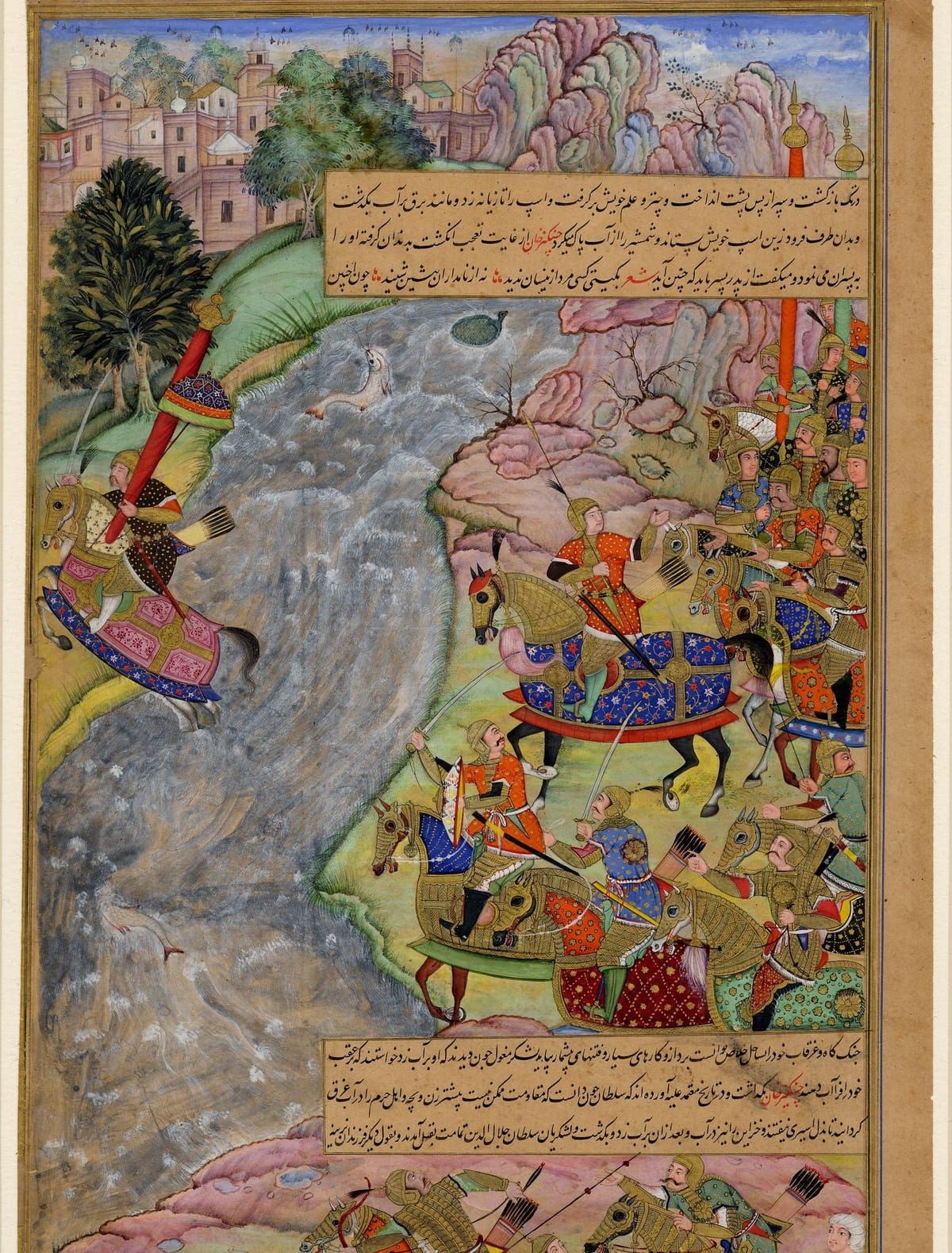
The last shah of the Khwarazmian Empire was losing a battle on the bank of the Indus, with Genghis Khan himself in the field against him. His men were being killed around him. Behind him lay a cliff and a fast river. Jalal al-Din chose the river.
The shah with no empire
Jalal al-Din was the son of Muhammad II, the Khwarazmshah, who had died on an island in the Caspian Sea. The son took the title and rode east. Encyclopaedia Iranica says he slipped past Mongol watchmen, defeated a force of Mongol cavalry, and gathered a large army at Ghazna.
At Parwan he defeated the Mongol commander Shigi Qutuqu. The victory was an upset, and it brought Genghis Khan himself. Wikipedia says the Khan gathered a force of at least 50,000. Jalal al-Din meanwhile lost a large part of his own army in a quarrel over plunder.
Battle at the river
The Mongols caught up with the Khwarazmians on the morning they were due to cross the Indus. The shah's army took a strong position on the bank. It held well in the early fighting and drove the Mongols back, despite being outnumbered.
Read next: Adrian Marks Landed a Seaplane on Open Ocean to Pull 56 Men From the Water
Then Genghis sent a general named Bela Noyan with an elite detachment up a ridge. It climbed it and attacked the shah's flank and rear. Jalal al-Din led a charge at the Mongol centre. His own biographer al-Nasawi has him reaching Genghis Khan himself, though the Mongols stopped the advance.
The leap
The battle was lost, but Jalal al-Din kept fighting until noon. His maternal cousin Akhash Malik begged him to flee. He charged the ridge, which the Mongols now held, and broke through the line.
He reached the edge of a cliff about 30 feet above the river. Then he rode his horse over it.
Genghis Khan watched from the bank. He is said to have called his sons to look, and ordered his archers not to shoot. Wikipedia gives his words as: "Fortunate should be the father of such a son."
What it cost
The mercy was for the horseman alone. Jalal al-Din's men had followed his example into the river, and many were shot in the water. Wikipedia says the shah's camp, harem and treasure were captured, and that all the male members of his family, including a seven-year-old son and an infant, were killed.
Encyclopaedia Iranica says Jalal al-Din managed to get some 4,000 of his troops safely across the Indus.
Read next: Wesley Autrey Jumped Onto Subway Tracks to Shield a Stranger
A date in doubt
Wikipedia dates the battle to 24 November 1221. Encyclopaedia Iranica is less certain. It says Jalal al-Din escaped the Mongols by riding his horse across the river either in August or September 1221, or two months later.
The wanderer
Jalal al-Din survived. He spent the next three years in India, then made his way to western Persia. Wikipedia says he built short-lived states in the Punjab, then in north-west Iran and Georgia, and that he lacked the political skill to match his gifts as a soldier.
In the end he fled westwards from the Mongols and could not raise an army to face them. Encyclopaedia Iranica says he was mysteriously killed in a Kurdish village in August 1231, perhaps for gain or for revenge. His kingdom collapsed soon after.
The man who outlived his empire is remembered above all for a moment at the edge of a cliff, when the most feared conqueror in the world let him go.