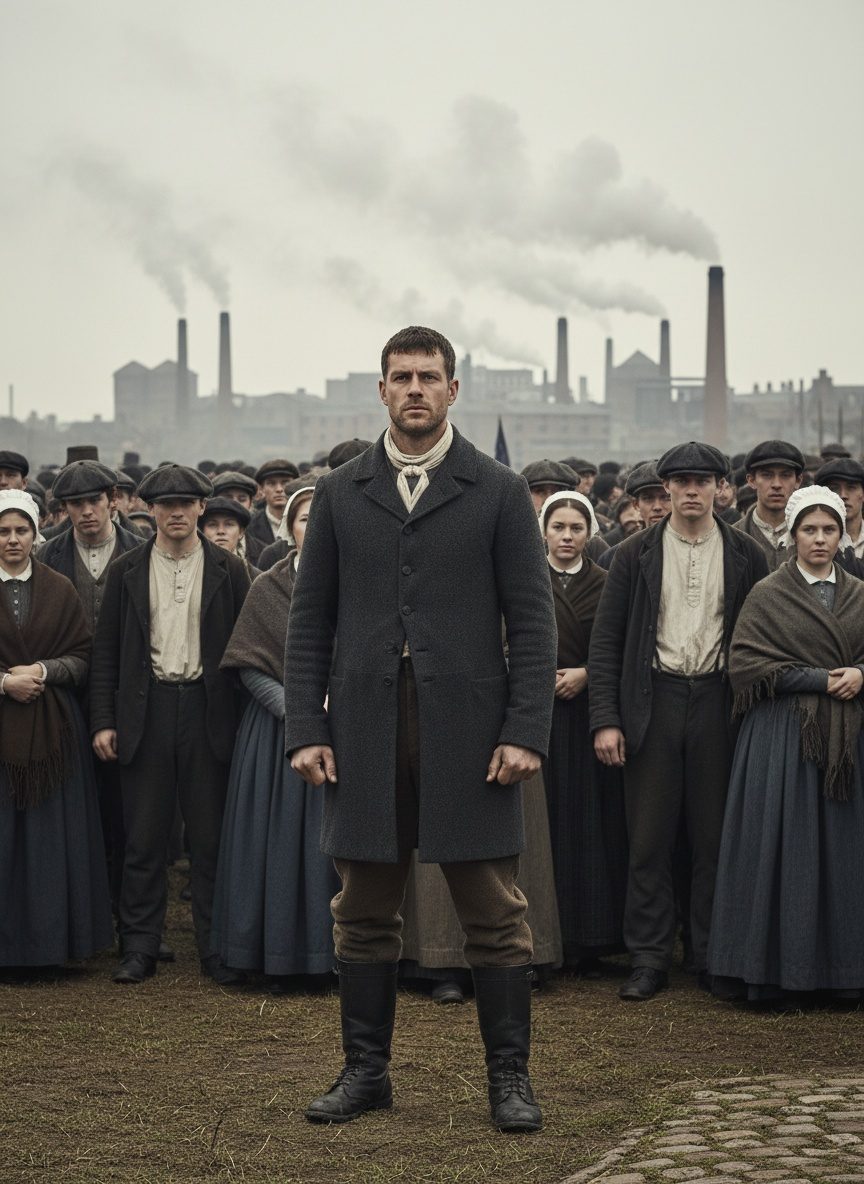
The sky over Manchester on that fateful August day in 1819 was a sullen grey, the kind of heavy cloud cover that seems to whisper secrets from the heavens. A faint drizzle clung to the city, masking the tension that simmered within the heart of St Peter's Field. Here, the architecture of the city seemed to close in, its narrow streets funneling over sixty thousand souls who were drawn to this open space, like rivers converging to form a torrent. The air was thick with anticipation and the muffled hum of hopeful voices. They were not merely here to idle; these people had come to pen the latest chapter in their struggle for representation and reform, a struggle that had long been brewing beneath the heavy yoke of the Industrial Revolution.
At the heart of this assembly was Samuel Bamford, a man whose very presence resonated with defiance and eloquence. The son of a blind weaver from Middleton, Bamford had clawed his way to literacy by the light of a meager fire, a testament to both his resourcefulness and the changing tides of the era that demanded new voices be heard. As he walked to the field that day, Bamford was enveloped in a cloak of determination. He became a symbol—a single man in a crowd seeking to ensure the cries for justice would reach beyond the veiled apathy of those in power.
To those who knew him, Bamford was more than just the son of a weaver. His presence was an embodiment of the striving working class, whose lives were being reshaped, for better or worse, by the relentless march of the machines. The Industrial Revolution had swept across Britain like a force of nature, reinventing towns and lives in its path with both promise and peril. While textile mills and steel foundries echoed with the hum of progress, they also bore the weight of severe poverty and inhumane labor conditions. The people who gathered at St Peter's Field were not just gathering for themselves; they gathered for every soul whose labor, sweat, and sacrifices fueled these engines of change they could barely comprehend.
The peaceful assembly had drawn in families, friends, and neighbors—all hemmed in by the fields and clasping banners inscribed with words of change and unity. It was a tapestry of humanity, woven with hope, promise, and the silent vow for a better tomorrow. But beneath this surface of unity lay a keen edge of anxiety. The government viewed such gatherings with intense skepticism, a potential seedbed for revolution that needed to be quashed before it could germinate.
Read next: The Day a Mill Owner Walked Into Parliament for His Children
As the day unfolded, the reverence of the assembly was shattered by the sudden thunder of hooves. Enter the cavalry—charged with a stark mandate to disperse the crowd. In moments, the tranquil assembly exploded into chaos. The drumming of hooves melded with screams, as horsemen bearing sabres scattered through the crowd, turning what was a peaceful protest into the infamous Peterloo Massacre. It was the sound of repression, impossible to mute, indelible in its impact, etching fear and outrage onto the canvas of British history.
Amidst the dust and despair, Bamford was arrested. The government could have silenced him there, deep within the bleak confines of a prison cell. But some fires cannot be so easily extinguished. From within the gaol's grey walls, Bamford penned his thoughts with the eloquence and defiance of a man unwilling to recant. His eyewitness account of the massacre became a powerful clarion call. It was as though his words channeled the collective voice of the oppressed, a voice that had resonated with righteous fury through the cavernous halls of their tormentors.
When Bamford walked out of gaol, he did not walk alone. He carried with him the memories and scars of those who had clamored for justice alongside him on that field, and his writings captured the essence and spirit of that day with unparalleled clarity. His account tore through the fabric of silence that had enveloped the working class, lending them a permanent voice that no authority could deny. The manuscript was shared far and wide, inciting indignation, debate, and a fervor that rippled through the nation and beyond.
This unyielding spirit for reform seeded the landscape for future change, slowly but inescapably bending the trajectory of British policy toward greater inclusivity and representation. The repercussions of Peterloo entered the annals of history, not only as a grimly remembered atrocity, but as a cog in the grand machinery of progress. Through Bamford’s pen, every man and woman on that field was accorded their rightful acknowledgement in the ongoing human epic.
Today, the tale of Samuel Bamford stands etched in the collective memory of a nation still wrestling with the complexities and contradictions of progress. His account remains a testament to the power of words and witness—to every worker’s voice rising above the din of industry. These echoes remind us that, although the machines may change the world, it is the people who can ultimately rewrite its story. As we continue to weather our own revolutions, we would do well to heed those whispers from St Peter's Field echoing down the ages, urging us to listen, to remember, and to weave new futures from the threads of empathy and justice. In that enduring narrative, Bamford and his compatriots compel us to consider what 'progress' might truly mean—and who it must serve. Only then, perhaps, will history sigh with the satisfaction of fulfillment, rather than the rustle of unrest.