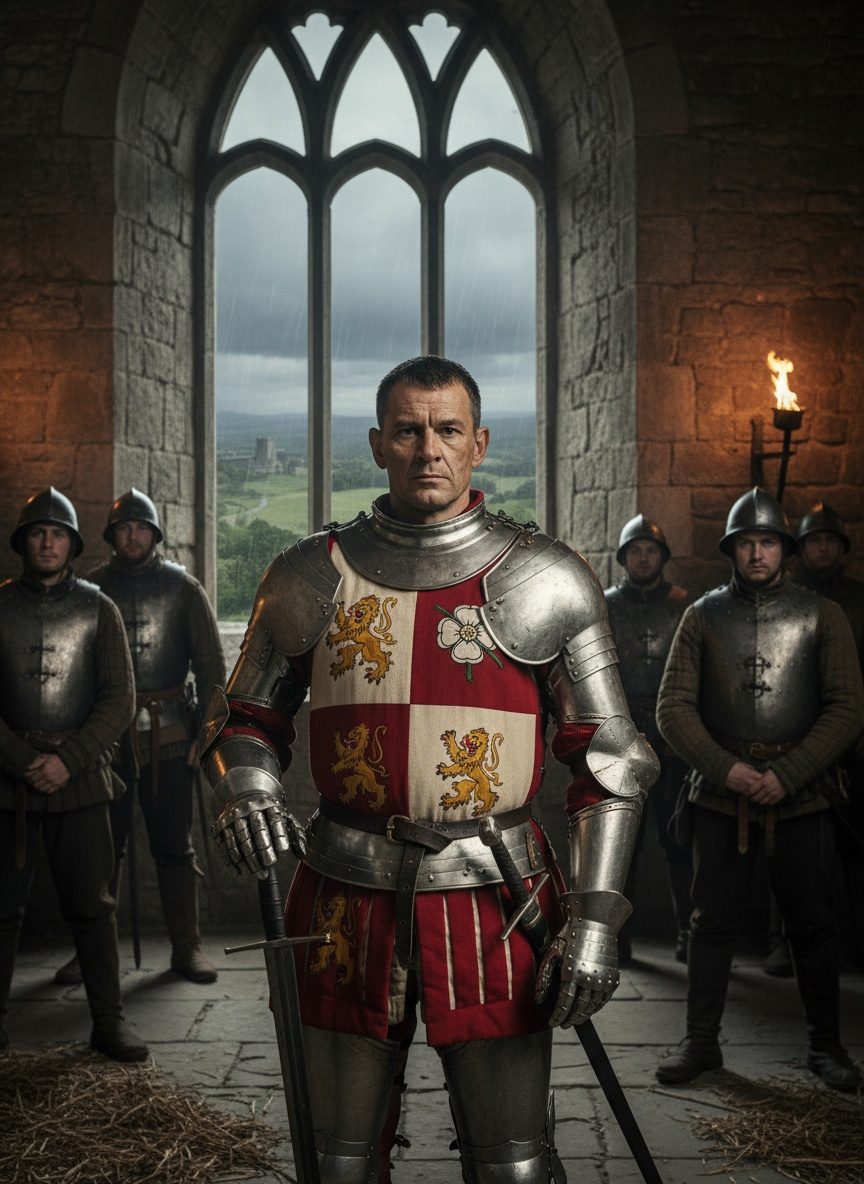
Most people believe Edward IV was a resolute king who reclaimed his throne through sheer force of will. Few recognize that he would have been a king without a country if not for the unwavering loyalty of William Hastings.
The Collapse of a Kingdom
In the tumultuous autumn winds of 1470, the reign of Edward IV crumbled like a castle built on sand. Cast out and defeated, Edward found himself adrift in a turbulent sea of power struggles that defined the Wars of the Roses. The Lancastrian resurgence, championed by the formidable Earl of Warwick, saw Edward’s crown lost to Henry VI, leaving the House of York’s future alarmingly uncertain.
Amid this chaotic backdrop, Edward became a fugitive in his own land. From the shadows, he watched as allies once loyal now knelt to the newly reinstalled Henry VI. Yet, unknown to him, far from the capital’s warren of intrigue, a steadfast ally refused to yield – a man whose dedication could shift not just allegiances, but the trajectory of a royal fate.
The Unyielding Loyalty of William Hastings
While most of Edward’s followers abandoned their Yorkist oaths, William Hastings remained defiantly loyal. He was neither swayed by fear nor tempted by gain as others were. His roots in the Midlands gave him both influence and resources, a power he would wield not for personal gain but for the restoration of his sovereign.
Read next: The Day a Welsh Girl Barred the Door on a King's Army
In an era where power was often measured in familial alliances and military might, Hastings was an outlier. His loyalty did not stem from kinship with Edward but rather an unyielding belief in the Yorkist cause and in Edward himself. By raising the Midlands anew, Hastings not only preserved a loyal base for Edward but also nurtured a vital spark of rebellion against a seemingly unassailable Lancastrian stronghold.
The Subtle Dance of Strategy
Edward’s return to England in the spring of 1471 was not the grand arrival of a triumphant king; it was the daring maneuver of a displaced monarch gambling everything on a slim chance for redemption. In Hastings’ capable hands were the hopes of a renewed Yorkist campaign and a scheme as delicate as a sword dancer's blade.
Communications were sent in cautious whispers across the English Channel. Hastings' endeavors to gather men and arms required deft diplomacy and secrecy, avoiding the prying eyes of Lancastrian loyalists while keeping the dwindling Yorkist network still aflame with hope. The strength Hastings amassed was not vast, but it was enough to provide Edward with a foothold, a chance to rally disaffected nobility and regain lost prestige.
As Edward landed at Ravenspurn in March 1471, his fortunes were critical, balanced on the knife-edge of both opportunity and disaster. Hastings' support transformed this precarious return – what could have been a forlorn bid for survival turned into a potent call to arms that reverberated across Yorkist lands.
Read next: The Day a Medieval Mayor Knelt and Saved Six Condemned Men
The Tidal Shift of Loyalties
Once dismissed as an exiled king with no future, Edward’s resurgence under Hastings' quiet but resolute support uncorked an astonishing revival. The weeks that followed were a whirlwind of reclaimed loyalties — nobility again flocked to the banner of York, swayed not just by old allegiances but by news of confidence from ‘rebel’ strongholds in the Midlands.
The sudden and revitalized Yorkist challenge spurred a reversal of momentum. Key battles at Barnet and Tewkesbury would soon reforge Edward’s place not just in crown, but in chronicle. However, it was Hastings who had first raised the clarion call, turning what seemed an insurmountable exile into a prelude to victory.
History often highlights Edward IV's daring and strategic acumen as the driving force of this turnaround. Yet, the quiet orchestrator of this grand restoration rarely survives into popular legend. The imagined quiescence of a loyal earl, even on his deathbed, is eclipsed by the storied clash of kings and parliaments.
This oft-overlooked chapter reminds us: the undercurrents of history are shaped not just by rulers but by the steadfast resolve of their followers. William Hastings, the quiet earl who knelt to Edward, endures as an unheralded architect of monarchy’s survival in a time when England teetered on the brink.