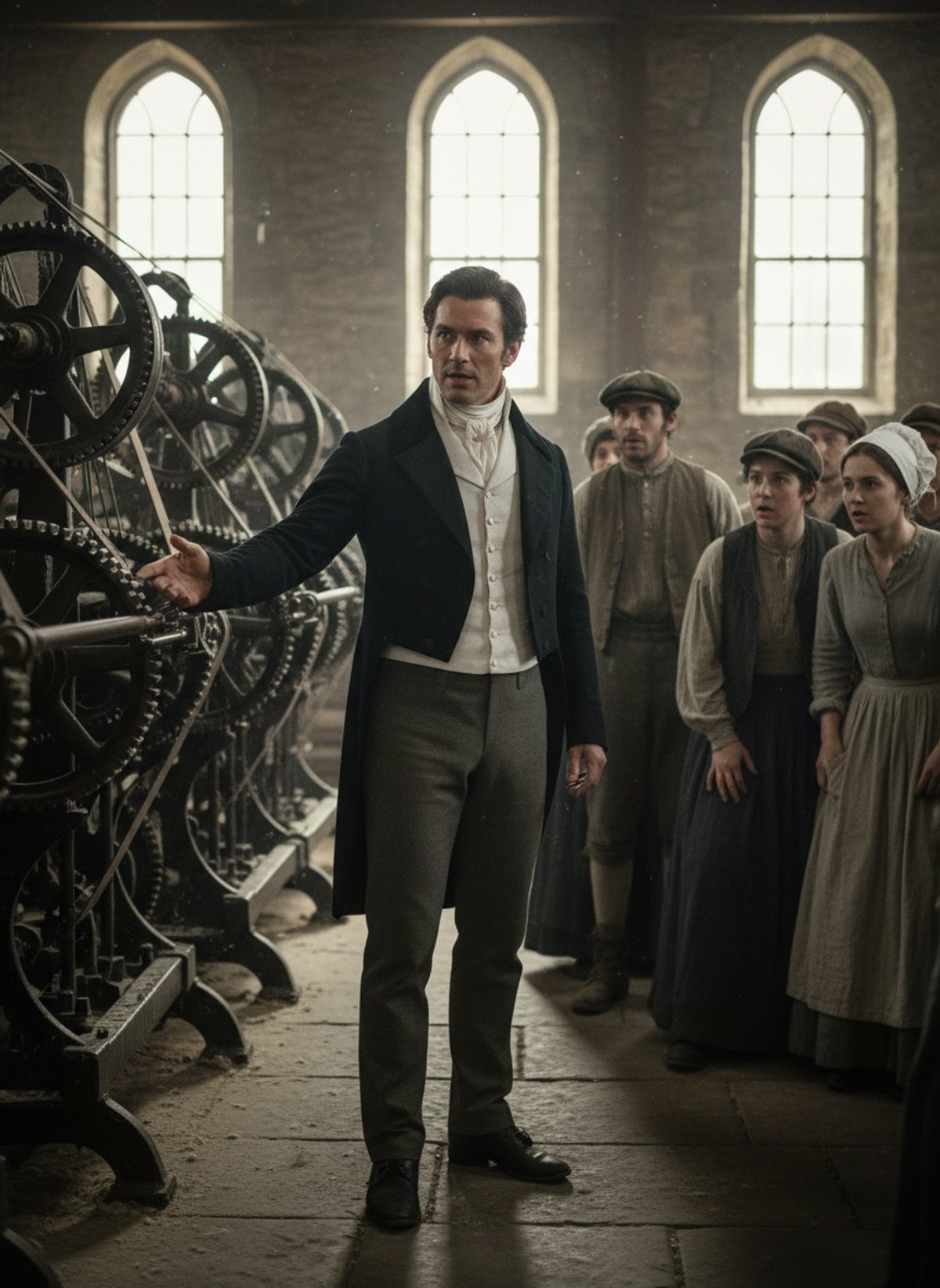
The clack of the weaving machines dulled to a low rumble as Robert Owen strode through the mill, his mind already set on the decision he'd been mulling over for months. The air was thick with the mingled scent of raw cotton and sweat, punctuated by the incessant whirr of looms. Owen's eyes scanned the rows of hunched shoulders and strained faces. Fourteen hours a day at the loom had etched lines of exhaustion and resignation into the features of his workers. Yet today, that drudgery was about to change.
Robert Owen, a man born into modest means, had climbed the mercantile ladder to become one of Britain's most esteemed mill owners. The New Lanark mills in Lancashire were the jewel of his empire; a place where fortunes were spun from cotton fibers. In 1815, the Industrial Revolution was in full swing, with humanity's mechanical ingenuity proceeding at a fever pitch. As machines took over the incessant labor once borne by human hands, productivity soared, fossilizing in his mind the notion that people, too, should benefit from these advancements.
Owen paused beside a loom operated by a young boy whose hands moved mechanically, mirroring the relentless pace of the machinery around him. The sight struck Owen with the weight of an ethical quandary he could no longer ignore. Not only could he change the working conditions, Owen could challenge the very foundation of industrial Britain. He had often lectured investors and fellow industrialists on the virtues of humane employment practices, even as industry norms suggested otherwise. Now was the time to act on his convictions.
In an uncharacteristic move for the era’s business magnates, Owen called a halt to production. The clamor of the mill reduced to silence, leaving a palpable tension thrumming through the expectant crowd of workers. Owen addressed them, his voice steady though his heart beat like a piston being driven by newfound purpose. He announced a reduction in working hours from fourteen to ten. The incredulity on their faces told of disbelief, a skepticism worn by generations who knew all too well the brutalities of mill life. But Owen was far from done. In the same breath, he forbid child labor and committed to constructing a school. "Education," he asserted, "was the greatest instrument of change." His actions spoke louder than any clattering loom: he was here to dismantle an exploitative system from the inside out.
Read next: The Day a Factory Boy Walked Into Court and Spoke
The decision was a calculated gamble, pitting him against conventional wisdom that perceived workers as mere cogs in the vast machine of production. Owen was acutely aware that the prosperity of his own enterprises hinged on exploiting lower labor costs for greater profit margins. The ripple effect of his decision, not just humane business ethics but elevated wages as well, could have cast him out as a pariah among financiers. Yet, oaths given to workers turned into opportunities for transformation, both socially and economically.
The success of Owen's experiment in New Lanark did not remain obscured for long. It was astonishing to witness the mill continue to crank out profits, while its workforce – better-rested, better-educated, more enthusiastic – took to their newly found roles with unexpected vigor. It was a stark contrast to the Dickensian mills scattered throughout the country, where laborers remained shackled to the unyielding wheel of progress at a devastating human cost.
Interestingly, it wasn't just local villages that began to take notice. News of the improved conditions spread beyond Lancashire, landing on foreign shores, intriguing the European intellectual elite and reformists alike. Ecclesiastical figures, philosophers, and even representatives of the monarchy came to witness the phenomena—a living, breathing blueprint of a harmonious industrial society.
But it was not solely altruism that drove Owen. He also foresaw an era where the betterment of working conditions and environments would leverage human potential into greater societal dividends. Owen's pioneering at New Lanark transcended mere mill reforms and became a snowball effect triggering public debates and policies that paved the way for labor rights movements across the globe.
The chapel, converted into a school as promised, became a hub for learning and enlightenment. Here the clangor of industrial machinery was replaced by the quiet rustle of pages and soft murmur of budding intellects, creating a fertile ground for future generations to thrive beyond the confines of factory work. Owen's vision was vividly alive—souls were not to be crushed under the weight of gears and machines, but to spring freely towards an age of reason and enlightened lives.
The world watched, many in awe, some with a kernel of envy, as Owen’s ideologies pierced through the ironfogged fabric of early 19th century Britain. Mill owners from far and wide journeyed to New Lanark, inspecting the conduit through which industrial might could coexist with humanity. Even skeptics left, albeit grudgingly, with the realization that perhaps industry did not have to be an unrelenting juggernaught of human suffering.
Though many might argue Owen’s ideas were but a small stone thrown against a monolithic industrial tide, that diminutive stone created significant ripples. It pressed on the consciousness of a nation wrestling with the cost of human labor as machines roared on. Today, Robert Owen’s legacy invites us to ask questions about the world we inhabit. How do we measure progress, who benefits, and at what cost? In the tireless strides toward technological excellence, Owen reminds us to not lose track of the humanity working behind the machinery. The story of New Lanark is not just a tale of mill owners and machinery, but of compassion capable of challenging and transcending inscribed social dynamics. As Owen revealed, industry and humanity, once seen as incompatible, could indeed belong at the same table—turning the gears of progress together.