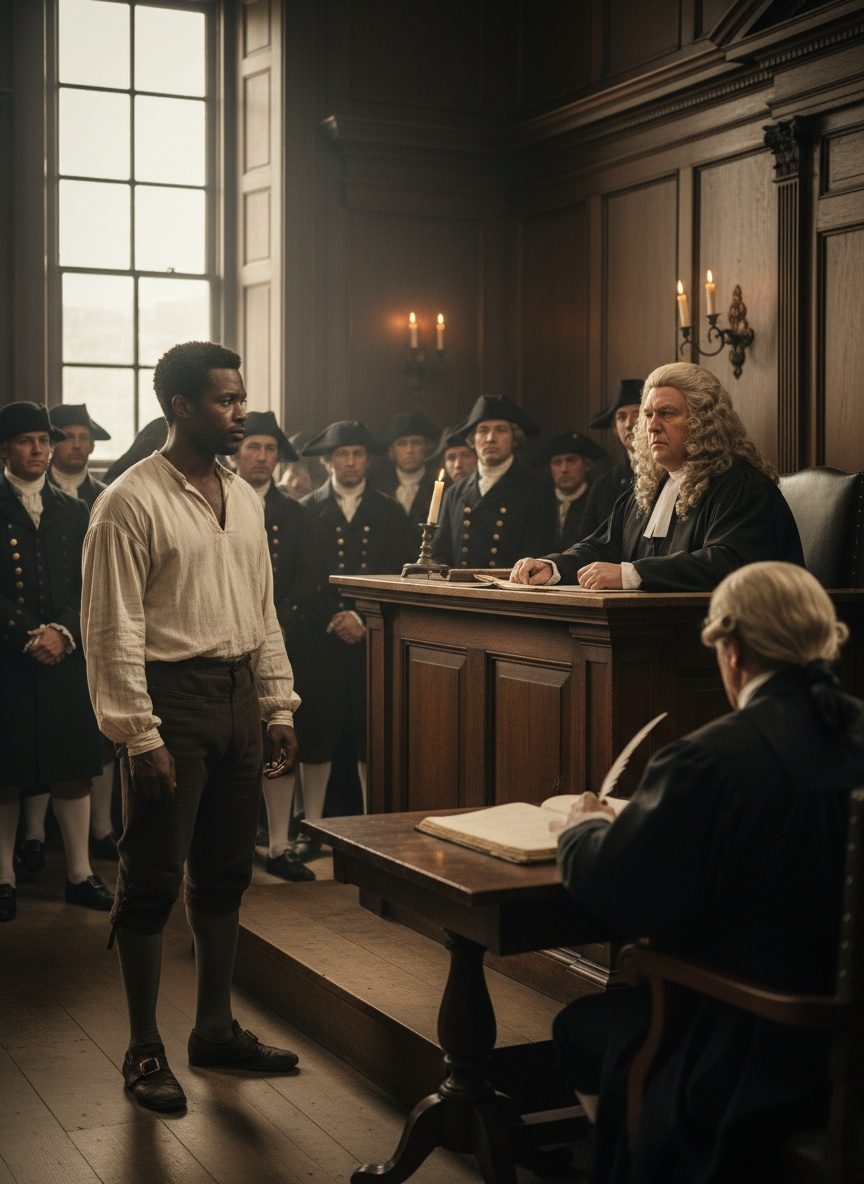
James Somerset was not born into the chains that fettered him. He crossed an ocean shackled and imprisoned by the whims of another man, but the quiet determination within him was never shackled. On a day that would reverberate through history, Somerset's voice, routinely suppressed and disregarded, found its power in a Georgian courtroom and turned the tide of an empire’s moral compass.
The Chains That Crossed the Ocean
In a world predicated on power and ownership, voyages across the Atlantic were often grim passages from freedom to enslavement. Somerset's journey to England had begun in the shadows of slavery—a reality that was devastatingly common in the eighteenth century. Enslaved by Charles Stewart, Somerset was removed from the overstretched sun of Virginia plantations to the bustling, rain-soaked streets of London. However, it was not the smoke-laden air or the cobblestones that would define his fate; rather, it was his determined modesty that ignited the spark of resistance. Somerset was forcefully taken from the streets of London with the intent to be shipped to Jamaica, set to revisit the cycle of enslavement. Yet, unbeknownst to his captors, this was a voyage that would ultimately never set sail.
The Unexpected Allies
As Somerset stood before Lord Mansfield’s courtroom, his chains were not the only heavy presence in the room—so too were the eyes and hopes of those who championed the cause of freedom. Advocates for abolition, many of whom had previously felt the might of chains themselves, rallied to Somerset's plight. Granville Sharp, a prominent abolitionist, threw the weight of his own struggle into the balance. The emergence of Somerset’s case was like a lighthouse piercing the fog of complacency—a vivid reminder of the disparity between human ideals and the darker undercurrents of colonial society. All the while, Londoners, previously indifferent or merely curious, were stirred by the realization that the entity of slavery was closer than their comfort had allowed them to believe.
The Hallowed Words of a Lord
Lord Mansfield, known for his judicious temperament and stern visage, faced a courtroom that held its breath in anticipation of his decree. Here was a man whose judgement could unravel the very tapestry of British colonial enterprise. As he deliberated, the echoes of every enslaved voice resounded in the silence of the court. The law was not just a mechanism of control; it was a canvas upon which the values of a society were painted. Despite pressure to uphold the status quo, Mansfield’s words broke the chains Somerset had worn not only physically but metaphorically as well. "No man could be enslaved on English soil." In those words, a statement carved from the very fabric of justice, Mansfield set a precedent that would resonate far beyond the oak-paneled courtroom.
A Victory Beyond the Verdict
James Somerset walked, not merely as a free man but as a symbol of possibility. The ruling was a catalyst, albeit slow-moving, for change—sending ripples outward to challenge the murky waters of complacency and economic convenience. Across the Atlantic, in the plantations where the air was thick with resignation, the news offered an intangible but essential hope. On English soil, questions echoed through taverns and salons. Could this verdict, hinged on a man who dared to resist his lot, mark the beginning of an unraveling? While not the complete dismantlement of slavery, it was a definitive blow to the institution that had been etched into the sinews of contemporary society.
The Unyielding Spirit of Redemption
Somerset's trial was not just the end of his personal ordeal; it heralded the trembling beginnings of a greater narrative—one where legal mechanisms began to align with moral imperatives. The day the slave’s voice silenced a courtroom was the day human dignity crept from the footnotes of history to find its place at the fore. Lord Mansfield’s ruling illuminated the inalienable truth that the soil beneath one’s feet could not hold them in chains. It was a bitter reckoning for a society that had too long ignored its reflection. This story endures as a reminder of resistance's power and the enduring march toward justice. It lingers in the whispers of the winds that sweep through Georgian facades, a testament to the enduring human spirit yearning for freedom.