No one expected a war to end on a heath. But on May 4, 1945, the carnage of World War II began its final gasp in just such a place.
Tables Turned on a Heath
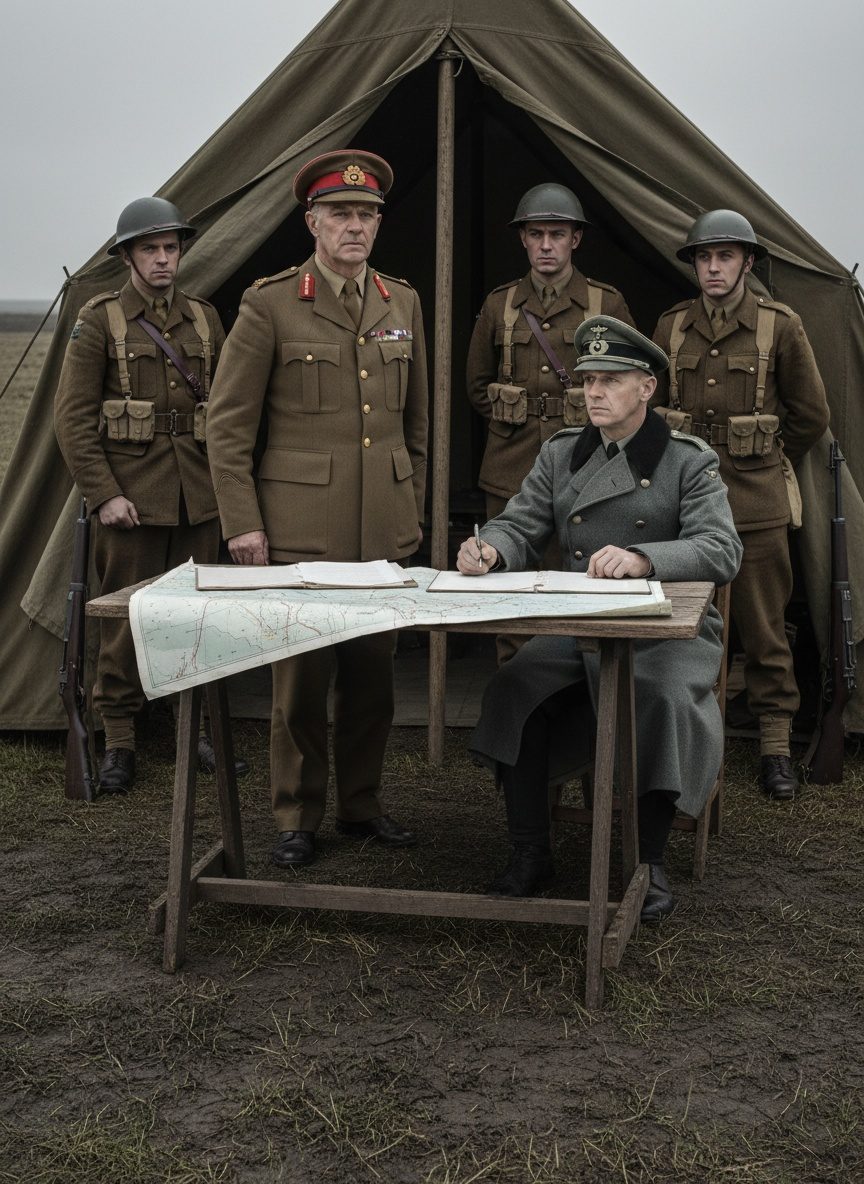
Lüneburg Heath, a sparsely populated expanse in northern Germany, was hardly the backdrop one might envision for a moment of monumental historical consequence. There were no grand palaces or triumphant arches here—just windswept plains and a lonely tent. Yet, within this humble, canvas setting, one of history’s most significant ceasefires was inked. British Field Marshal Bernard Montgomery waited, his demeanor a blend of steely resolve and palpable relief. Across from him, high-ranking German officers—men who had once issued orders to terrorize an entire continent—sat in grim silence. On this cold, flat expanse, Montgomery would oversee the surrender of the German armies in northwest Germany, Holland, and Denmark. It was a desolate place for an occasion so full of consequence, but perhaps, after years of unimaginable suffering, simplicity was fitting.
Montgomery's Measured Approach
Field Marshal Bernard Montgomery, or "Monty" as he was known to his troops, was no stranger to the theater of war. His leadership during the North African Campaign had proven his strategic prowess, yet it was his characteristic precision and attention to detail that served him on this day. Montgomery was never one to leave things to chance. After securing the surrender of the German forces in front of him, he peppered the meeting with questions designed not only to ensure the clarity of the terms but to gauge the sincerity of German intentions. It was a methodical dance on a precipice between hostility and peace. Yet, the setting could not have been more understated, removing any theatrics and placing the event firmly in the realm of the practical. Monty's approach was not about basking in triumph, but about ensuring the war ended decisively and peacefully.
The Silent Signatories
The German officers—among them Admiral Hans-Georg von Friedeburg and General Eberhard Kinzel—were seasoned military men, their uniforms now representing a defeated war machine. They brought with them the weight of a collapsing regime and an inkling of what awaited their country. These were men of rank who had spent years at the helm of strategies that sent millions to the front lines and new technologies of warfare raining from the skies. Now, their role was reduced to a reluctant participation in Montgomery's solemn ceremony of surrender. As each officer signed the document, relinquishing their armies to the Allies, the air was thick with the unsaid. There was no room for grandiloquence or dramatic flourishes—a quick, scrawled name was all that it took to seal the fate of countless soldiers and civilians alike.
Read next: The Day a Army Chaplain Gave His Coat to a Dying Stranger
The Quiet Power of Paperwork
It’s easy to forget how powerful a simple piece of paper can be. On this day, the act of signing was not merely administrative; it was transformative. With a few pen strokes, Europe began its slow journey to peace. For many on the homeland front and in occupied territories, this signing would signal not only the cessation of gunfire but a sliver of hope that normalcy might return. As the signing concluded, the moment was marked by nothing more than a few handshakes and the shaking of heads. The practicalities of ending a war often outstrip dramatics, and in this small circle under the tent, the pageantry of victory was replaced by the sobriety of renewal. Fields would fall silent, guns would cool, and homes would soon ring with a quiet not heard in years.
Why Lüneburg Matters
Lüneburg Heath may not have the storied reputation of Versailles or the grandeur of the Reichstag, but the surrender inked on its soil was the quiet catalyst for a new Europe. This unadorned moment speaks not to the pomp of power, but to the human quest for order out of chaos. It reminds us that moments of ending, even those as immense as the conclusion of World War II in Europe, are often more whisper than shout. The windswept plain and canvas tent encapsulated the end not only of battles fought but of ideologies and eras. In the simplicity of their setting, Montgomery and his German counterparts mirrored the fundamental truth of history: that change often finds its catalyst not in grandiose declarations, but in the ink blot that marks a signature, and the quiet turning of a page from war to peace.