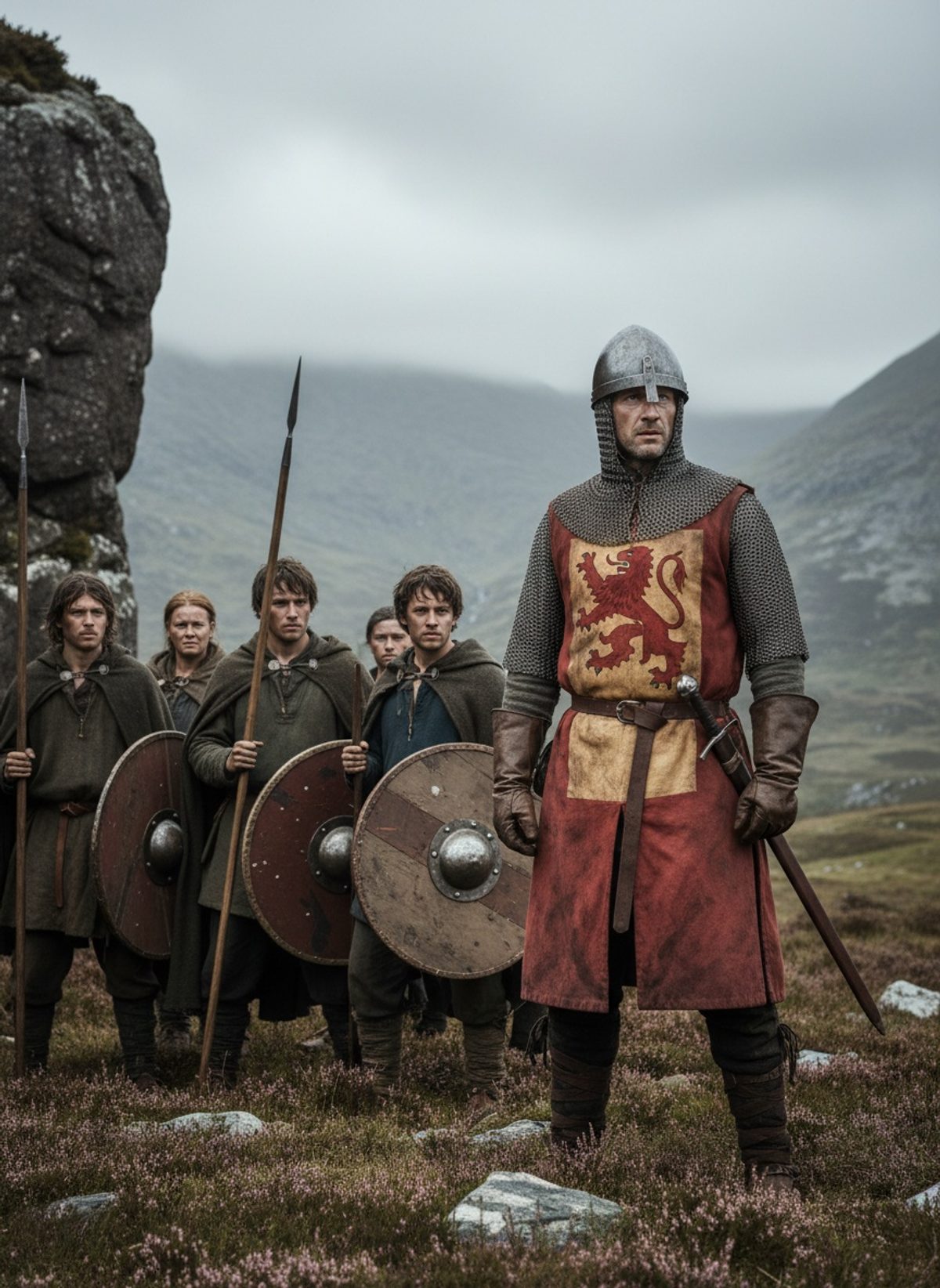
He was a king without a home. Few realized that the man who would define Scottish sovereignty lived for a time like the hunted, hiding from his own people among the shadows of Scotland's wild, unyielding terrain.
The air was crisp and biting in 1306, as an exiled Robert the Bruce trudged through Scotland, the dream of a united kingdom clinging to him with the same persistence as the mist around him. The paths he took were often littered with betrayal and doubt, the nooks and crannies of his homeland offering neither comfort nor consolation, but only precarious refuge. His name echoed through royal courts and whispered among the forests—a rallying cry for a nation that needed both courage and cunning to free itself from the iron grip of English dominance.
That year Robert the Bruce was not yet the noble figure draped in the romantic memories of triumph at Bannockburn; he was a fugitive, a displaced nobleman with a tarnished past and an uncertain future. His path to the Scottish throne was marked not just by ambition but by acts of ruthless determination. The odds were stacked against him, but behind him loomed a lineage intertwined with Scottish regal aspirations. His grandfather had aimed for the throne, yet it was Robert who understood that the weight of a name could carry more than just the burdens of heritage—it could pivot the destiny of a people.
Caught in the tumult of medieval strife, Robert's mishaps and victories painted his early reign. His familial ties with the English crown through a series of arranged marriage alliances spurred suspicion; the assassination of his rival, John Comyn, at Greyfriars Kirk damned him even further. With English forces at his heels, survival became his banner. Scotland's landscape became a testament to his resilience—each mountain and moor a co-conspirator in his quest. Seeking sanctuary in the isles, relying on coastal caves, and finding strength in solitary contemplation, Robert the Bruce was wrought from Scotland's very bones. His resolve, tempered and trained by harsh trials, was the crucible needed to forge a leader of unyielding fortitude.
Read next: The Day a Scots Girl Thrust Her Arm Into a Lock to Save a King
By the time 1306 unfurled its harsh tapestry, the pieces were set long before. A bold coronation in March, cloaked with both trepidation and tenacity, crowned him not just with gold, but with a nation's burgeoning hope. Yet, this moment was fleeting. England's retaliation came swiftly, as if the very earth quaked at the defiance exhibited by the Scots. Valued prisoners were executed, family members incarcerated—and Edward I's shadow grew long and dark over the northern lands. Robert's tactical retreats masked strategic recalibrations; fortitude learned through the cracks and crevices of defeat itself.
The heart of Bruce's leadership lay not just in hardening his spirit against adversity, but in knowing when to masked vulnerability as strength. Like the stones of Scone, which were once symbols of kingdom's blessings, Robert understood that his real throne would be carved out of battle and blood. His robust vision for Scotland surged from the lessons snatched from ruin. What many deemed rebellion, he designed as revival—an anthem of the resolute, sung in broadswords and banners.
Perhaps the most profound of realizations was that Robert the Bruce could not rely solely on grandeur or might. He needed an invigorated belief, a trust from his people to whisper louder than war cries—trust that was not inherited through blood or bestowed by armys’ laurels but was cultivated in hardship and built on shared prospects of freedom. This nascent bond blossomed in the glens and forests, mobilizing clans and forging alliances where none seemed possible. As if his very veins were filled with the rivers Caithness and Clyde, Robert's maneuvers on the face of Scotland outwitted opponents, bound scattered resistances, and made manifold the fealties amongst factions.
It was Bannockburn that served as both crucible and crown. By 1314, merely eight years from his frantic flights, Robert the Bruce struck the chords of valor in a battlefield crescendo to echo across centuries. The Scottish army, once mere whispers among windswept crags, swelled into an embodiment of Bruce’s envisioned legacy—a testament proven. The invading forces were sent scampering, disbanded by a blinding dawn that burnt the myth of English invulnerability to the ground.
Robert the Bruce's story, sketched in landscapes steeped with more than the blood of contentious centuries, drawn on by untamable wilderness, shows us that history too can possess heartbeats worth hearing. His is a name which rallied souls not content with the tethers of subjugation; an emblem etching past shadows of loss, now standing as testament to ambition intertwined with identity. The ripples from the Scots’ resilience speak profoundly of more than just battles won—they narrate the odyssey of a name that transcended royal aspirations, becoming a saga devoted to the spiritual tether a people hold to their land, and their sovereign.