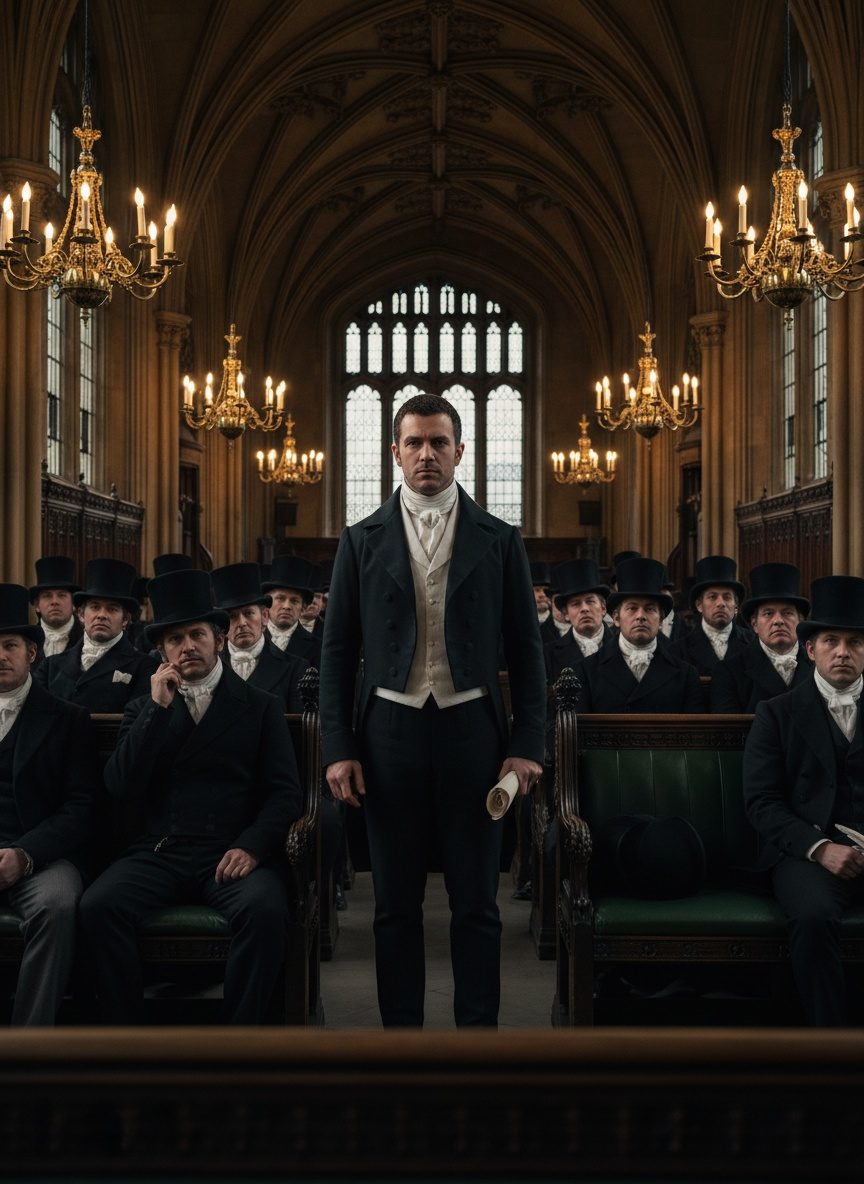
He was a Scotsman with an odd obsession. His friends raised eyebrows when he disappeared to the shed.
The Secret Shed of Redruth
In the murky fields of Cornwall in 1792, William Murdoch was concocting a quiet revolution. The son of a Miller from Ayrshire, Murdoch had always been driven by curiosity more than obligation. Locals might have dismissed him as eccentric, but his experiments were far from mad clatterings in the night. Sequestered in a shed that seemed more workshop than a gardener's retreat, Murdoch was playing with fire—literally. With nothing more than scattered tools and an insatiable thirst to brighten the world, he embarked on a mission that would shrug aside centuries of reliance on flickering candlelight.
It was a grim decade of hard work in the mining town of Redruth, where coal was both the lifeblood and the scourge of daily existence. To many, coal meant grime and grind, but to Murdoch it signaled an unexploited potential. He focused on perfecting the art of gas production by burning coal and channeling its luminous gift. Through a system of tin tubes, which he crafted painstakingly, Murdoch conducted this otherworldly light into his own modest abode. In a spectacle surreal even to Murdoch himself, his home glowed invitingly, untouched by wick or oil. He had devised a personal, alchemical wonder from common coal.
The Glow That Changed the Night
The phenomenon of lighting an entire room using gas from coal was unprecedented at the time—and, without question, dangerous. Yet, Murdoch's confidence in his invention was marveled at by those who witnessed his house glowing warmly in the ink-black night. Here was a lone engineer who had achieved in solitude what grand institutions had barely begun to conceive.
Read next: The Day a Mill Owner Walked Into Parliament for His Children
This wondrous event wasn’t greeted with universal acclaim. The chilling chill of change, after all, can be slow to thaw the hearts of skeptics. There, in a cloudy crossroads between tradition and innovation, Murdoch stood quietly pressing the boundaries of possibility. His resourcefulness was not merely a rejection of the candle-laden past but a clarion call to his contemporaries: the future could be powered, quite literally, from beneath the ground.
Gas as a source of illumination would eventually redefine the nightly landscapes of towns and cities. The seed planted in Murdoch’s garden shed foreshadowed the dazzling nights of an industrial world yet to come. Days might have still been ruled by the sun, but artificial light was now set to elongate human hours beyond its fall.
The Path from Oddity to Innovation
Murdoch’s illumination of his cottage served not merely as a scientific curiosity but as a proof of concept that didn’t simply alight a room but ignited imaginations. His quiet brilliance began to seep into the public consciousness, seeding ideas of a society buoyed by accessible energy. His efforts did not go unnoticed or remain sequestered for long. Others soon followed his lead, enhancing and adapting his methods, widening their application beyond mere novelty.
These cascading echoes of innovation reached across Europe. It might have started in the Cornish fields, but the ripples soon lapped at the shores of the Thames, spurring on the grand cityscapes of modern development. Engineers and entrepreneurs now viewed coal not only as a burdensome resource but a ticket to a future illuminated by its latent light. Gas lighting would soon blaze its trail across history, transitioning from individual ingenuity to systematic implementation.
Among those inspired by Murdoch's achievement were visionary industrialists and municipal leaders who began to orchestrate the remarkable spread of gas lighting. Despite the familiar pushback of entrenched interests—and the threat of explosions that came with the precarious practice of transporting gas—perception eventually yielded to practicality. The world saw its nights transformed, step by careful step, into a spectacle never before conceived.
The Darkness Yielded
William Murdoch’s modest beginning in a small Cornish town slid upon a pivotal axis onto the grand stage of history. The echoes of his solitary labor transcended mere utility, symbolizing the dawn of an era where individuals could illuminate the paths ahead. He might never have joined the wider conversation of household names like Watt or Boulton, but his contributions were tangibly felt by all who lived within the cityscapes he helped to illuminate.
As popular renown often remains just around the corner for humble engineers, Murdoch's light did not burn brightly in the annals as much as it did silently alter the fabric of everyday life. It was a practical poetry of mechanized illumination that chased shadows to far corners and created twilights in which dreams could now comfortably bloom.
Witnessing the magic every time light flows from a switch today, one can remember Murdoch—a lone Scotsman in a secluded shed—whose isolated effort in the glow of Cornwall’s night beckoned an entire world to grasp at the particles of light dancing among shadows. In understanding this Scottish engineer’s legacy, one finds a story of quiet pioneering and the enduring triumph of human innovation against the tides of darkness.