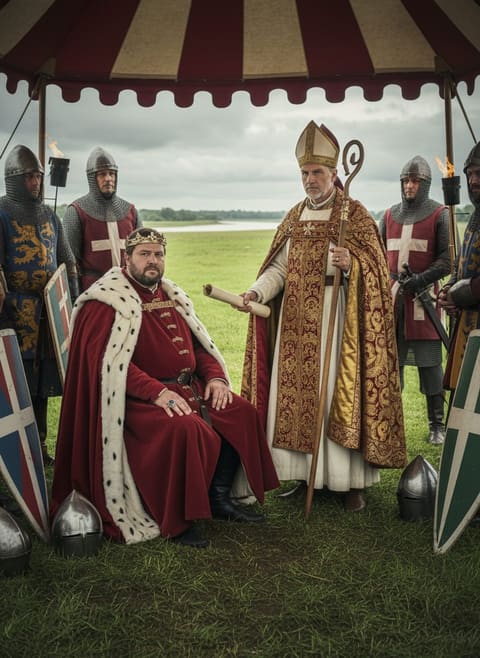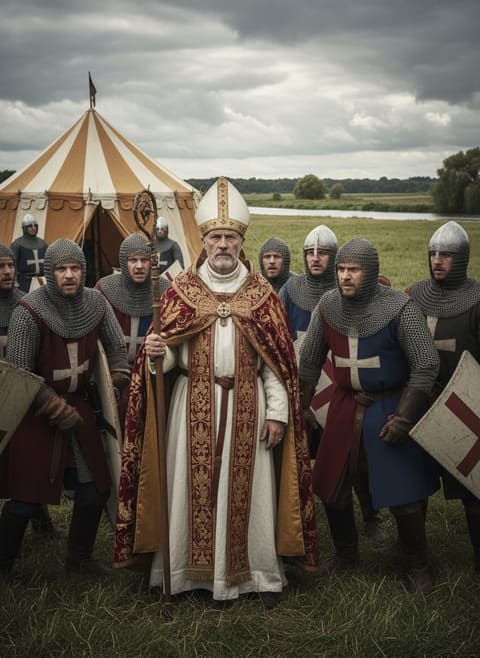
His kingdom laid ransom for his freedom, yet he did not stay. Richard the Lionheart was crowned king for the second time, only to leave England twenty-five days after.
The Lion in Chains
The tale of Richard I of England, known throughout history as Richard the Lionheart, is a saga of medieval irony and unequalled charisma. In 1192, the powerful English king fought valiantly during the Third Crusade, gaining formidable fame among Christian warriors and fear among his Muslim foes. Yet, just as his crusade drew to a close, his return journey was marred by disaster. While incognito, Richard was shipwrecked in the Adriatic Sea and captured near Vienna by Duke Leopold V of Austria, a hawk-eyed princeling whom Richard had previously insulted by tearing down his banner from the walls of Acre.
It was a humbling capture for one of Christendom’s most celebrated knights. Leopold held a grudge that bore a hefty price tag. In an act echoing the sordid dealings of medieval politics, Leopold transferred Richard to Emperor Henry VI, the ruler of the Holy Roman Empire, who saw in Richard a golden opportunity. England, buckling under heavy taxes from the crusade, was mercilessly threatened with the unthinkable — a king in chains.
Henry demanded a ransom of 100,000 pounds of silver, an amount that equaled two years of England’s revenue. For over a year, English nobles and clergy labored ceaselessly to collect the astronomical sum. Monasteries emptied their coffers; the treasury scraped together every ounce of silver, straining under a debt whose echoes resounded across the English countryside. The English people — weary from Richard’s continental wars — foraged deep into their pockets for this inglorious tribute.
Read next: The Day a Welsh Girl Barred the Door on a King's Army
Homecomings and Crowning Moments
Finally, in February 1194, the ransom was met, and Richard was released. The Lionheart, as his appellation portrays, was not subdued by his captivities; instead, he emerged with magnified legend. On his return to English soil, Richard's steps led him to Winchester Cathedral, not as a man defeated but as a sovereign renewed.
The ceremonial recrowning on the 17th of April symbolized his resilient kingship. He arrived bedecked in full regalia, wielding the accoutrements of power and prestige. The cathedral, an architectural tapestry of medieval devotion, stood witness to resplendent pageantry. Richard sought to erase any doubts of legitimacy caused by his brother, John, who had sought the throne during his captivity. The consecration aimed to reaffirm his divine right to rule, a monarch’s duty undergirded with the pomp and splendor only crown jewels and church finery could manifest.
However, soon after the flickering torches of celebration dimmed, Richard departed once more. Twenty-five days later, he left the kingdom he had rarely seen during his reign, crossing the Channel for the warfare-laden lands of his mother's tenure in Aquitaine. His actions portrayed an enigmatic monarch and a warrior at heart, more concerned with cross-Channel dominions and continental conflicts than the governance of England herself.
Read next: The Day a Medieval Mayor Knelt and Saved Six Condemned Men
The King Who Walked Away
Throughout his reign, England was more often a realm governed by his trusted justiciars than by the king himself. For Richard, England was not his polity's heartland; it was a bastion of financial sustenance for his military ambitions abroad. His scarce presence on the fertile isle, only twice gracing its shores as king and notably residing there for less than six months of his ten-year reign, tells of a monarch driven by the knightly ideal over the duties of domestic rulership.
The recrowning in Winchester and the subsequent hiatus to French terrains encapsulated the paradox of a king more foreign to his land than familiar. His European aspirations overshadowed domestic concerns, steering his battles against Philippe II of France with an ardor that England’s merriest sovereigns typically reserved for their subjects.
In this relentless quest for power, grandeur, and martial legacy, Richard's brief sojourn in England shines as a haunting reminder of a sovereign who loomed larger-than-life— a storied figure whose legend lived louder in song and saga than it did in the administrative courts of his own people. This complex legacy of the Lionheart's reign underscores a monarchy defined as much by absenteeism as by heroic romanticism. A kingdom left behind may shape a history where myths and truths collide, weaving a narrative of medieval kingship that champions chivalric adventure over the quotidian task of rule. Indeed, Richard's journey home was less about being a king among his people and more about being a legendary lion whose heart never truly returned to Albion.