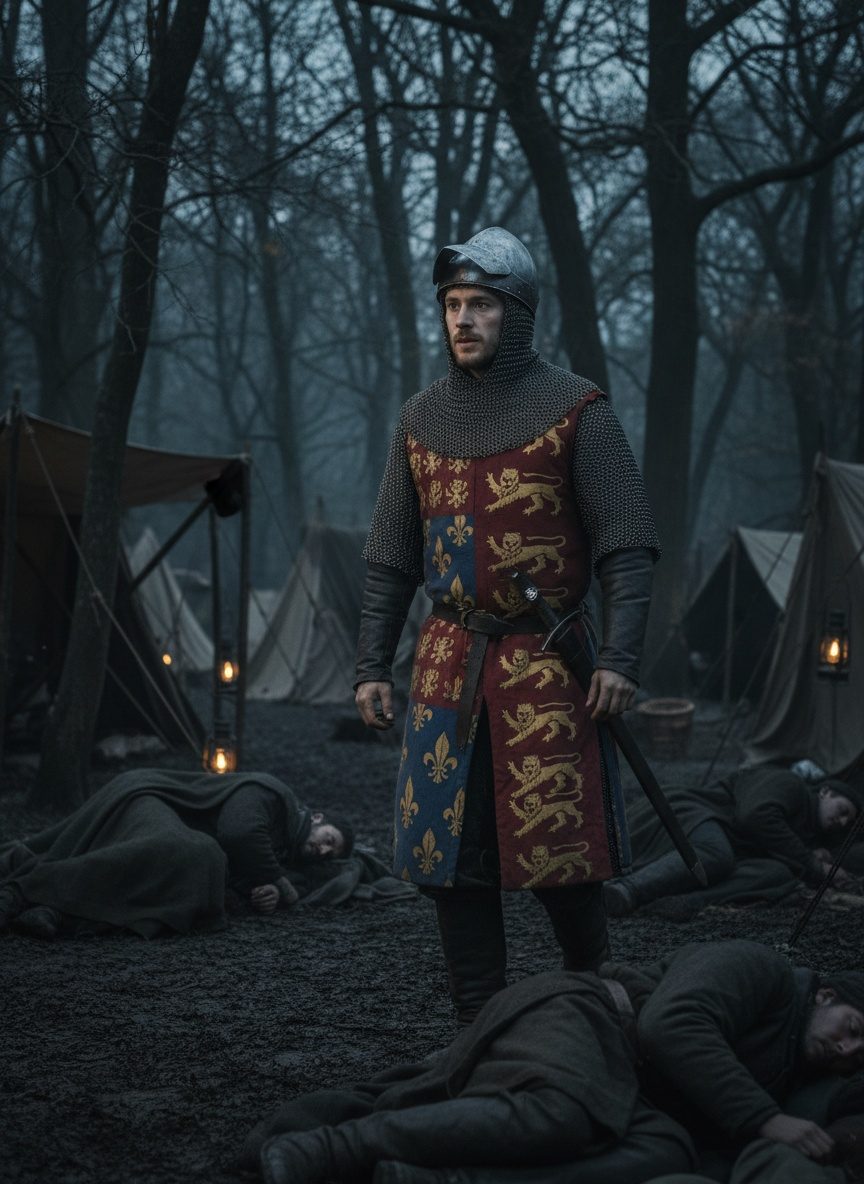
The man who faced the mighty French host was no battle-seasoned warrior. From the tableaux of history steps a 27-year-old king, once a prince banished from court and now, the solitary pilgrim of a fate-laden night.
The Lonely Road to Agincourt
The night of October 24, 1415, was taut with anticipation. As the sun bid its farewell, casting long, uncertain shadows over the English camp, Henry V chose an unlikely path. Instead of strategising with his captains or rousing morale with speeches, he walked alone into the chill of the approaching winter. The weight of the crown felt especially heavy as he left the flickering firelight behind, blending into the cloak of darkness. He was more than a king; he became a forlorn supplicant, a man entwined with destiny yet unsatisfied with the machinations of men.
The French, with their thousands swelling greater than threefold the English, were camped nearby, electric with the anticipation of a victory they deemed all but assured. Despite the odds stacked against his outnumbered forces, Henry sought no council of war, no maps. Instead, he sought solace in the silent witness of the wooded expanse. Here, beyond the drumming of the English drums and the restless snuffling of anxious horses, lay a clearing; a sanctuary for a king in need of divine passage through his tribulations.
A Wilderness Prayer
What occurred beneath the cathedral of trees remains one of the great mysteries of history, an untold chapter written in the inkwell of night. Did he kneel upon the earth, fingers tracing patterns in the soil as ancient kings might have done? Was his prayer a plea, born of desperation, or a negotiation with the Almighty for the battle to come? Whichever it was, the solitude allowed Henry a moment to shed his burdens. For a brief interlude, he was not a monarch fighting for a claim in France but a human seeking clarity amidst chaos.
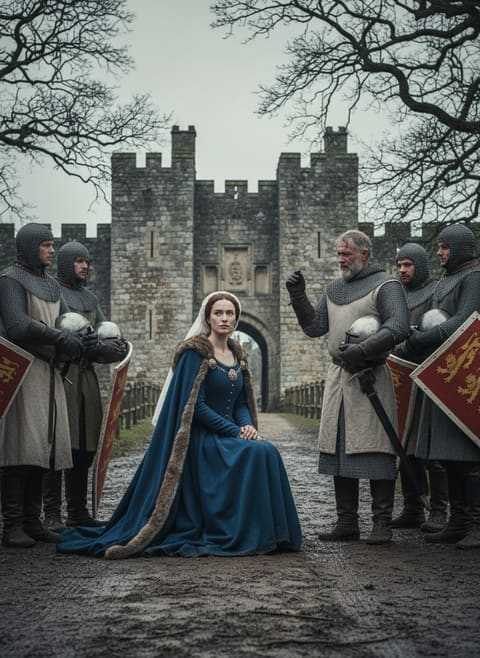
Read next: The Day a Welsh Girl Barred the Door on a King's Army
Echoes of medieval chronicles whisper how, in the face of what the morrow would bring, Henry invoked the saints, the Virgin, perhaps even the sympathetic spirit of his father, Henry IV. But what stirred in those moments alone, in the cold crucible of night, reshaped the man destined to become England’s warrior king. When he arose and retraced his steps back to camp, the air was thick with the inhalations of men who would soon be fighting for their lives. Yet, a transformation flittered in the king’s aspect as dawn began its slow climb toward Agincourt.
The Unseen Burden Lifted
Before the break of first light, Henry’s demeanor seemed changed. He moved among his men, not as a sovereign upon a pedestal, but as one of them—shouldering their uncertainties as his own. The silence of night had granted him a decision, a revelation even, which buoyed him and flowed through the ranks. Removing his bejeweled crown, he donned instead an armor of human connection and fiery resolve.
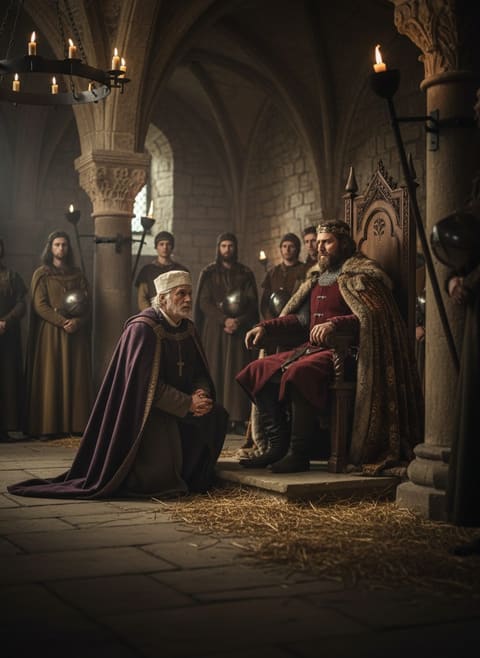
Read next: The Day a Medieval Mayor Knelt and Saved Six Condemned Men
When battle cries finally tore through the mist of morning, it wasn’t just steel that clashed with the knights of France but the unyielding spirit of an inspired force. Those English soldiers, beleaguered by illness and fatigue, felt the swell of that singular quiet night of the king. They moved to the rhythm of a purpose that transcended the mere claiming of land—they fought for the man who had lifted the encumbrance of fear from their shoulders, trusting their might to the wind of destiny bound with faith.
An Undying Echo
History knows the outcome of Agincourt—the English prevailed against staggering odds. It was not victory alone that etched Henry V into the annals of legend but the unseen weave of fidelity and humanity invoking bright fortune from the shadows. Those who observed the day marveled at their king’s courage, yet few understood the true crucible lay not in the fields of France but in the solitude of a night cloaked in silent reflection.
The story of that evening echoes through time as a testament to faith—a faith not just in divine providence but in the interconnected might of shared purpose. Henry’s solitary walk into the heart of darkness left behind an indelible footprint—a testament to true leadership where symbolism wields greater force than strategy, and the valor of a single soul can, even momentarily, tilt the scales of history towards hope.