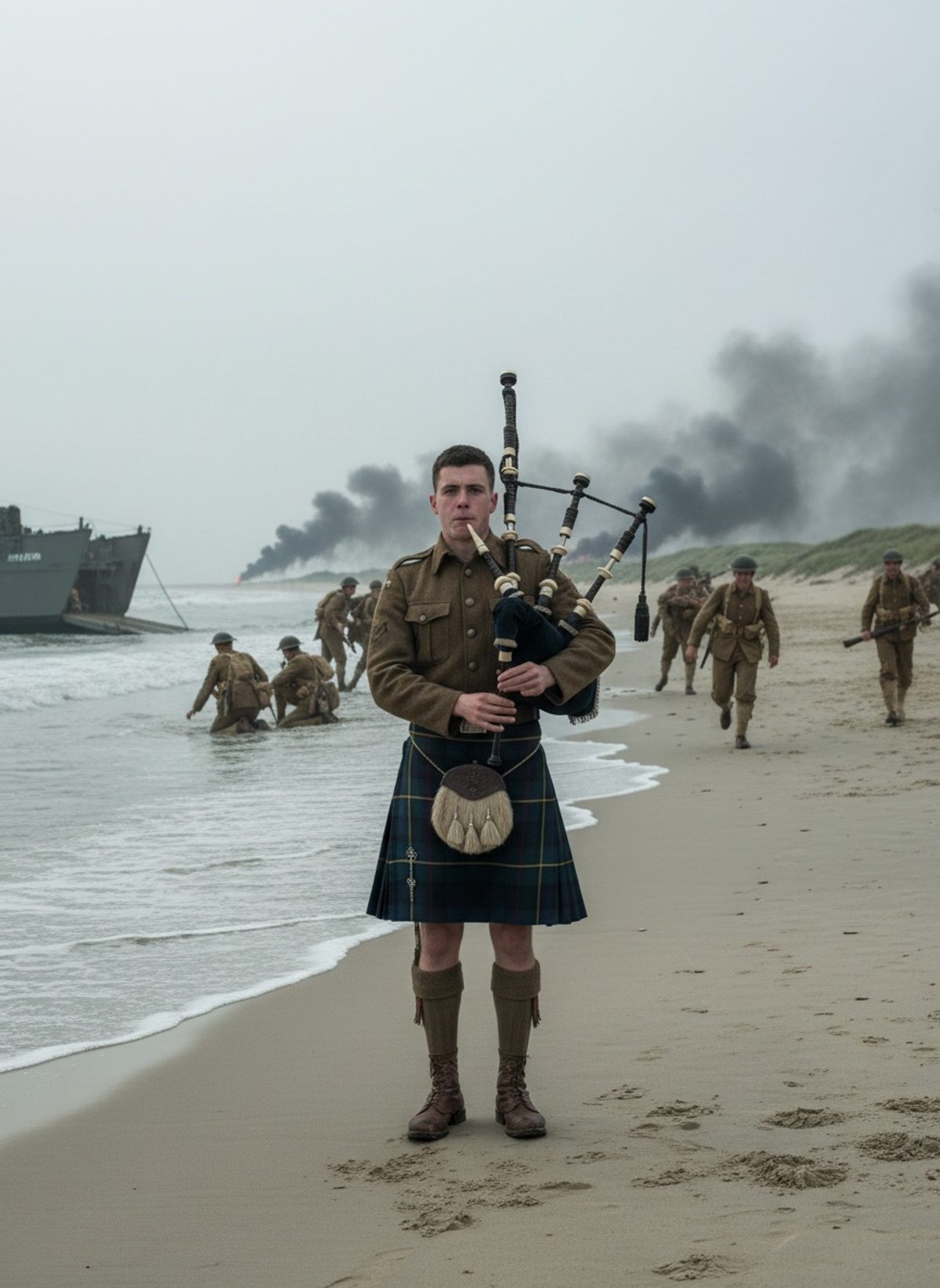
He was twenty-one when he faced the chaos that unfolded on Sword Beach. And he didn't have a weapon in his hands.
The Unarmed Warrior
Among the thunder of gunfire and the cries of men, a lone Scotsman stood apart, wading into the swirling surf of the Channel. His attire was as unique as his mission; a kilt that had seen many days, handed down from his father, enveloped him in the traditions of his homeland. But it was the haunting strains of the bagpipes he carried that set him apart most of all. While others donned helmets and rifles, he bore no armament. His task was one of spirit and defiance, punctuated by the mournful and triumphant tunes that soared above the sounds of battle.
The Piper's Path
As the Allied forces stormed the shores of Normandy on June 6, 1944, the piper paced back and forth across the chaotic sands of Sword Beach—a deliberate, almost surreal contrast to the urgency around him. Each step marked with the rhythm of the pipes, he moved with a calm that belied the surrounding turmoil. His name might elude history textbooks, yet his presence imprinted itself deeply into the fabric of that morning. Unyielding to the barrage of the advancing German forces, his courage drew the incredulous attention of both friend and foe.
The Germans' Dilemma
Amidst clusters of stowed-away snipers, German eyes focused on the Scotsman who dared to cut across their line of fire. For reasons lost to time—or perhaps guarded by the mysticism of war—those poised with rifles chose not to pull the trigger. Perhaps it was disbelief, or maybe respect, that stayed their hands. They might have looked at him and seen no combatant, no threat, just a solitary figure wrapped in tradition, whose audacity was mistaken for folly. His specter left the enemy confounded, the folly of a madman perhaps too noble to extinguish with a bullet.
Read next: The Day a Army Chaplain Gave His Coat to a Dying Stranger
Music Amidst Mayhem
Why did he play? To those there, it was as if the sound of his bagpipe was a lifeline—a reminder of life beyond the tide of wartime horror. Its music was raw and ancient, reflecting resilience, stirring the spirits of those around him. For his fellow soldiers, the tones of the pipes cut through the cacophony, offering solace under fire. And, unmistakably, the melody infused the fighters with courage, a living symbol of a heritage that stood unshaken and proud in the direst of moments.
The Legacy of Courage
On that June day, the piper's actions offered more than music; they offered a glimpse of humanity against the pale of mechanical war. The Germans' decision to view him as untouchably mad speaks to war's surreal moments when logic bows to metaphor and myth. For those who scrambled through that fateful beach, the music remains an enduring part of their tale—an echo of tenacity and an emblem of home. While his name may be lost to most, his deeds inspire; they are reminders that courage can transcend conventional weapons, and sometimes, the battles fought in the psyche can be as pivotal as those in the flesh. In the face of peril, he showed that there are innumerable ways to confront and confound an enemy, proving that history's most potent legends need no sword, but merely conviction and song.