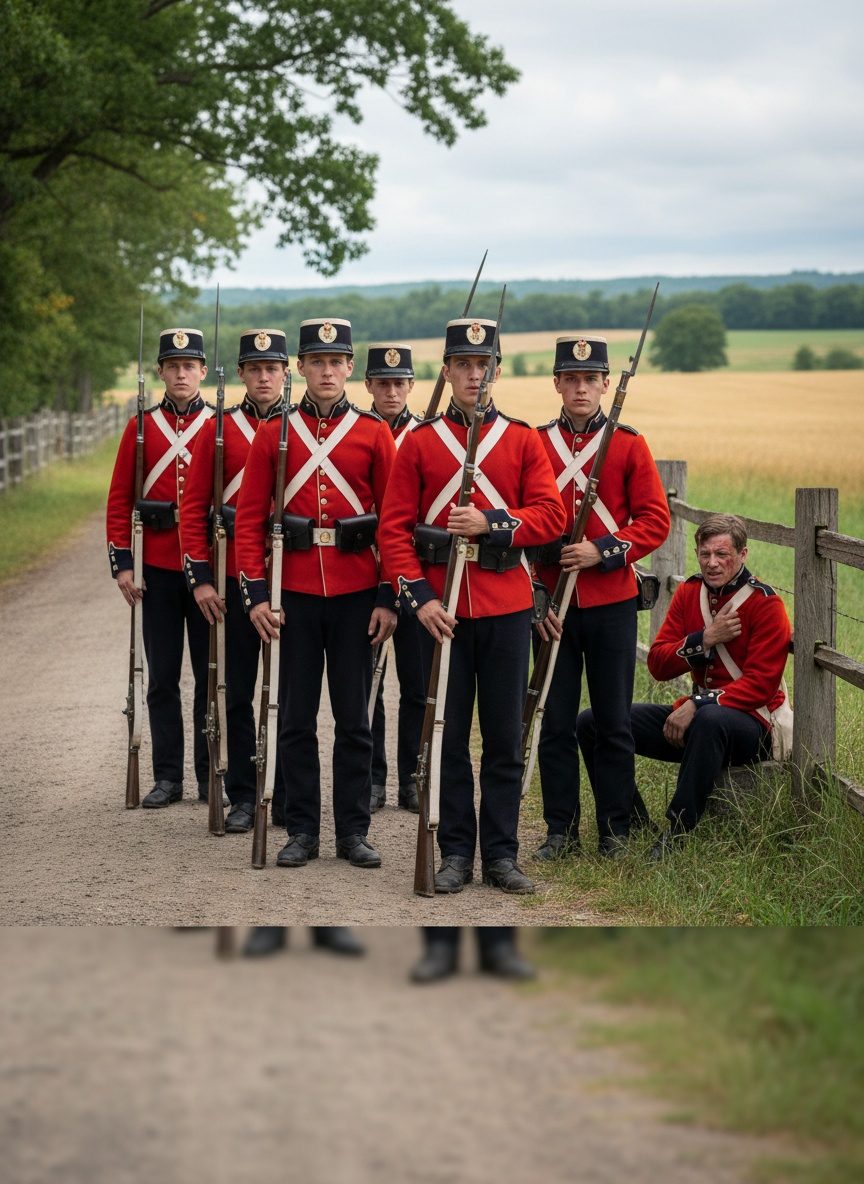
June 1866. The summer heat hung heavy over the fields of Southern Ontario, oppressive and palpable. Along the narrow dirt roads, the air shimmered above rows of young militiamen trudging westward, their boots kicking up clouds of dust that seemed to swallow each footfall before it could echo. These young men bore expressions marked not just by the burden of their Enfield rifles but by the weight of uncertainty hanging around them like the humidity that drenched their wool uniforms.
In a world still familiar only with its antiquated boundaries, there was a giant on the cusp of its birth—a nation more idea than reality. Canada, not yet a confederated entity, was merely an aspiration shared by a clutch of British North American provinces. Yet, across these lands, whispers had grown to shouts as the Fenian threat crossed the border, a menace carried by Irish-American veterans who had cut their teeth in the bloodiest conflict America had ever known. Many of these veteran soldiers had fought not only with great skill but with the desperation of exiles longing for a free Ireland, now seeking to exert influence over British holdings in the Americas.
These were hardened men, assembled under banners of green emblazoned with harps and rifles as symbols of their republican dreams. Their discipline and experience stood in stark contrast to the raw youthfulness of the Canadian militiamen. The latter were hastily cobbled together, men of local farms and villages who had traded their plows for muskets. They were compelled by loyalty—loyalty to their communities, their families, and an embryonic nation gestating within the heart of the British Empire.
On June 2, 1866, the two forces met near the small village of Ridgeway, not far from the Niagara frontier, where trees stood solemn like sentries and the ground undulated towards the horizon. Here, the stage was set for a struggle that would add a sombre footnote to the chapters of Canadian history yet to be written. As daybreak swept over the tangled fields, the young Canadians, staring ahead with resolve, stood ready against the Fenians, each man knowing that nothing could be more uncertain than this day.
Read next: When John Macarthur's Rival Built a Free Colony, 1836
As shots rang out, the air was filled with the acrid scent of gunpowder, the vicious sound jarringly at odds with bird chatter and rustling leaves. Torn for a moment between fear and duty, the hearts of the militiamen pounded both in defiance and terror. For many, it was the first time they confronted death not as an abstraction but as a grim possibility. When the first men fell, nine of whom would not rise again, the realization sank in that this fight was not just across a border but within their own spirits.
The engagement at Ridgeway was chaotic, filled with volleys and advancement, retreats and rallying cries. As reports cracked through the morning mist, the conflict morphed the serene landscape into a tableau of smoke and fury. History would note the inadequacies and missteps—the lack of proper communication among Canadian officers, the misplaced orders—but what emerged more profoundly was a baptism by fire for these young soldiers who marched under the Union Jack more out of heritage than of national identity.
Despite the ferocity, the Fenians held their ground with practiced skill, their ranks featuring men who had seen far bloodier scenes at Bull Run, Gettysburg, and Antietam. Yet the fight that day was a culmination not merely of ideology but of desperate hope and exhausted dreams. These veterans were striving to spark a broader revolt, to use Ridgeway as a lever against perceived oppressors thousands of miles across the Atlantic.
By the day's end, Ridgeway saw more than just a clash of arms; it witnessed a rise of consciousness. The loss of nine colonial militiamen imparted a cutting edge to the nascent Canadian psyche, stirring a growing, though unformed, sense of identity. In the solemn aftermath, grief hand in hand with silence, the fields bore witness to an emergence. The meaning of their sacrifices could not yet be wholly understood, existing in quiet anticipation of the day when a flag different from any British insignia would fly, imbued with the maple leaf's red and white.
Read next: When Caroline Chisholm Fed the Hungry at Sydney's Gate, 1841
The engagement bore no grand strategic outcome or conclusive victory, yet Ridgeway unfolded a moment unforgotten in the ledgers of Canadian history. The young men’s stand—eighteen and twenty-year-olds who had left their families for an amorphous idea of a country—etched upon an emerging narrative of bravery and commitment to something larger than oneself.
Canada, born a fractured dream in the mind of politicians and landowners, found at Ridgeway a mortar for its foundation. Though their actions echoed an allegiance to a queen an ocean away, they set the stage for the voices that would soon rise, demanding a sovereign melody of their own. By defending their land, they were shaping a national story no textbook had yet to chronicle.
As names were carved into headstones and memories, Ridgeway rendered an indelible truth that cut through the lush summer foliage: you need not wear a nation's emblem for your sacrifice to breathe life into it. Canada's birth was an unfathomable abstraction to their silenced breaths, yet Ridgeway, an overlooked spell in the story of empires and revolutions, marked an invisible turning point—an unspoken gift to a future land yet to be truly mapped in the pages of history.