The humid air of the Gold Coast jungle clung to the skin like a living thing. Beneath the thick canopy, General Garnet Wolseley crunched through the underbrush, every step a calculated war against nature's attempts to reclaim its own. Ahead, the shadowy outlines of Kumasi emerged through the mist, a spectral silhouette hinting at the Asante Empire’s formidable heartland. His men, steel-eyed and resolute, moved like a silent current behind him, menacing yet vulnerable under the pressing weight of the unseen enemy: the jungle itself.
The Crucible of the Gold Coast
Kumasi was no ordinary city. It was more than a capital; it was the pulsing heart of the Asante Empire, a realm shrouded in both majesty and mystery. For centuries, the Asante had held their lands fiercely, their strength drawn not just from their martial prowess but from the natural fortress of the jungle that enveloped them. No European army that dared to venture into this verdant fortification had returned unscathed. Yet, it was here that General Wolseley, with a force of just 2,500 men, set his sights.
Preparations were meticulous. Wolseley knew that every day of delay could mean disaster if the rains came and transformed pathways into torrents and fields into swamps. Timing was everything. The General’s orders were brisk, his strategy a delicate interplay of speed and subterfuge. The march to Kumasi was as much a test of endurance as it was of military ingenuity, an unrelenting push through tangled undergrowth and stifling heat.
A Town of Ashes and Pride
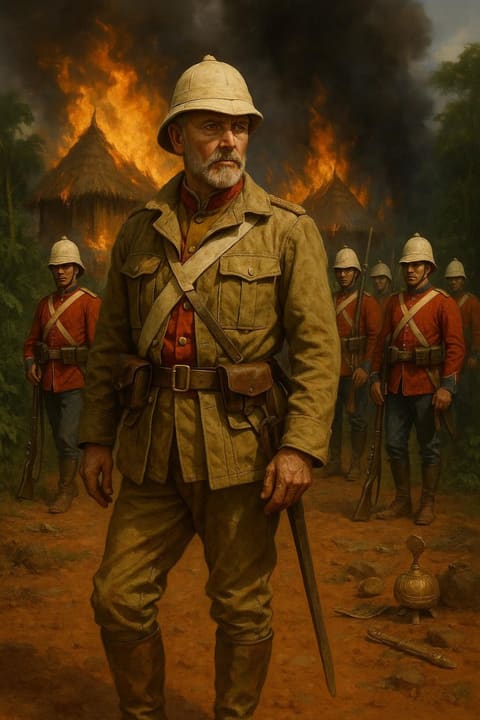
When Wolseley’s troops emerged from the dense underbrush and into the clearings that announced the vicinity of Kumasi, their presence was marked not with a blaze of cannon or the clash of steel, but with an eerie silence. The city, an imposing entity of grand shrines and sprawling courtyards, lay quiet, its luster dimmed by the smoke rising from smoldering ruins. Kumasi had been largely evacuated in anticipation of their arrival, its population melting into the jungle or regrouping elsewhere to continue their resistance.
Read next: When Samuel Baker Knelt Before the Khedive, 1869
The fall of Kumasi was not the brutal climax one might expect; instead, it unfolded in a single afternoon of unsettling calm broken only by the crackling of flames and the distant sounds of wildlife slowly reclaiming their territories. The city that had once thrummed with vibrant life was subdued into an enigmatic shadow of itself, its capture more a symbolic act than a decisive military conquest.
Through the Eyes of the Invaders
To the British soldiers stationed at Kumasi, the victory was tinged with a surreal quality. Many stared in awe at the architectural marvels and the richness of the culture that the Asante had built over the centuries. The streets they treaded were lined with ornately carved structures, the artistry a testament to a sophisticated society resistant to submission.
Yet, there was an underlying awareness among the men of the transient nature of their victory. The Asante had not been defeated in spirit; rather, their withdrawal was a strategic maneuver, leaving open the possibility of counterattacks and guerrilla warfare that could torment any occupying force. Wolseley’s troops, while triumphant, lived in a perpetual state of alert, surrounded by an enigmatic enemy that knew the land intimately.
A Race Against Nature
Time was both an ally and an adversary. The looming rains posed an existential threat to the British campaign in Kumasi. Wolseley’s gamble in timing had paid off, for they seized the city before the heavens opened. But the jungle showed no mercy in its relentless encroachment, threatening to sever supply lines and strand the expedition team in hostile territory.
Read next: When Samuel Crowther Preached in Yoruba Before a King, 1857
With Kumasi under tenuous control, Wolseley initiated the withdrawal with the same alacrity that marked their advance. The journey back, through swollen rivers and muddy trails, became a saga of survival and endurance. Each step was haunted by the specter of being overtaken by the jungle's hazards, the oppressive humidity a constant companion. Despite the harsh conditions, Wolseley's meticulously planned expedition succeeded in extracting his force largely intact, an achievement unheard of in the annals of European incursions into the Asante domain.
The Legacy of a March
Wolseley’s campaign against Kumasi stands as a stark chapter in the history of the Scramble for Africa—a potent reminder of the complex dynamics between empire and indigenous resistance. The brief occupation of Kumasi marked neither the end of the Asante’s influence nor the last of their defiance. It highlighted the limits of military might when pitted against a land and people adept at countering imperial ambitions through non-conventional means.
History books often glaze over the nuances of such encounters, focusing on political gains over personal costs. Yet, each soldier’s hurried step through the jungle bore witness to the broader narrative of resistance and resilience. Wolseley’s march into Kumasi was a fleeting illustration of strategic brilliance on one front and the unyielding heart of the Asante on the other. In the quiet, smoking ruins of Kumasi, a more profound truth emerged: that conquest could be as ephemeral as the campaign itself, the jungle retaining its dominion long after the triumphant had departed.