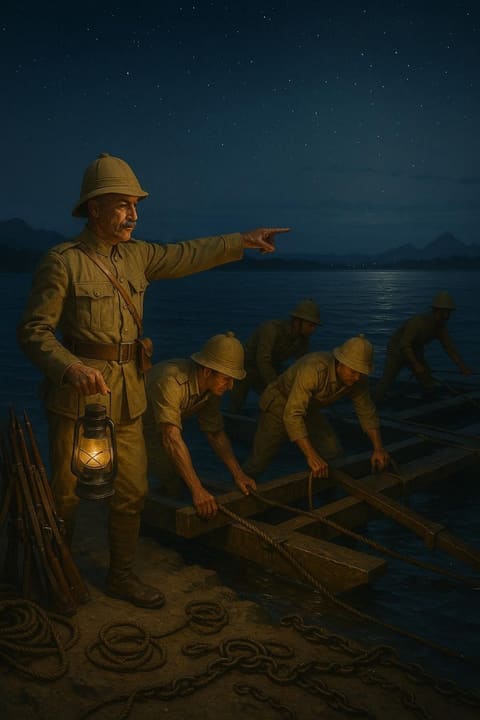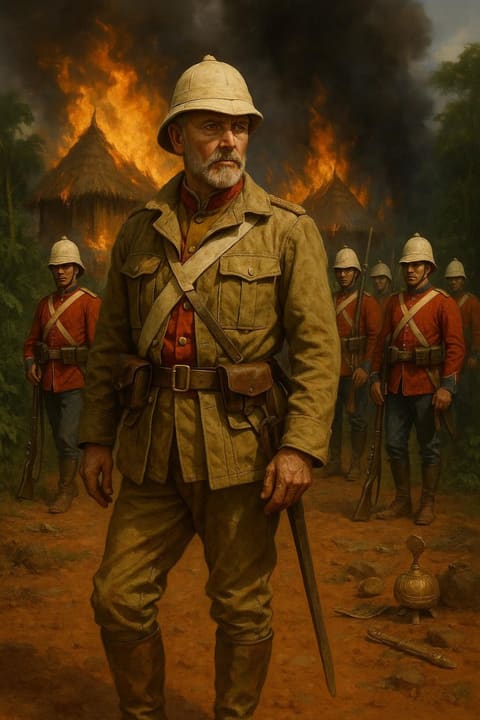
The heat was suffocating, and the grains of sand whipped against the soldiers’ faces with each gust of searing wind. As General William Hicks scanned the horizon, the relentless desert seemed to consume the horizon in waves of shimmering heat. Around him, ten thousand men marched southward, each bootfall sinking slightly into the vast expanses of the Sudanese desert. They were a formidable force with the confidence of an imperial power behind them, but out there in the arid wilderness, whispers of doubt and danger stalked every step.
The March into the Unknown
In that fateful autumn of 1883, the British Empire, through its proxy, the Egyptian Government, sought to reinforce their waning control over Sudan, a region boiling with discontent. At the helm of this mission was General William Hicks, a battle-hardened veteran tasked with leading the largest military expedition composed so far into Africa’s interior—an army ten thousand strong. The mission was clear: to crush the rebellion led by Muhammad Ahmad, known as the Mahdi, whose calls for holy war against the Egyptian regime had rallied an immense following.
The journey south into Sudan was not merely a military maneuver; it was a calculated risk. The landscape was treacherous, characterized by endless stretches of sand and sky. The troops carried enough rations for weeks, their supplies teetering on rail-thin lifelines of camel caravans. Near Kebir, the blistering sun and whispering winds echoed through their ranks, serving as constant reminders of isolation. Yet Hicks was undeterred. With no immediate warning of lurking danger and a profound trust in their imperial might, his forces trudged deeper into the sands—ever closer to the enemy that awaited them.
A Battlefield Coated in Deception
The Mahdi, whose followers believed he was a divinely guided redeemer of the Islamic faith, possessed not only an army of zealots but also invaluable knowledge of the harsh desert terrain. This advantage would become clear near the small oasis at El Obeid, where Hicks and his men stumbled into a meticulously crafted trap. The Mahdi’s warriors had been tracking the British-led force, their patience masked by the movement of the sands and an eerie silence that clung to the air.
Read next: When Samuel Baker Knelt Before the Khedive, 1869
In the days leading up to the confrontation, tensions ran high within Hicks’s ranks. The vast expanse seemed endless, and while the officers remained outwardly stoic, the foot soldiers, mostly Egyptian conscripts, whispered of omens and doom. As they drew near to their unwitting destination, shadows flitted across the dunes—from where, they couldn't be sure. With each step deeper into Mahdist territory, the patience of their unseen enemy was quietly rewarded. Then came the ambush. Surrounded and outmaneuvered, Hicks’s force faced overwhelming odds as the desert erupted with the roar of battle.
Disaster Under the Desert Sky
November 1883 was forever marked by a battle that was less a struggle and more a catastrophic slaughter. The noise of warfare echoed against rocky outcroppings, cries of the wounded lost to the elements as mounted Mahdist warriors, clad in white robes that blended with the sands, descended upon the flanks of Hicks’s beleaguered column. What began as strategic military engagement soon unraveled into chaotic desperation.
Read next: When Samuel Crowther Preached in Yoruba Before a King, 1857
No word of the exact fate of General William Hicks survived that desert clash. Some accounts suggest he fell early in the fray; others, that he mounted a final, desperate stand with his remaining men, attempting to rally them against the inevitable storm. Yet, beneath the merciless sun, morale crumbled, and one by one, the imperial soldiers succumbed to an enemy bolstered by belief and a profound understanding of the land they fought to defend. Not one man returned to recount the horror of that day, swallowed as they were by the desert sands and the implacable ferocity of the Mahdi’s forces.
The Shockwave Heard in London
News of the “disappearance” of Hicks’s army sent a wave of shock and disbelief through the corridors of power in Britain. For an empire that boasted control over territories that spanned the globe, admitting a crippling defeat and the total annihilation of such an impressive force was almost inconceivable. The British government, now acutely aware of the volatile and complex web of Sudanese politics and geography, came to see this tragic episode as a grim prelude to the challenges that awaited in this contentious portion of Africa.
The battle near El Obeid, while representing a single painful chapter, foretold of a longer, bloodier conflict—the Mahdist War—that would unfold over the following years. For Britons at home, the vanished army was a stark reminder of the cost of imperial expansion, and for those charting a course in Africa, a cautionary tale of overreach and underestimation. Hicks’s ill-fated expedition serves as a historical marker, not merely of lost men but of the perils of power employed without understanding. To march into the heart of a land without truly knowing its pulse, as Hicks's force tragically learned, was to risk disappearing into history without a whisper.