March 14, 1886. The docks at Chatham were alive with the clatter of hammering and the ceaseless chatter of shipbuilders.
The Rising Tide of Torpedo Boats
In the late 19th century, the shiver of anticipation and anxiety ran through the mighty empires of the world at the mention of torpedo boats. These small, nimble vessels packed a punch that far exceeded their size, utilizing newly developed self-propelled torpedoes. For the mightiest navy of the era, the British Royal Navy, the threat was immediate and clear. They needed a countermeasure, something that could match the agility and speed of these lithe aggressors. Enter the Archer class torpedo gunboats.
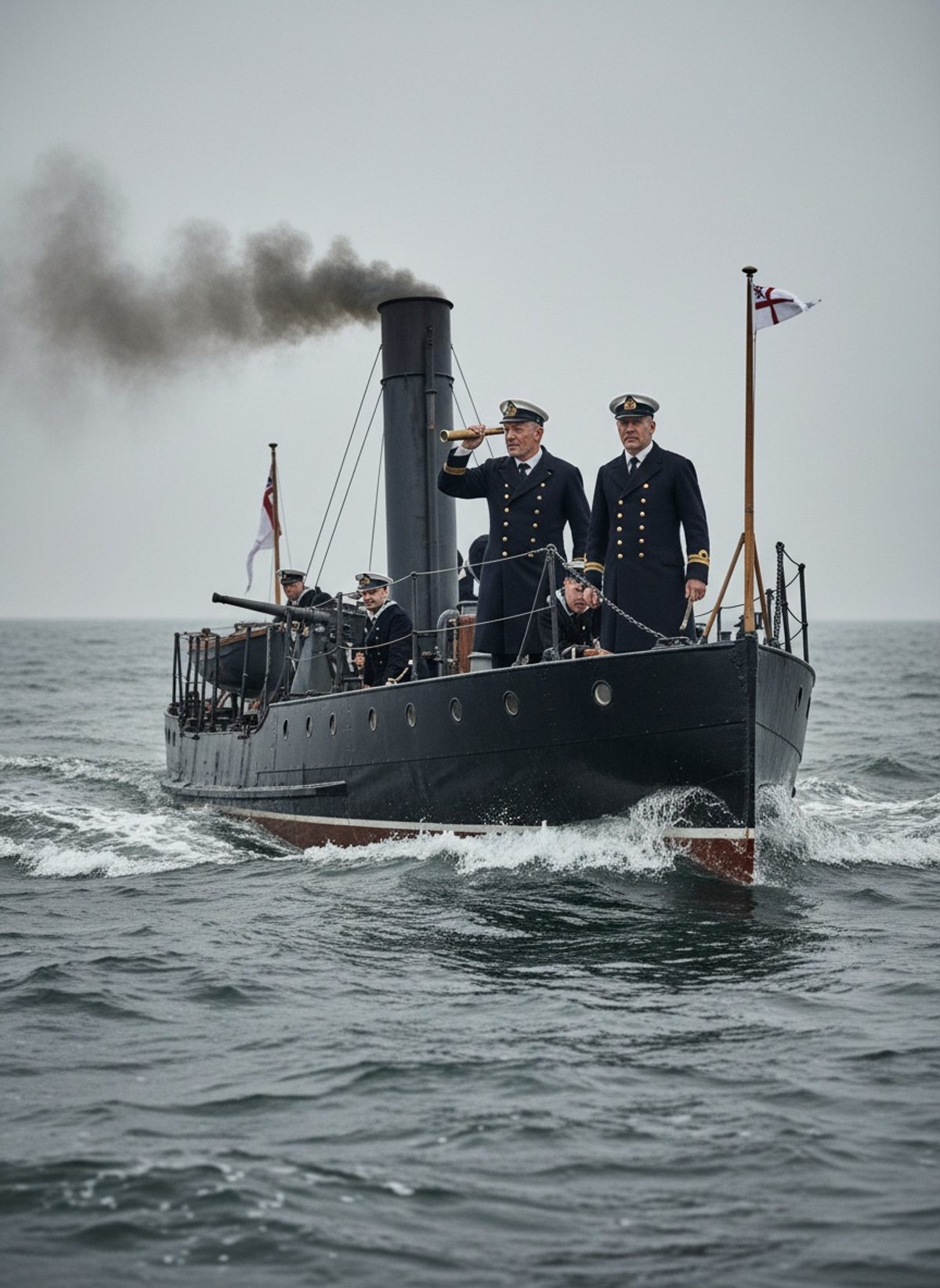
Designed to intercept and obliterate the menace of torpedo boats, the Archer class promised a swift, maneuverable solution. These vessels were slender, capable of cutting through the water at impressive speeds. The Royal Navy aimed to reclaim its dominion over the waves, ensuring that no ship, no matter how small, could escape its grasp. Yet, as these ships were laid down and construction began, the world around them continued to change at an astonishing pace.
Into the Industrial Maelstrom
As riveting tools and steel plates synchronized in a dance of creation, a significant transformation was overtaking naval warfare. By the time the first Archer class vessels slid down the slips into waiting waters, the torpedo boats they were meant to hunt had themselves evolved. Torpedo boat destroyers, soon known simply as destroyers, began to take center stage. Larger and more heavily armed, these new ships raised the stakes, shifting the paradigm of naval strategies.
Read next: When Broke Boarded the Chesapeake in Thirteen Minutes, 1813
The Royal Navy, ever-keen to maintain its superiority, realized that the Archer class ships, once envisioned as hunter-killers of torpedo boats, now faced obsolescence. As a testament to the relentless pace of technological advancement, these vessels had to be repurposed even before they were completed. Hence began the remarkable transformation of the Archer class, a shift that would redefine their purpose and ensure they served with distinction, despite their outdated beginnings.
The Reinvention: From Gunboat to Broadside Protector
The Archer class's journey of reinvention reflects a broader narrative of adaptability in maritime history. The Royal Navy, recognizing the shifts in warfare tactics, began to see a new role for these ships. They were repurposed, re-imagined not merely as solitary hunters, but as protections for larger fleets. Armed with more firepower than their intended targets, they now supplemented the existing fleets as gunboats with roles in reconnaissance, patrolling, and importantly, as convoy escorts.
This transformation required astute engineering and a rethinking of their design. The existing hulls were adapted, their internal workings recalibrated for new weaponry and engines. The Archer class was living proof that strategic innovation was not always found in new designs or cutting-edge technologies, but sometimes in the clever adaptation of existing resources. In this capacity, they more closely resembled their destroyer namesakes—light, fleet crafts meant less for front-line warfare and more for strategic envelopment and protection.
Under the Shadow of a New War
As the final vessel of the Archer class was commissioned, geopolitical tensions loomed ominously on the horizon. The Boer War was a nascent struggle simmering in the shadows of empire, eventually erupting into a conflict that would test the might and mobility of the British navy. The Archer class, by virtue of their redesign, entered this international theater not as marginalized relics but as relevant tactical entities.
Read next: When HMS Glamorgan Turned Away From an Exocet, 1982
Their missions during this period were as varied as they were vital. Archer class ships patrolled distant waters, enforced blockades, and ensured the movement and safety of crucial supply convoys. They proved particularly adept in coastal waters, where their original design's maneuverability still gave them a crucial edge. Though originally designed in response to a perceived threat that never fully materialized, these vessels found and fulfilled a need born from the evolution of maritime warfare.
The Legacy Beyond Their Time
By the turn of the century, newer, faster, and more heavily-armed ships began to leave yards around the world, and the Archer class quietly began to fade into history. However, their story remained embedded as an instructive tale of adaptability. They served a dual purpose: as a strategic acknowledgment of rapid technological change, and as unexpected successes borne from necessity. In adapting to new roles, the Archer class reminds us that history is shaped not only by foresight but also by the ability to pivot and evolve in the face of unforeseen challenges.
Though the names and roles of these historic vessels may have faded from mainstream memory, the lessons they embodied hold relevance today. In a world relentlessly driven by the winds of change, where new challenges continually emerge, it is the ability to adapt, to innovate, and to repurpose that often dictates success or failure. And in some dockyards today, maybe, just maybe, someone is retelling their tale, uncovering the unsung stories of those who navigated through uncharted waters, guided not by compass alone, but by the unyielding tide of human ingenuity.