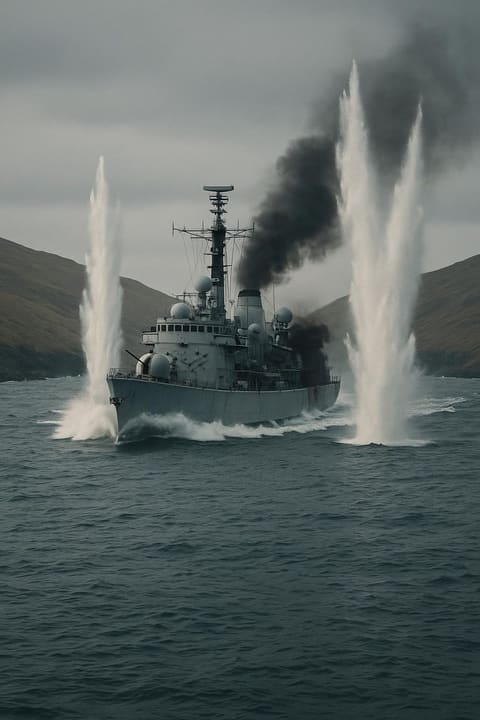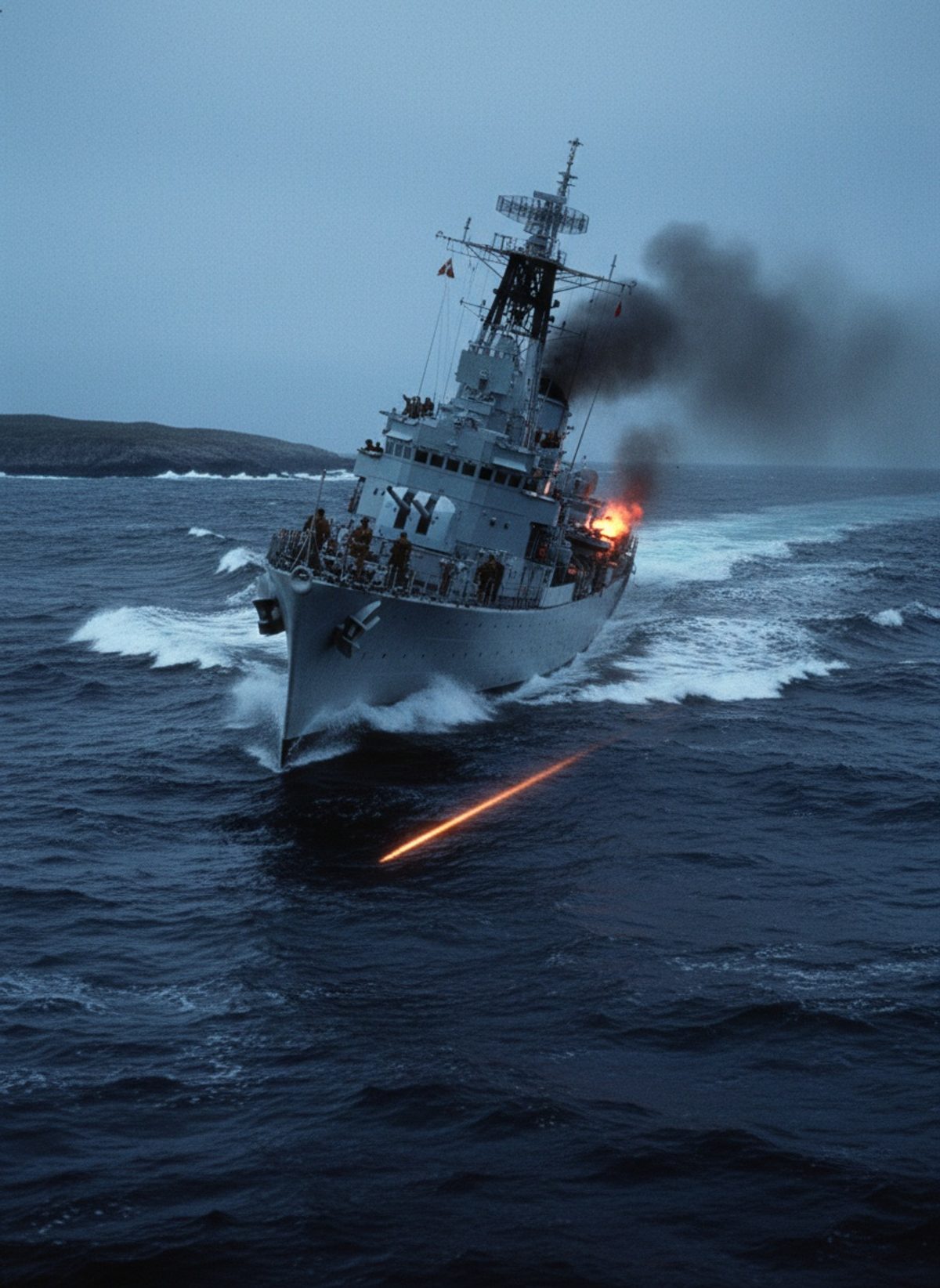
The South Atlantic Ocean on a cold June morning of 1982 bore the chill of an unyielding conflict. As the first light of dawn crept over the horizon, the sea around the Falkland Islands was eerily serene, masking the tension and turmoil brewing below its surface. Against the backdrop of gently undulating waves, HMS Glamorgan, a County-class destroyer of the Royal Navy, cut through the water with measured precision.
This serenity was deceptive, for in just moments, a confrontation would unfold, one not recorded in the grand annals of maritime conflict but as noteworthy. It was June 12, 1982, and HMS Glamorgan was about to encounter a life-and-death struggle with an Exocet missile—a weapon launched from the shore of an island embroiled in war.
A Night at Sea: On the Eve of Battle
The Falklands War had already demanded much from HMS Glamorgan. Arriving in May 1982, the destroyer had been engaged in a series of relentless assaults on Argentine positions, offering crucial support in the theater of war. Her twin 4.5-inch guns roared across day and night, becoming a reliable companion to allied ground forces. By early June, her services were required elsewhere, detached to protect essential shipping some two hundred miles from the islands.
However, the exigencies of war imposed sudden changes. On the evening of June 11, as twilight descended, HMS Glamorgan received fresh orders: return, and bring her might to bear in support of the Royal Marines at the Battle of Two Sisters. Little did her crew know the twists of fate awaiting at dawn.
The Improvise Edge: A Shore-Based Exocet
Innovation often wields the power to shift the tide in warfare, and it was such innovation that the Argentine forces adopted. At Puerto Belgrano, technicians had deftly removed two MM38 Exocet missiles from the destroyer ARA Seguí. These, along with their launchers and critical components, were transported by a C-130 Hercules to the Falkland Islands. On the rocky landscape, the Argentines clandestinely mounted the missile system onto a makeshift contraption. They affectionately dubbed this apparatus 'ITB'—a crude yet ingenious platform, epitomizing the necessity that spawns invention.
Read next: When Lewis Roteley Took Command at Twenty Years Old
As HMS Glamorgan charted her path 18 miles off the shore, barely aware of the watchful radar eyes tracking her, the Argentine team prepared. Fortunate in their position, their sharp improvisation was about to challenge the experienced might of the British naval forces.
Seconds to Impact: The Heart-Stopping Turn
The tension aboard HMS Glamorgan reached its zenith at precisely 06:37 on the morning of June 12. The incoming Exocet missile appeared as a blip upon the radar, a specter of fire and metal, intent on destruction. The ship surged forward at about twenty knots, unaware that decisions within the next few moments would determine her fate.
Upon the bridge and within the operations room, alarms rang—a cacophony of urgency. As minds raced and commands barked, the helmsman wrenched the destroyer into a sharp turn. This last-minute maneuver would tilt the scales, dictating whether the Glamorgan would pierce through the day or plummet into history.
The missile veered toward the ship's side, hitting with an ungainly angle, its initial objective thwarted. While it careened across the deck, detonating in proximity to the hangar, it resulted in catastrophic loss—yet also survival.
The Toll of Sacrifice: Fire and Ashes
The aftermath aboard HMS Glamorgan was a haunting theater of flame and destruction. A gaping hole scarred the hangar deck, and another, smaller but devastating, marred the galley below. Fire hungrily claimed entire spaces, including the fully fuelled and armed Wessex helicopter, transforming it into a sputtering inferno.
Yet bravery is rarely devoid of cost, and in those smoldering halls, fourteen souls paid the ultimate price. Thirteen sailors received their burial at sea that very evening—a stoic tradition amidst the churn of conflict. The valor of HMS Glamorgan's crew was further seared into memory as Able Seaman David McCann succumbed to his injuries two months later.
Despite injuries to over thirty crew members and the immense challenges post-strike, the ship tenaciously quelled the flames and, by 11:00, set back on course. As she sailed from the frontline of a war-torn archipelago, the embers of her recent ordeal cooled in the chill of the South Atlantic wind.
Read next: When Jim Prescott Tried to Defuse the Bomb Inside HMS Antelope, 1982
Memory Sails Beyond
Interestingly, HMS Glamorgan's story did not end amid the cold Southern waters. More extensive repairs in the tranquil alcove of San Carlos Water followed Argentina's surrender on June 14. With damage repaired and armed anew, she headed home, entering Portsmouth on July 10, 1982, closing a chapter marked by endurance and sacrifice.
After her service with the Royal Navy concluded in 1986, under Chilean dominion, she bore the name Almirante Latorre, extending her odyssey for another 12 years before she sank on April 11, 2005. But the ship's legacy traversed further than just physical remnants housed within naval trials; it expanded into the collective memory of sailors, the fraternity of shared battles, and those of countries once at odds, now interwoven by history.
The encounter on June 12, 1982—an impressive choreography of fate, fire, and fortitude—serves as a reflection not only of naval warfare's exigencies, shaping lives and seas, but also as a tangible reminder of the unseen beaches where courage resided, and of the countless human narratives punctuating the broader letters of empires.
Last month, British paratroopers rehearsed a landing on the islands she fought to free.
Part 17 of 24: One Falklands story a day until Remembrance Sunday