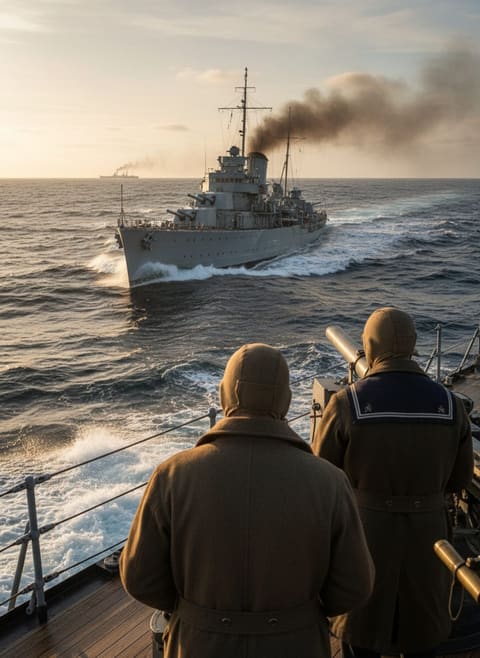
HMS Jervis Bay was a British liner converted into an armed merchant cruiser. On 5 November 1940 she was sunk in battle by the German heavy cruiser Admiral Scheer, in an action which earned her captain, Edward Fegen, the Victoria Cross.
The Unlikely Defender
The ship was launched in 1922 as the Commonwealth Line's Australian steamer Jervis Bay, named after the Australian bay of that name; the line named all its passenger liners after bays. She was one of five large liners in the immigrant trade between the United Kingdom and Australia. The Commonwealth Line struggled with high operating costs and frequent industrial action, and in 1928 its ships were sold to the White Star Line, which ran them as the Aberdeen and Commonwealth Line. Under new ownership TSS Jervis Bay used Southampton as her UK port instead of London, and in 1931 she was converted to a one-class ship carrying 270 tourist-class passengers. In August 1939, at the outbreak of the Second World War, she was requisitioned by the Royal Navy.
As an armed merchant cruiser she was given seven 6-inch guns of 1898 vintage and two 3-inch anti-aircraft guns of 1894 design. The 6-inch guns sat in single centre-pivot mountings with open-backed shields, which at best protected against blast and splinters, and only four of them could fire on a broadside. She was first placed under the Commander-in-Chief, South Atlantic, and on 13 October 1939, at Rosyth, she rammed the old destroyer HMS Sabre, which was under repair for over six months. In May 1940 Jervis Bay became a convoy escort based at the Royal Naval Dockyard, Bermuda. She was refitted for war service at Saint John, New Brunswick, in the summer of 1940, and after brief repairs at Halifax, Nova Scotia, she became the sole escort for Convoy HX 84, nearly forty merchant ships, bound for Britain.
Her captain was Edward Fegen. Vice Admiral Charles Kennedy-Purvis, under whose command she served, said in 1941 that she was manned by a crew mostly Royal Naval Reserve and Mercantile Marine, and that the only Royal Naval officer aboard was Captain Fegen himself. Jervis Bay escorted a convoy from Bermuda which merged at sea with a convoy from Halifax. Convoys formed at Bermuda, coded BHX, joined those formed at Halifax, coded HX, because it was easier to protect one large convoy than two smaller ones: larger convoys suffered fewer losses than smaller ones because of their relatively smaller defensive perimeter.
Read next: The Day a Merchant Ship Sailed Into a Pocket Battleship
The Crucible of Choice
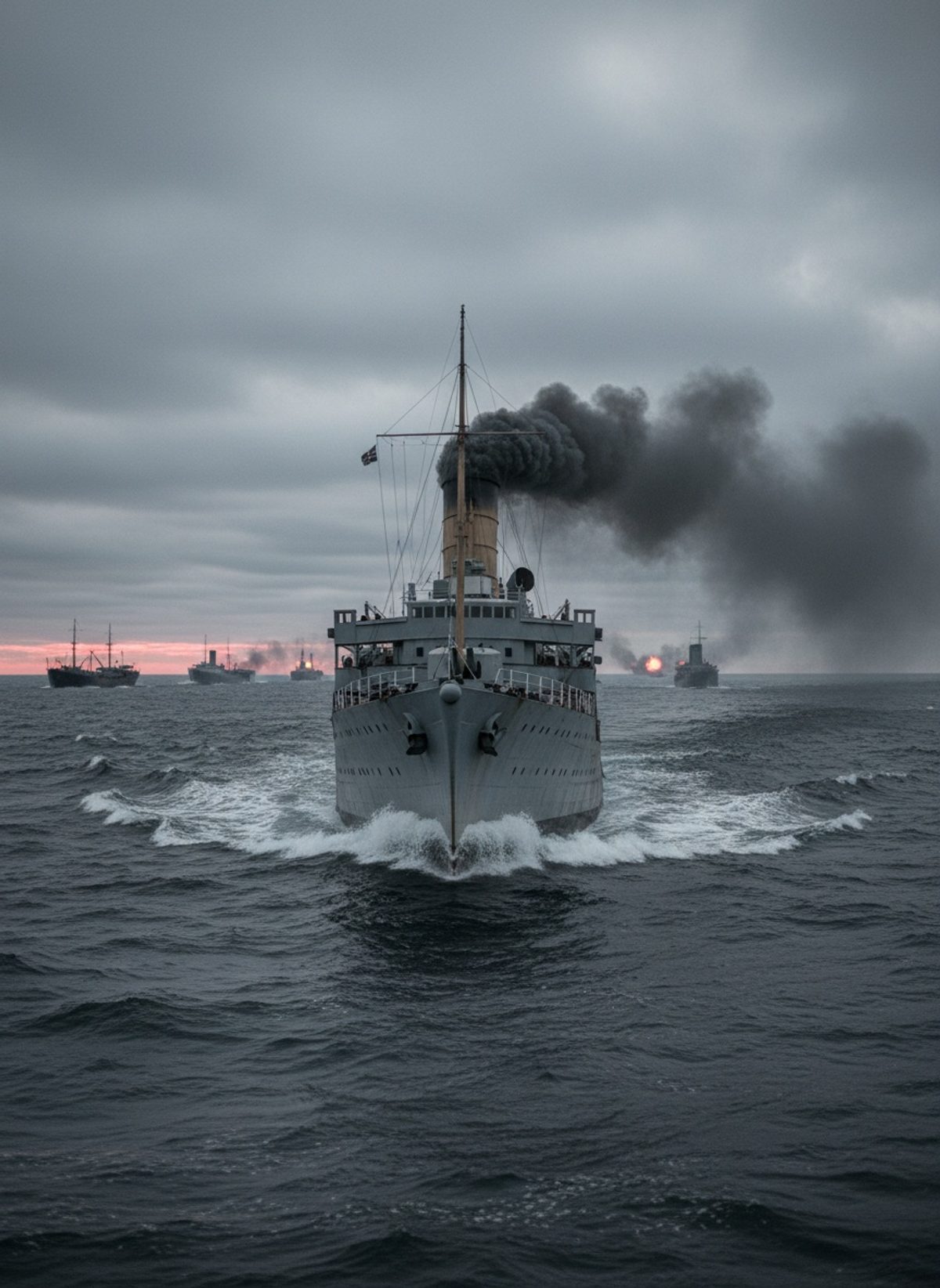
On 5 November 1940, towards evening, Jervis Bay was steaming in the centre of the front line of the convoy, whose ships were disposed in columns of four. About 755 nautical miles south-southwest of Reykjavík, the port wing ship sighted smoke on the port bow, and very soon afterwards the foretop of a warship. It soon became plain that the ship was German: the heavy cruiser Admiral Scheer, one of the so-called "pocket battleships". Jervis Bay was hopelessly outgunned and outranged by the German ship's 28 cm (11-inch) guns.
Fegen had told the commandant of the convoy that, if the ship proved to be an enemy, he was to turn the convoy to starboard and scatter, while Jervis Bay went out to port to engage. Jervis Bay steamed out ahead and turned to port, setting a course towards the German warship to draw its fire. The convoy turned to starboard, dropping smoke floats, and soon afterwards scattered. Kennedy-Purvis called it "a tremendous decision to take when you are faced with overwhelming odds", but said that in Fegen's case "there were no second thoughts".
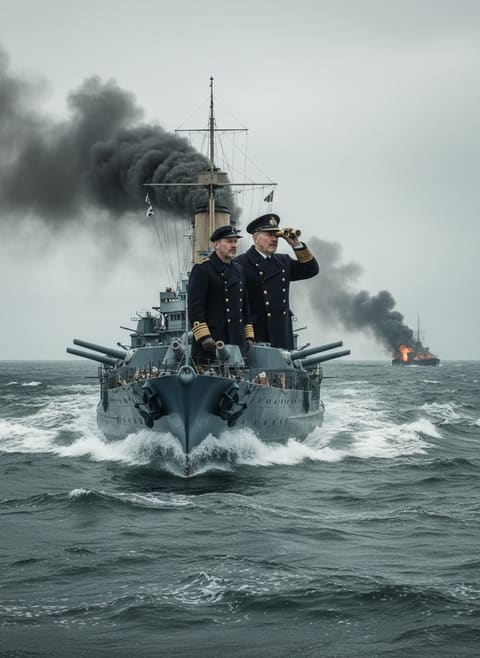
The German ship's 11-inch guns were soon firing on Jervis Bay. She was heavily straddled and hit, and caught fire. As soon as he was within range, Fegen opened fire, and he kept his 6-inch guns firing until the last, more to distract the German ship from the merchantmen than with any hope of doing damage. Fegen was wounded and many of the crew were killed, but Fegen and the surviving crew fought on until their ship was sunk. In the words of his Victoria Cross citation: "Crippled, in flames, unable to reply, for nearly an hour the Jervis Bay held the German's fire."
Echoes on the Sea
The ship became a blazing wreck and went to the bottom, and Captain Fegen and many of the crew went down with her. Her sacrifice bought enough time for the convoy to begin to scatter. Some sources say the freighter SS Beaverford bought further time by engaging Admiral Scheer for over four hours, but the account published after the war by the captain of Admiral Scheer, and the timings of the sinking, show that there was no such engagement. Beaverford fled with the other ships and was sunk during the night. In the end Admiral Scheer was able to sink only five merchant ships, and the remainder of the convoy escaped.
Read next: When HMS Glowworm Rammed the Admiral Hipper, 1940
Sixty-eight survivors of Jervis Bay's crew of 254 were picked up by the neutral Swedish ship Stureholm, and three of them later died of their wounds. One of the survivors, Guy Byam, was later killed while covering an air raid over Germany for the BBC.
Fegen was awarded a posthumous Victoria Cross. His citation praised his "valour in challenging hopeless odds and giving his life to save the many ships it was his duty to protect", and it ended: "So she went down: but of the Merchantmen all but four or five were saved." There is a monument at Albouy's Point in Hamilton, Bermuda, from where Jervis Bay had departed on her final mission; it was unveiled on 5 November 1941. There is a monument to Fegen and the crew at Ross Memorial Park in Saint John, and in early 1941 the city of Owen Sound, Ontario, dedicated the HMS Jervis Bay Park as a memorial to the ship and to Stoker A.M. "Jimmy" Johnson, a resident of the city who was a casualty of the sinking. The ship was crewed extensively from Caithness, and in 2006 the town of Wick erected a plaque to the Caithness members who died in the sinking.
In London, the main room of the Merchant Navy Hotel was known as the "Jervis Bay Room" and included a display detailing the action; it was the custom for everyone entering the room to salute the display. The Australian poet Michael Thwaites wrote a ballad about Jervis Bay in 1941, while he was serving as a naval officer in the Atlantic, and her final action was portrayed in the 1943 film San Demetrio London, which told of the heavy damage and survival of MV San Demetrio, one of the vessels of Convoy HX 84.
Part 5 of 24: One Second World War story a day, 16 November to 9 December