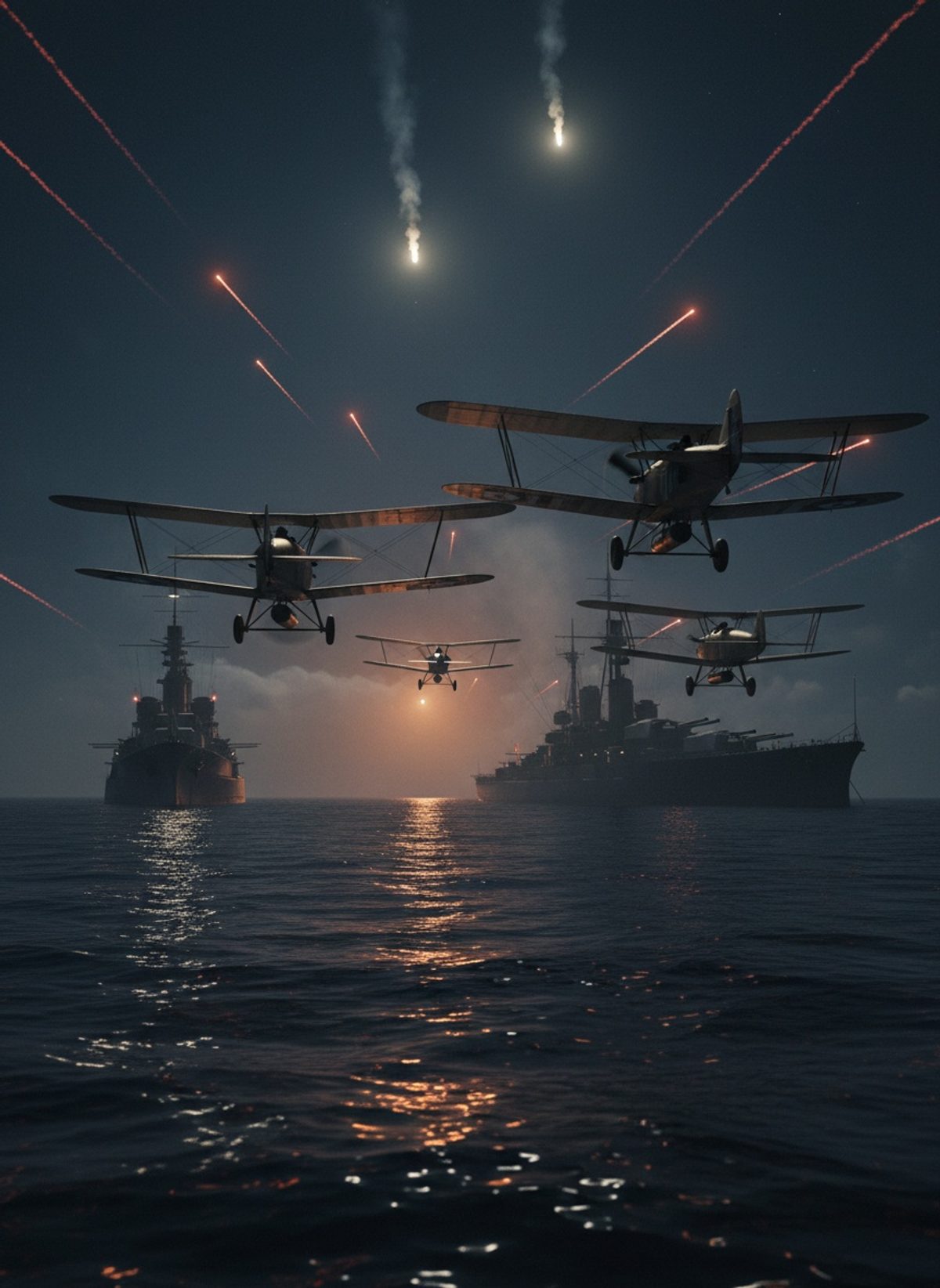
On the night of 11/12 November 1940, the Royal Navy launched the first all-aircraft ship-to-ship naval attack. Twenty-one Fairey Swordfish biplane torpedo-bombers from the aircraft carrier HMS Illustrious struck the battle fleet of the Regia Marina, the Italian navy, at anchor in the harbour of Taranto, using aerial torpedoes despite the shallowness of the water. The operation, Operation Judgement, pitted British naval forces under Admiral Andrew Cunningham against Italian naval forces under Admiral Inigo Campioni.
The Threat from Taranto
Since long before the First World War, the Regia Marina's First Squadron had been based at Taranto, a port city on the Italian south-east coast. In the inter-war period the Royal Navy made plans to counter the Italian navy if there was a war in the Mediterranean, and plans for capturing the port were considered during the Italian invasion of Abyssinia in 1935. After Italy entered the war in 1940, the threat from the Regia Marina and the Italian air force made it very difficult for British convoys to cross the Mediterranean from Gibraltar via Malta to Egypt, and British ships were routed around the Cape of Good Hope and through the Suez Canal to reach Alexandria. The Italian fleet at Taranto was powerful: six battleships (though Andrea Doria's crew was still in training after her reconstruction), seven heavy cruisers, two light cruisers and eight destroyers. Following the concept of a fleet in being, the Italians usually kept their warships in harbour, but the threat of a sortie against British shipping was a serious problem.
The idea went back to the Munich Crisis of 1938, when Admiral Sir Dudley Pound, commanding the Mediterranean Fleet, ordered his staff to re-examine plans for attacking Taranto. Lumley Lyster, captain of the carrier HMS Glorious, advised him that his Swordfish torpedo bombers were capable of a night attack, and Pound ordered training to begin. Security was so tight that there were no written records. A month before the war began, Pound advised his replacement, Admiral Andrew Cunningham, to consider the possibility, which came to be known as Operation Judgement. The attack was originally scheduled for 21 October 1940, Trafalgar Day, with Swordfish from both HMS Illustrious and HMS Eagle. A fire in an auxiliary fuel tank destroyed two Swordfish and caused a delay, and Eagle was removed from the operation after a breakdown in her aviation fuel system on 4 November. Illustrious took on board five of Eagle's Swordfish and launched the strike alone. The force was commanded by Lyster, now a Rear-Admiral, who had written the plan for the attack.
The Attack
At 20:00 on 11 November, Illustrious and her escorts, detached from Cunningham's force, were 170 miles from Taranto. The normal range of the Swordfish was not enough to reach Taranto without bringing the carrier close to Italy, so they were fitted with extra fuel tanks. Half of them carried torpedoes and the other half bombs and parachute flares. Taranto harbour was only about 39 feet deep, so a drum was attached beneath the nose of each torpedo aircraft, with a wire to the nose of the torpedo; as the torpedo dropped, the wire pulled its nose up, producing a belly-flop rather than a nose dive. The loss rate for the bombers was expected to be fifty per cent. The first wave of 12 aircraft, led by Lieutenant Commander Kenneth "Hooch" Williamson of 815 Naval Air Squadron, took off from 20:30. About an hour later a second wave of nine followed. One of them had been damaged on the flight deck and followed on separately, unknown to the rest, and another turned back when its auxiliary fuel tank fell away, so only eight of the second wave reached the target.
Read next: When HMS Inflexible Stopped at Gibraltar and Changed the War
Taranto was defended by 101 anti-aircraft guns and 193 machine-guns. It was usually protected against low-flying aircraft by large numbers of barrage balloons, but strong winds on 6 November had blown away 60 of them and only 27 were up on 11 November. Only a third of the anti-torpedo netting the capital ships needed had been rigged, because of a scheduled gunnery exercise, and the nets did not reach the bottom of the harbour, allowing the British torpedoes to clear them by about two feet. The six battleships and three heavy cruisers lay in the outer harbour, Mar Grande, with more cruisers and destroyers in the inner harbour, Mar Piccolo. Alerted by listening posts, the Italian defences began a barrage before the aircraft arrived. The main group of the first wave reached Mar Grande at about 11 p.m. One aircraft dropped 16 parachute flares east of the harbour, adding to the moonlight. Three torpedo aircraft led by Williamson flew over San Pietro Island and struck the battleship Conte di Cavour with a torpedo, which blew a 27-foot hole in her side below the waterline. Anti-aircraft guns on the ship immediately shot down Williamson's aircraft, which was only feet above the water.
The two other aircraft in Williamson's sub-flight dodged barrage balloons and pressed home their attack on the battleship Andrea Doria through massed anti-aircraft fire, but missed. The next sub-flight of three attacked from further north, hitting the battleship Littorio with two torpedoes; a third torpedo, aimed at the flagship Vittorio Veneto, missed. Bombers led by Captain O. Patch of the Royal Marines found their targets hard to identify, but hit two cruisers moored in Mar Piccolo with a bomb each. The second wave, led by Lieutenant Commander J. D. Hale of 819 Naval Air Squadron, approached from the north and dropped its flares shortly before midnight. One more torpedo hit Littorio, and another struck the battleship Duilio, blowing a large hole in her hull and flooding both of her forward magazines. One aircraft, despite having been hit twice by anti-aircraft fire, aimed a torpedo at Vittorio Veneto but missed. The last aircraft to arrive, 15 minutes behind the others, made an unsuccessful dive-bombing attack on a cruiser and landed safely back on Illustrious at 2:39 a.m.
The Aftermath of a Night Assault
Two Swordfish were shot down. Williamson and his observer, Lieutenant N. J. 'Blood' Scarlett, were taken prisoner. The second, flown by Lieutenant G. Bayley, was shot down by fire from the heavy cruiser Gorizia after the attack on Littorio, and Bayley and his observer, Lieutenant H. Slaughter, were killed. The Italian fleet lost half of its capital ships in one night: three battleships were damaged. Conte di Cavour's keel touched the bottom, leaving only her superstructure and main armament above water, and 27 of her crew were killed. She was raised but never returned to full service. Littorio, hit by three torpedoes, had 32 crewmen killed and was saved by being run aground, as was Duilio. The next day the Regia Marina moved its undamaged ships from Taranto to Naples. Repairs to Littorio took about four months and to Duilio seven.
The balance of power swung to the Mediterranean Fleet, which could now split into two battle groups, each of one aircraft carrier and two battleships. Cunningham expected the Italians to be unwilling to risk their remaining heavy ships, but he was quickly proved wrong: five days after Taranto, Campioni sortied with two battleships, six cruisers and 14 destroyers, leading to the indecisive Battle of Cape Spartivento on 27 November 1940. Measured against the aim of disrupting Axis convoys to Africa, the attack had very little effect, and Italian shipping to Libya increased between October 1940 and January 1941. Caravaggio argued that, while a tactical success for the British, Taranto was a missed opportunity.
Read next: Tōgō Had One Fleet. He Bet Everything on One Turn.
Beyond Taranto
The success of the attack augured the ascendancy of naval aviation over big-gun battleships. As a consequence of the raid, many harbours that had been considered too shallow for air-dropped torpedoes were now vulnerable; most navies had thought such attacks needed water at least 75 feet deep. The Imperial Japanese Navy staff studied the Taranto raid while planning the attack on Pearl Harbor, which was also a shallow harbour. Lieutenant Commander Takeshi Naito, the assistant naval attaché to Berlin, flew to Taranto to investigate the attack, and a group of Japanese naval officers visited Taranto in May 1941. Pearl Harbor was a considerably larger operation, in which all six Japanese fleet carriers took part. In Germany, according to Gooch, "Taranto convinced the German navy that any possibility the Italians might achieve mastery of the Mediterranean had disappeared".
Cunningham and Lyster were set on striking Taranto again the next night, but there was not general agreement. One wag in the pilots' room remarked, "They only asked the Light Brigade to do it once!" In the end, bad weather prevented a repeat of the attack. Denis Boyd, the captain of Illustrious, wrote later: "It is notable that the enemy did not use the searchlights at all during either of the attacks". Williamson and Hale were awarded the DSO, their observers the DSC, and Patch and his observer Goodwin the DSC. Lyster was made CB in the New Year Honours, with the CBE for the captains of Illustrious and Eagle.
Cunningham summed up the night: "Taranto, and the night of 11/12 November 1940, should be remembered forever as having shown once and for all that in the Fleet Air Arm the Navy has its most devastating weapon."
Part 6 of 24: One Second World War story a day, 16 November to 9 December