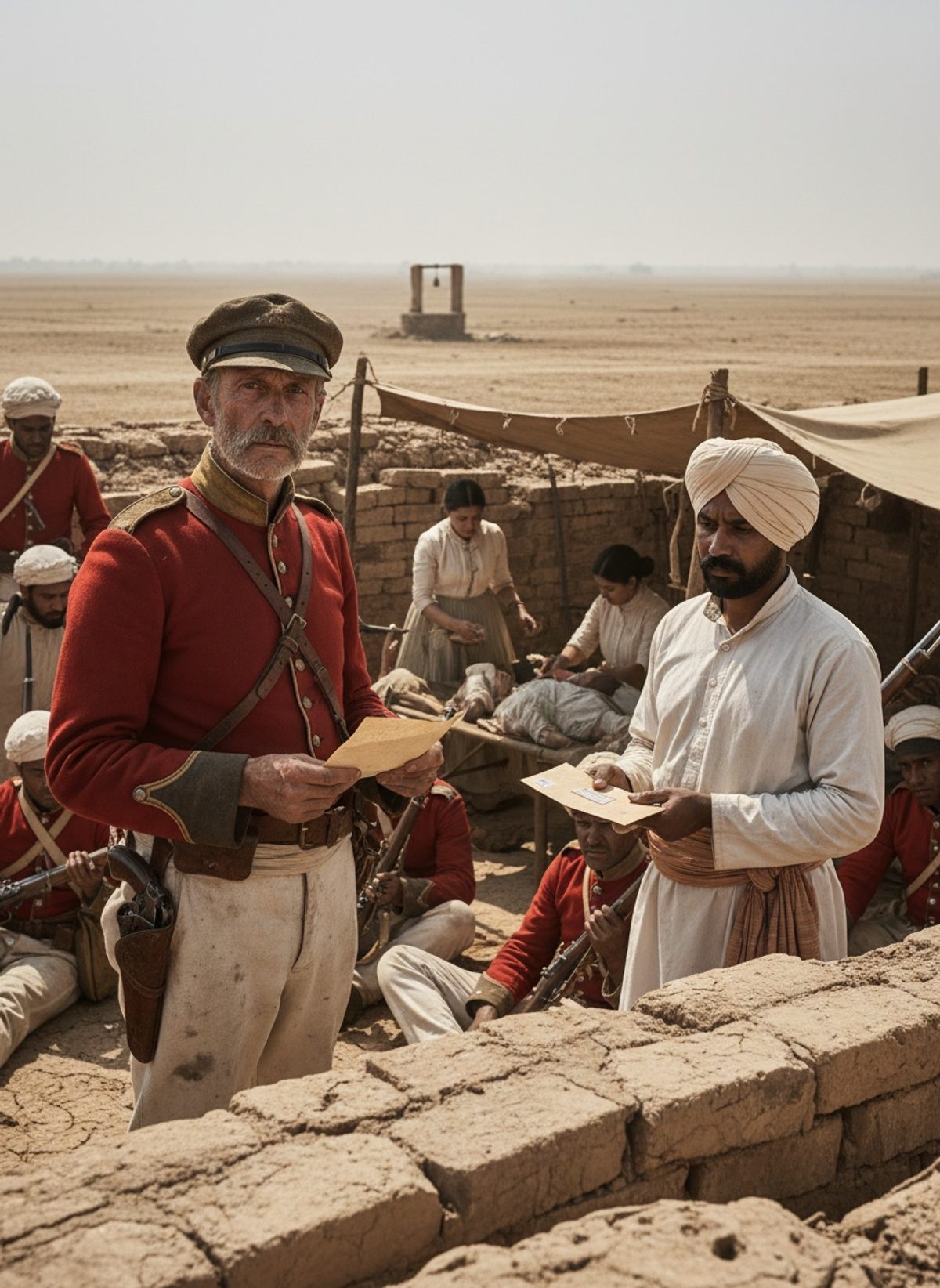
As the harsh June sun climbed the sky over Cawnpore, the air shimmered with oppressive heat. Dust settled heavily across the barren landscape, its stillness occasionally disrupted by the distant rumble of cannon fire. Inside General Hugh Wheeler's makeshift fortifications, the garrison clung desperately to the dwindling illusions of relief. In this crucible of despair, any sign of reprieve was a thin thread of hope. Yet, encircled by the clamorous Indian rebellion, this hope was mirrored only in the skeletal structures where the defenders took their last stand. This was the stage when Nana Sahib's messenger entered Cawnpore, a harbinger of both potential salvation and impending doom.
The Mirage of Salvation
For weeks, General Wheeler and his men had been sequestered within the confines of their entrenchments. The formidable heat of the Indian summer was not their only adversary; they faced the relentless onslaught of a siege that seemed designed to break the very spirit of its defenders. With resources exhausted and morale waning, the garrison clung tenaciously to tales of British supremacy that seemed ever distanced by circumstance and dust. The day the messenger arrived from Nana Sahib, it wasn't just words he carried—it was the promise of respite.
Nana Sahib's offer was simple: safe passage to the Ganges, a chance for Wheeler's beleaguered forces to escape the penumbra of death that loomed over them. It was an offer dripping with irony. For engaging in rebellion against the East India Company, Nana Sahib, a man with princely ambitions and personal grievances, exemplified the chasm between imperial trust and local reality. Yet, there came a point when Wheeler had to weigh mere survival against the shred of trust in an enemy's word. The Cawnpore garrison had been driven by desperation, a mount of haphazard defenses and hollowed weapons. Every man within those worn barricades confronted the dilemma that no history book could prepare them for—the betrayal of hope.
General Wheeler's hesitance was palpable; he understood that in the theater of war, cordiality was all too often prelude to treachery. Perhaps it was the wan eyes of hunger-stricken children, or the frail shadows cast by his troops that ultimately nudged him towards making an impossible choice. To gamble was to court risk; to delay was to embrace the certainty of obliteration. The messenger's arrival, intricate and enigmatic, offered no easy deliverance, only a stark reflection of the path to come.
Read next: When Nain Singh Counted His Steps Across Tibet, 1865
The Cost of Trust
In the waning days of June 1857, beneath a sun that seemed to scorn the weakness of man, General Wheeler made up his mind. It was a decision wrapped in the guise of necessity rather than belief—a conjecture rather than conviction. The promise of Nana Sahib's safe passage rallied in whispers among the weary soldiers and civilians alike. History holds few trials as profound as this moment: a frail fraternity of the besieged, hung on the scaffold of an uncertain truce. Wheeler was bound to ask, with silent anguish, if he made the right choice.
The fraught procession set forth towards the river, a tableau of hope beneath the scalding light of high noon. Led by both weary souls and resilient spirits, the men and women exited the entrenchment one after another. Yet, as wheels of fate turn, they often take not the smooth path, wrenching unexpectedly towards the jagged. Within the relief of the air seemed to lurk a predatory pause; sightlines imprinted with nature's calm façade, which promised tranquility but whispered peril.
Camouflaged among the anticipation of salvation was the specter of betrayal. With assault unfamiliar to some and betrayal familiar to many, the convoy neared the riverbank—a hazy ribbon of liberation in sight, only to be engulfed by the most visceral form of perfidy. In breaking trust with Wheeler and his beleaguered garrison, Nana Sahib transformed a potential passage into the annals of infamy. The massacre that followed remains an indelible mark, scarifying the narratives of empire with unflinching brutality.
The Fabric of Endurance
In retrospection, the haunting question emerges: did Wheeler have any choice at all? Some say the ghosts of Cawnpore linger as eternal arbiters of this inquiry, pointing out the stark divide between human expectation and the unpredictable swivels of circumstance. The alleged treaty served as illusion—a delicate veil over the abyss of distrust and repercussion. Underneath the consequences of his decision lies the broader narrative of imperial tension stretched to the breaking point, and the individual brief moments that ultimately orchestrate the symphonies of history.
Beyond the harrowing massacre by the river that ensnared Wheeler's last stand, lies an echo that resonates with our modern sensibilities—of the importance of discernment and the precarious scales where trust is measured against survival. If history is the observable outcome through the tinted lens of hindsight, then it is in these moments of ambiguity that we find lessons as eternal as they are enigmatic. In the charged atmosphere of 1857 Cawnpore, choices were crystallized—with ironclad ramifications that both shaped and shattered identities.
Ultimately, Cawnpore was more than a mere record of colonial confrontations; it captured the heart's perennial struggle against fate's arbitrariness. Nana Sahib's emissary served not just as a messenger, but also as a reminder that within the theater of human affairs, perceptive lessons often hide amidst fallible truths. Through the prism of intensity, history delivered a tableau blanketed with dust and defiance—Cawnpore remains etched within the complex tapestry of stories they left out of textbooks, whispering enigmas of the past into the pages of today.