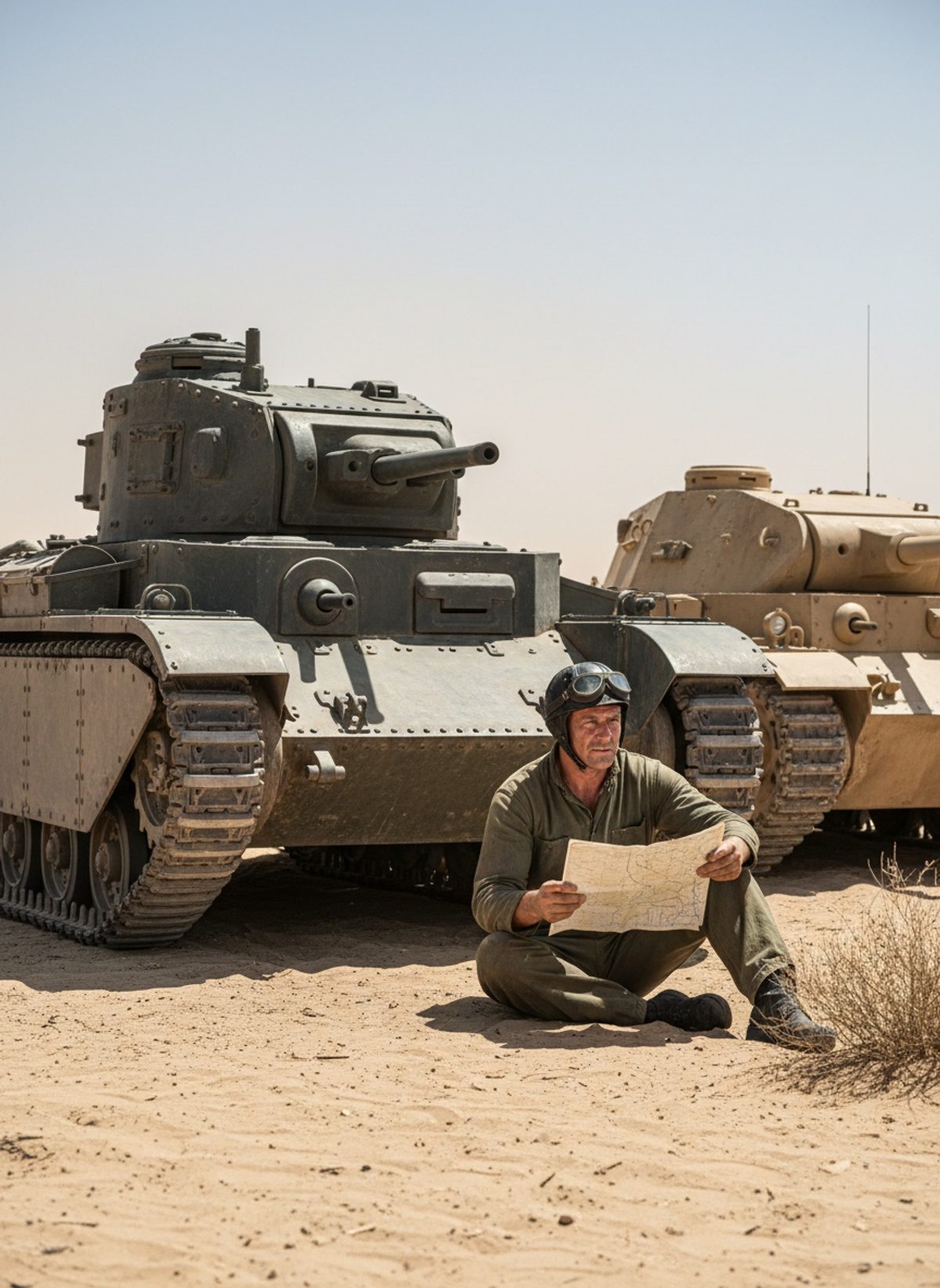
June 5, 1940. The desert sun bore down with unrelenting ferocity.
The Western Desert Campaign was in full swing, a theatre where the shifting sands hosted the clash of empires. Among these sands, the Matilda II and Panzer III tanks faced off, each embodying their nation's strategic doctrines. On the side of the British, the Matilda II lumbered into battle, a steel behemoth whose thick hide rendered it nearly impervious to enemy fire.
Her adversary, the German Panzer III, skittered like a desert lizard, swift and cunning, seeking every opportunity to outmaneuver and outlast its foe. This confrontation was not merely of metal against metal but of tactical philosophies tested in the crucible of war.
The Ironclad Lady: Matilda II's Armored Might
The Matilda II was designed with a clear purpose: to provide unbeatable defense on the battlefield. It was purpose-built for survivability, boasting an armor thickness that left its German counterparts in the dust of sandy frustrations. Its features included the seemingly magical ability to shrug off 37mm shells, each bounce a death sentence denied.
Read next: When Little Willie Crawled Out of a Lincoln Workshop, 1915
However, the Matilda’s robustness came at a cost. While her armor was her triumph, her speed was decidedly her Achilles' heel. With a maximum speed comparable to a brisk jog, working up to 15 miles per hour on smooth terrain, it moved no faster than an armored tortoise. In the sprawling expanses of the North African deserts, this meant that the Matilda II was often left behind by its faster counterparts and, sometimes, the shifting tides of battle.
The British crews, ensconced within these steel fortresses, were emboldened by their seeming invulnerability. The Matilda II's 2-pounder gun, while effective against many targets, was less versatile against hardened fortifications or swiftly maneuvering enemies. Victory often demanded patience, as these crews endured sweltering heat, confined existence, and the occasional slow-moving hunt. Yet, the reputation of the Matilda II was such that it compelled enemies to rethink their strategies, seeking ways to counter its armored supremacy.
Nimble Fury: The Panzer III's Tactical Edge
The Panzer III, in stark contrast, was the epitome of German engineering efficiency—swift, adaptable, and deadly under the right conditions. Unlike the heavily armored Matilda, the Panzer III was not designed to dominate in defensive might but rather to excel in speed and firepower. This tank wielded a main armament capable of delivering precise strikes, its design embodying the ethos of Blitzkrieg—quick, ferocious, and decisive.
The Panzer III's agility enabled it to exploit the terrain, darting in and out of engagements, harassing enemy lines, and executing flanking maneuvers with uncanny skill. Its crews capitalized on this agility, turning the desert’s seemingly boundless expanse into an advantage.
However, when confronted with the impregnability of the Matilda II frontally, the Panzer III found itself in a vexing position. Its early 37mm gun lacked the punch necessary to breach the Matilda's defenses, necessitating innovation and adaptation from the German Wehrmacht.
Thus, the German expedient solution emerged: the conversion of the formidable 88mm Flak gun into an anti-tank role. Originally intended as an anti-aircraft artillery piece, the 88mm could pierce the stout defenses of the Matilda from considerable range. By skillfully combining the Panzer III's mobility with the overwhelming might of the 88mm, German forces crafted a counterbalance to the British armor-girded assault.
Read next: When The Last Post Echoed Over Spion Kop, 1900
Doctrines of Victory: Clash and Consequence
This matchup between the Matilda II and the Panzer III was more than steel confronting steel; it was the testing ground for each nation's wartime doctrine. The British believed in the power of impenetrable defense, crafting tanks that could hold the ground stubbornly against any adversary, yet requiring coordinated efforts with infantry and artillery to achieve breakthroughs.
Conversely, the German forces, nimble in thought as in action, saw war as a cavalcade of dynamic engagements, where speed and decisive action could render defense moot. This ideological clash brought innovations that would later redefine armored warfare. The very terrain toughened the tank crews, who learned to navigate sandstorms, scorching temperatures, and deceptively cold nights, testing their endurance as much as their skill.
The North African campaign became a proving ground for strategies that would later impact the broader theaters of war. It was a place where the limits of machines and men alike were pushed, daring each side to adapt and overcome endlessly evolving challenges. The lessons learned here on the dunes would ripple outwards, influencing tank design and tactics across the Allied and Axis powers.
So, pondering the choice between the Matilda II and the Panzer III is not simply about comparing machines. It's about understanding the broader tapestry of World War II, where these steel titans fit within grand strategies and battlefield necessities. The legacy they leave is akin to the desert sands—shaped by winds of chance, bearing the imprint of every footstep, each engagement a story buried and uncovered anew.