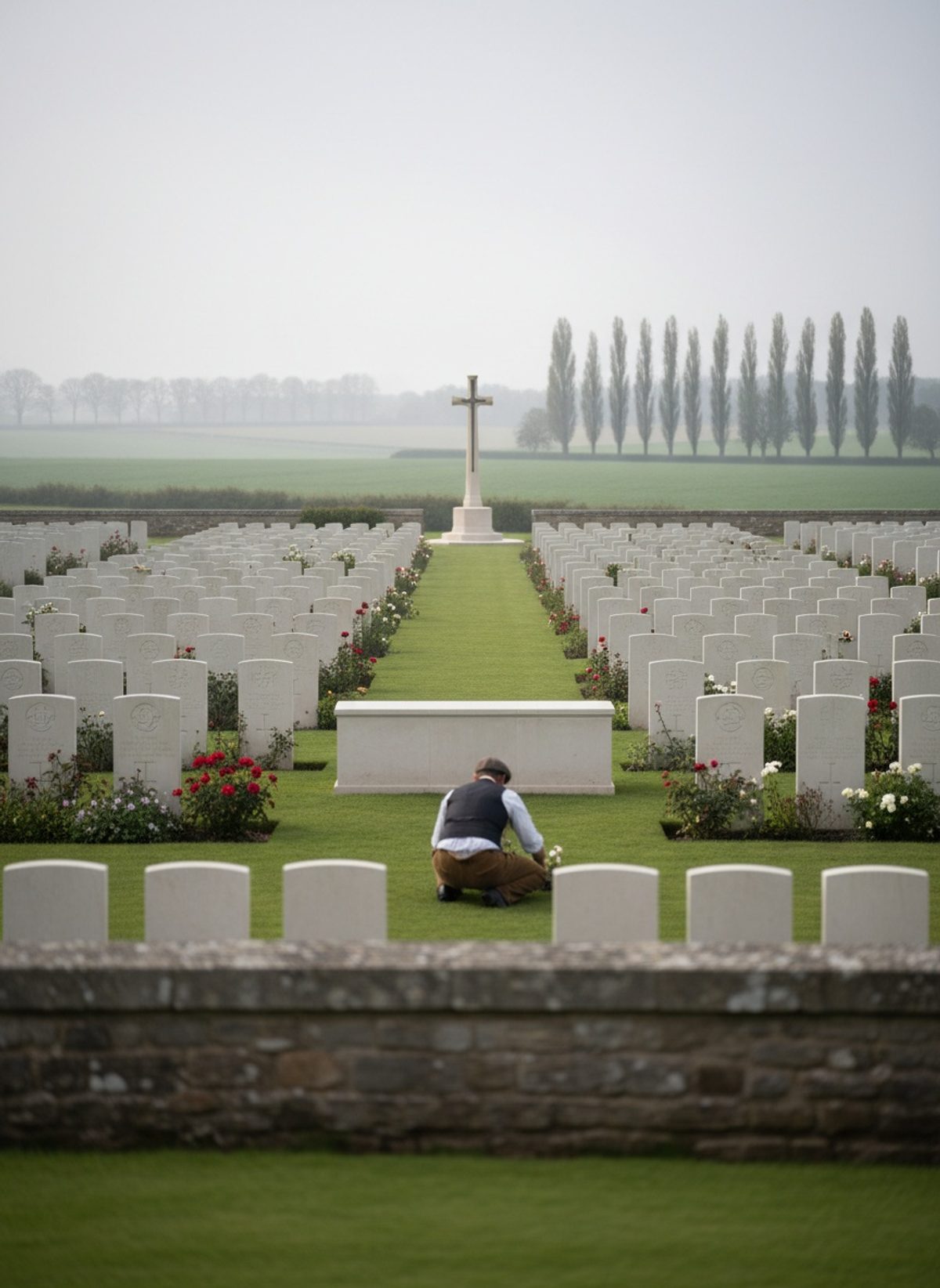
The chalky earth of Northern France was silent, save for the whispering of the wind through neatly planted rows of hedges. The afternoon light, soft and somber, cast long shadows over the rows of uniform headstones, each identical in shape and size, their pale stones glistening in the sunlight. Beneath lay the bones of men who had once fought and fallen in fields not dissimilar from these. Here, beneath the skies that bore witness to their courage, lies the legacy of an empire’s solemn promise: no soldier, whether a general or a humble private, shall lie forgotten, regardless of rank or race. This was the promise of the Imperial War Graves Commission, born amidst the ravages of the First World War on May 21, 1917.
Foundations in the Fog of War
To grasp the magnitude of this promise is to step back to the early months of the Great War, where amidst the grim haze of battle, one man's vision began to take shape. Fabian Ware, a 45-year-old too elderly for active service, obtained command of a British Red Cross mobile ambulance unit in France, with the help of Lord Milner. Ware, witnessing first-hand the harrowing disarray of unmarked graves and unanswered losses, felt a profound call to action. With a mixture of compassion and resolve, he began to meticulously log the places where soldiers fell, catalyzing a movement that would honor each sacrifice with dignity and precision.
In March 1915 his work was given official recognition by the War Office, and his unit was transferred to the British Army as the Graves Registration Commission. By October 1915 it had registered more than 31,000 graves. With unwavering determination, Ware pushed for a concept radical at its heart—a simple yet unwavering equitable commemoration for all ranks. The headstones, unadorned by status but etched with soldiers' names, unit, and often a poignant inscription, became the great equalizers of death, defying the class stratifications so steeped in the society that had sent these men to war.
This egalitarian vision gained royal endorsement on May 21, 1917, as the Imperial War Graves Commission came into formal existence, championing the principle that each individual soldier’s memory would be preserved steadfastly and uniformly. As the war trudged on, marked by unparalleled carnage, the commission’s mandate grew in importance, offering solace and certainty to families torn apart by loss and distance. Even the renowned writer Rudyard Kipling contributed to this grand narrative, finding solace for his own anguish—the loss of his son John at the Battle of Loos—by giving voice to the nameless. His proposed epitaph, "Known unto God," would mark those headstones where identities eluded discovery, an acknowledgment of the depth of sacrifice made for king and country.
Read next: When Sergeant Ian McKay Charged the Guns on Mount Longdon, 1982
Crafting the Covenant of Rememberance
The guardianship of memory was no small feat, stretching across the globe and into the aftermath of turmoil. By Armistice in 1918, millions lay dead. Decisions had to be made with an eye not only toward practicality but profound duty. Not a single body would return home; instead, men would be honored perpetually at the site of their sacrifice. This decision, though controversial, held firm. Sir Fabian Ware and his team saw these cemeteries emerge not simply as plots of land but as solemn, sacred spaces of pilgrimage and reflection.
The commission, committed to architectural beauty, appointed three eminent architects, Sir Edwin Lutyens, Sir Herbert Baker and Sir Reginald Blomfield, to design the cemeteries and memorials that embodied both gravity and grace. Their vision ensured that the resting places were landscaped with precision and respect, adhering to the highest standards of care. These places became etched with the seal of permanence, quiet gardens resonant with the echoes of valor, duty, and despair.
Construction of approximately 2,500 meticulously arranged cemeteries followed, where the dead were laid at Commonwealth war grounds scattered across 153 nations. Each name was entered into a massive register, honoring over 1.7 million Commonwealth servicemen who perished in World War I and later World War II. Herein lay a promise converted into a physical testament of remembrance and reconciliation, crossing boundaries and traversing oceans.
This immense dedication brought foresight into tangible form, enabling families worldwide to glean some measure of solace from the knowledge their loved ones lay memorialized with dignity. By setting aside hierarchical structures in death, the Imperial War Graves Commission manifested a profound respect for human life lost—each inscription a story, a connection sealed for eternity.
Read next: When Sergeant Roberts Put a Shell Through a King Tiger, 1944
The Enduring Legacy Beneath Our Feet
Decades have come and gone since the guns fell silent, and time has tread soft over the emerald fields that cradle the bones of those who gave everything. The Imperial War Graves Commission, known today as the Commonwealth War Graves Commission, stands resilient in its task—preserving the immutable history of sacrifice. In the shadow of these monuments, the commission maintains its dedication to honor the equality of the fallen, its mission echoing softly through the corridors of time and across the hearts of descendent generations.
This promise to the dead reaches beyond mere stone and script; it resonates as an enduring testament to the cost of war and the sanctity of memory. These cemeteries serve as both a reminder of the shared grief inflicted by global conflict and a harbinger of hope for future generations—a hope firmly rooted in the wisdom that came at so steep a price. As visitors wander, reading names and tracing lineage in silent contemplation, the weight of history bears witness to the enduring covenant—a collective vow to never forget.
As the sun sets, casting a golden hue upon these resting grounds, one is left to contemplate the fragility of peace, the resolve of human spirit, and the shared duty to ensure that such sacrifices remain not in vain. These corners of foreign fields are forever England; they are Canada and Australia, India and New Zealand; they remain hallowed ground, binding nations in remembrance and reminding us that while wars may rage, the memory of the quiet heroes they forge remains steadfast and eternal, reminding us to choose compassion over conflict.