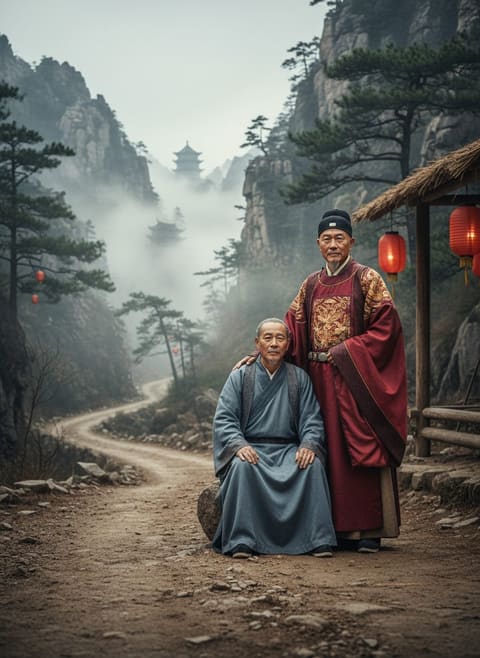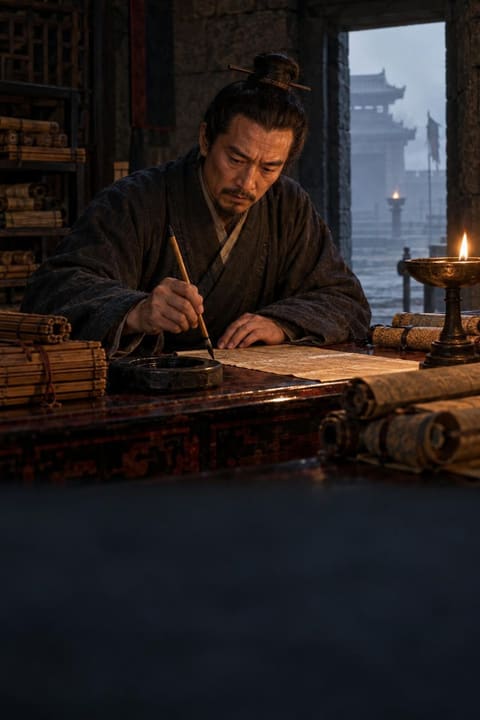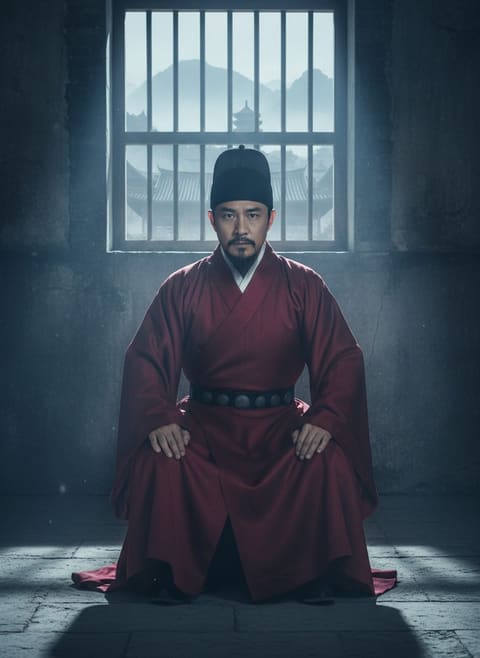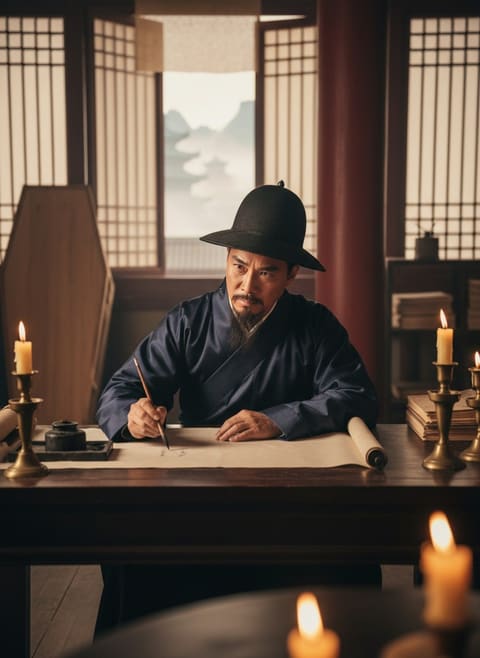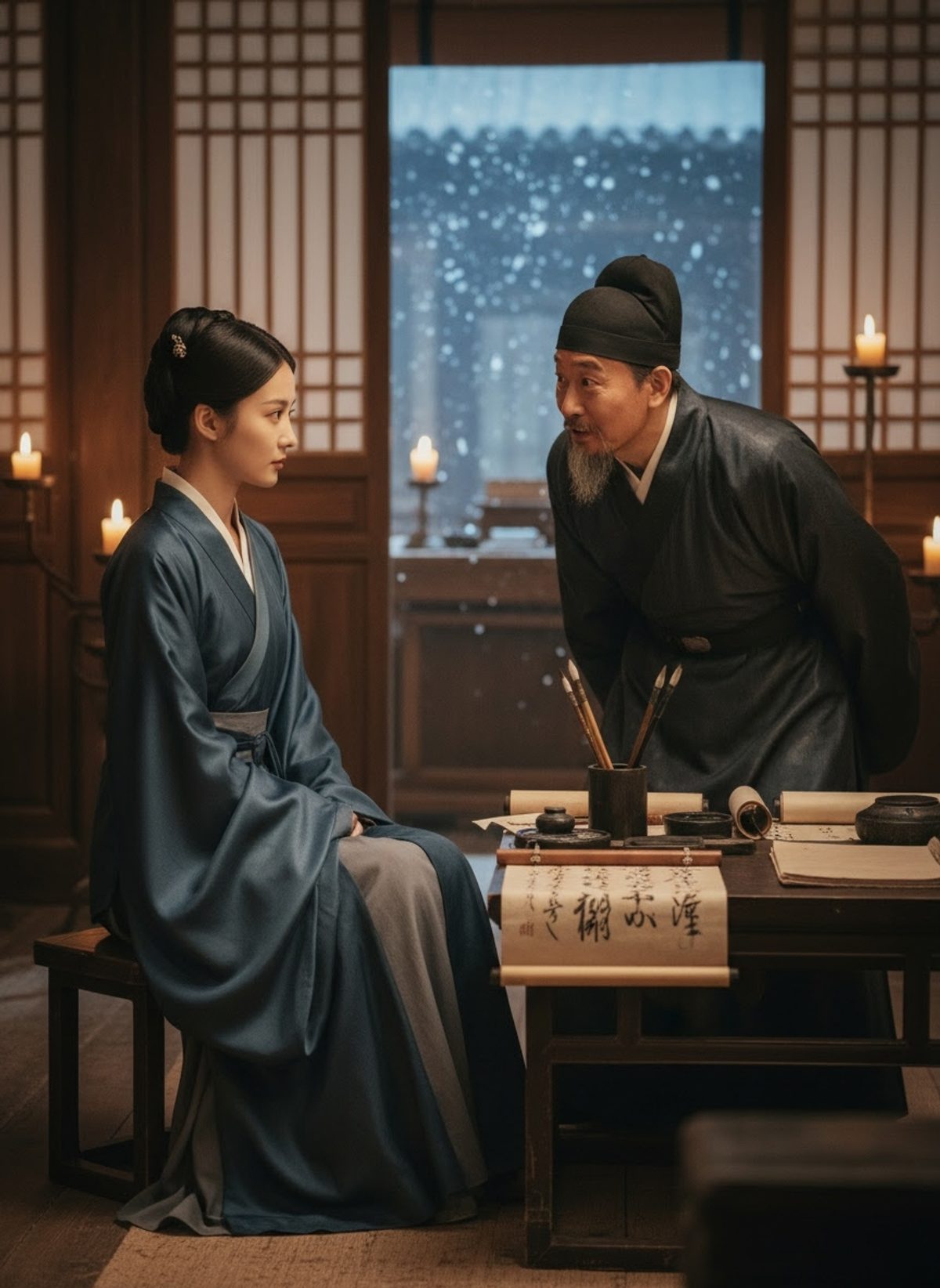
Winter, 370 AD. Fresh snow fell silently over Jiankang, transforming the bustling city into a canvas of white serenity. The chill crept into the bone, but inside the warmth of Xie An’s study, a scene of intellectual warmth unfolded. Xie An, Prime Minister of the Eastern Jin dynasty, had a scholarly gathering of family members, young minds eager for challenge and recognition.
The Test of the Snow
In an age where wisdom was the currency of status, Xie An sought to prod the minds of his kin through a test of metaphor, a reflection of the Wei-Jin era’s profound philosophical ethos. With a glance toward the swirling snow outside, he posed a deceptively simple question: “What does snow resemble?” Such questions were more than wordplay; they gauged depth of insight and cultural sophistication, paramount traits among China’s elite.
The boys offered tentative responses. Xie Lang ventured an answer: “Like salt scattered in the air.” It was a fair attempt, yet lacking the imaginative flair his uncle sought. The room hushed, attention focusing on Xie Daoyun, a young girl stooped under no social expectation to outshine the boys but carrying a fire of keen intellect nonetheless.
Her voice, soft yet resolute, broke the silence. “Not as fitting as willow catkins rising with the wind.” Metaphor had struck magic, crystallizing the image with poetic elegance. A young girl had distilled the icy whiteness into a vivid picture of nature’s unfettered dance. In that room, her words commanded an authority that transcended gender; the occupants sat, momentarily unshackled by convention, compelled by the undeniable clarity of her vision.
Read next: Zhang Heng Built a Seismoscope 1,700 Years Before Europe Tried
A Mind Amidst Change
The Eastern Jin era was a complex tapestry, woven during an epoch rife with upheaval as the dynasty restored Han Chinese rule south of the Yangtze. The Xie family was part of this scholarly resurgence. Yet, for women, expectations were rooted not in outward expression but inward modesty. Xie Daoyun’s intellectual energy defied this prescribed quietude.
Born into the illustrious Xie clan in Yangxia County, her path was significantly shaped by a family steeped in political influence and scholarly achievement. Her father, Xie Yi, and her uncle, Xie An, were towering figures in the government.
The intellectual rigor within her home laid fertile ground for her curious mind, allowing her to absorb literary and philosophical discourses—particularly the Daoist practice of *qingtan*—a cultivated art of conversation that probed the mysteries of existence without rigid adherence to Confucian norms.
Yet, Xie Daoyun stood out not only for her poetic insight but also for her ability to navigate her gender’s societal constraints. As she matured, her capability to articulate complex ideas became her tool for recognition, bridging the inherent gap between expectation and potential.
Bound by Tradition, Freed by Wit
Marriage to Wang Ningzhi, the son of renowned calligrapher Wang Xizhi, further tested her adaptive prowess. Wang Ningzhi, though born into eminence, was as uncommitted to governance as he was passionate about metaphysical speculation, often without substance. While their union tied two eminent families, it strained under the weight of mismatched temperaments.
Read next: Wang Zhaojun Chose Exile on the Steppe to Bring China Peace
This did not deter Xie Daoyun. Within the limits set upon her, she wielded her sharp intellect, a guardian to her brother-in-law's waning arguments in debates often beyond his depth. Behind a carefully hung curtain, her unseen presence reinforced his failing positions, disrupting the fabric of male-dominated scholarly discourse. Guests, oblivious to her physical absence but conscious of her intellectual prowess, conceded defeat, momentarily glimpsing the subtle power of a silenced voice speaking through her husband’s weakness.
Her mere presence altered dynamics, instilling an invisible but palpable respect among her male peers, proving that although confined by tradition, she could still render profound influence.
Beyond the Snow
Though the annals of history often swallow the voices of women, Xie Daoyun's words have endured. Few of her written works survive, yet her legacy as an exceptional female poet and thinker of her time remains etched in the literary memory of China. Her story speaks to the depth of human capacity to transcend the boundaries placed upon us by tradition, gender, and expectation.
In contemplating the snow, Xie Daoyun mastered more than a poetic metaphor; she unveiled the ability to carve a place for herself within a male-dominated, albeit intellectually rich, era. Her narrative proffers a poignant reminder that brilliance can blossom amid silence and that the world's boundaries may yet be expanded by ideas too luminescent to ignore.