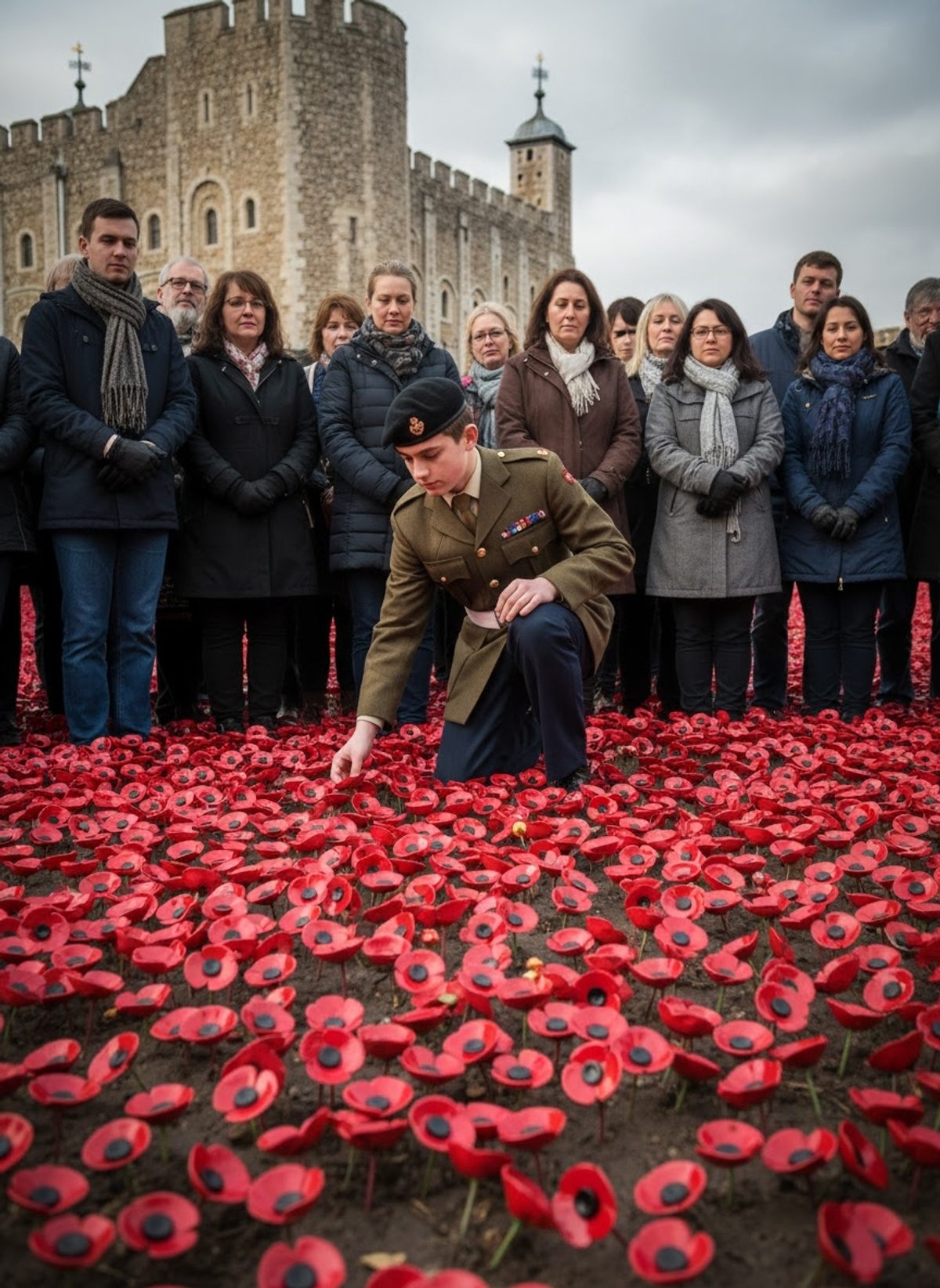
The popping click of ceramic against ceramic echoed softly as the last poppy was gently placed into the ground. It was November 11, 2014, and the historic Tower of London was surrounded by a river of vibrant red, each poppy a silent scream of sacrifice and remembrance.
The crowd of onlookers held their breath as 13-year-old cadet Harry Hayes completed the sea of 888,246 hand-crafted flowers. For the five million people who bore witness to this metamorphosis of the Tower's moat, this was more than historical commemoration — it was a poignant confrontation between past and present, life and loss.
A Poetic Legacy Unearthed
At the heart of the installation was a poem, its origin story as profound as its effect. The first line, "Blood swept lands and seas of red," penned by an unknown Derbyshire soldier, encapsulated the devastation of the war. This soldier, like many, answered the call to arms swiftly and paid the price with his life.
His words survived him in a forgotten will, discovered by ceramic artist Paul Cummins amidst dusty archives in Chesterfield, England. This poignant relic of the past resonated deeply, inspiring not only Cummins but also stage designer Tom Piper to create an artwork that would speak to the soul of a nation a century later.
Read next: Jalal al-Din Rode Off a Cliff and Genghis Khan Held His Archers
With the challenge of visually encapsulating the loss of over 888,000 British and colonial soldiers, Cummins and Piper joined forces with Historic Royal Palaces. The Tower of London, with its historic moat, was a fitting canvas. During World War I, this moat had doubled as a training ground for City of London workers who formed the "Stockbrokers' Battalion". A century later, this storied site became the epicenter of remembrance, with the past symbolically spilling over into the present.
The Crafting of Tribute
The task was monumental: craft nearly 900,000 ceramic poppies, each a brushstroke in a sweeping memorial. Cummins set to work, producing the flowers with the aid of his ceramics workshop in Derbyshire, and in collaboration with Johnson Tiles in Stoke-on-Trent. The poppies, made from Etruria Marl-based earthenware, weighed a collective 497,000 kilograms — testament to the industrial might summoned for this creative endeavor.
This formidable feat required the dedication of over 21,000 volunteers, overseen by Piper and Yeoman Warder Jim Duncan, who installed the poppies between July and November 2014. Their labor transformed the Tower's moat into a powerful landscape of loss and remembrance. The poppy formation, flowing like blood from the Tower itself, included several striking elements: the "Weeping Window," "Over the Top," and the "Wave," each crafting a narrative of sacrifice and bravery.
“Weeping Window” became iconic, a cascade of poppies from Legge's Mount that captured the hearts of those who came to see it. Each form of the installation played with drama and emotion, allowing visitors to experience the memorial on multiple levels. It was history made tangible, inviting reflection and interaction.
A Mosaic of Memories
On the evening of August 5, 2014, a day after the centenary of Britain's entry into World War I, the finished piece was unveiled. For weeks, five million people visited this vast, somber tapestry of red, drawn to reflect upon the enormous cost of conflict.
From September through to November, at twilight, the tower echoed with the names of 180 World War I servicemen and women read aloud each day — a deeply personal Roll of Honour that further connected the installation to the sacrifices commemorated by its audience.
Read next: Alvin York Refused the Draft, Then Silenced 35 Machine Guns in the Argonne
The installation culminated in Remembrance Day's poignant ceremony, embodying a collective act of healing and memory. As crowds faded and the poppies were carefully lifted by another group of 8,000 volunteers, these ceramic flowers, pre-ordered by the public for £25 each, traveled to homes across Britain. The proceeds — more than £15 million — offered tangible assistance to service charities, including Help for Heroes and the Royal British Legion.
This art installation was not merely a spectacular sight but a critical reminder of the individual stories of bravery and loss, creating links between past tragedies and contemporary lives. In the hands of every volunteer who planted a poppy, and every spectator who paused to reflect, history breathed anew.
What mattered was not just the grandeur of the display but the intimate, personal connections it forged. Each poppy held within its form a story of life cut short, yet through this collective act of remembrance, those lives were celebrated anew.
As the final poppy was laid on that melancholic November day, the message was clear: though time may pass and memories may fade, the legacy of those who served endures, captured fleetingly within the tender, blood-red sweep of a ceramic sea.