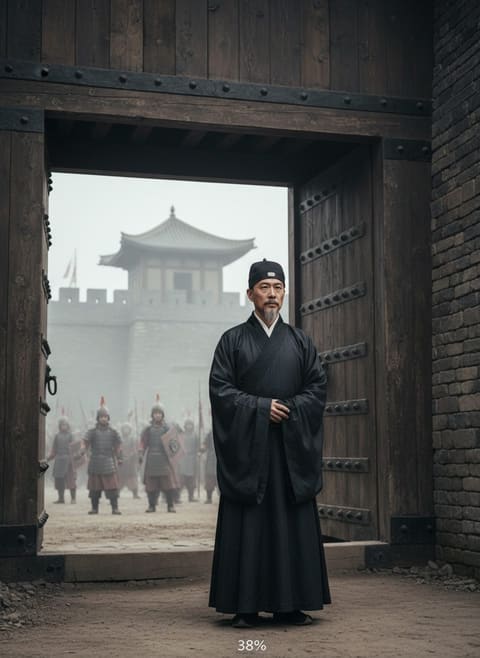
The air in the ancient city of Luoyang was heavy with humidity as summer rains pounded in rhythmic succession against the cobblestones, echoing through the corridors of the imperial court. In the dim light cast by oil lamps, a thin sheet lay drying, unremarkable to the untrained eye, but destined to unravel the fabric of time. For in this crude prototype lay an innovation that would expand humanity's collective memory far beyond the limits of oral tradition and cumbersome writing materials.
Until that crucial day in 105 CE, the scholars and bureaucrats of China relied on two primary substances for writing: bamboo slips, strung together in bundles, and silk scrolls, as delicate as they were costly. Both options bore significant limitations — bamboo, for all its availability, was heavy and unwieldy, while silk amounted to an extravagance reserved for the elite. It was within these constraints that Cai Lun, a eunuch with notable political acumen and modest beginnings, envisioned a new path.
By the time Cai Lun was born, between 50 and 62 CE in Guiyang Commandery (modern-day Leiyang), the Chinese empire was experiencing a cultural and political revival under the Han dynasty. His rise to prominence was as much a result of circumstance as it was of his keen intellect. A chamberlain first under Emperor Ming and an imperial messenger for Emperor Zhang, Cai Lun soon navigated the labyrinthine halls of power, his strategic prowess earning him the trust of those at the pinnacle of imperial rule.
Ahead of his time, Cai Lun's opportunity to revolutionize writing materials emerged alongside his appointment as the head of the Palace Workshop, a position that placed him in charge of crafting the instruments of empire—ceremonial weapons and, ultimately, paper. The addition of pulp made from tree bark, hemp, old rags, and fishing nets was his masterstroke, transforming stiff and cumbersome records into pliant, lightweight information carriers capable of holding ink with unparalleled precision.
Read next: Władysław III Ordered a Charge. His Men Followed Him In.
The secret to his success lay not just in the materials, but in the process. Cai Lun imbued the fibers with water, softened them into a slurry, and then pressed and dried the resulting sheets, which were as portable as they were durable. Recognizing its potential, Cai Lun presented this rudimentary paper to Emperor He. Unveiling this in the capital must have felt like an audacious gamble — a temporary note against centuries of precedent — but Cai Lun’s innovation was unmistakably practical, and soon even emperors acceded to its superiority.
When Cai Lun’s method entered the mainstream, the transformative ripples reached far and wide. Documentation of laws, literature, and scientific treatises no longer required sizable teams to transport them. Within the span of a generation, knowledge flowed over the empire more swiftly than armies could march. And with this ubiquitous paper, the rhythm of Chinese civilization marked a more consistent beat, immortalizing bureaucratic and personal communications alike.
Read next: Iry-Hor: The Pharaoh Who Signed His Name 5,200 Years Ago
Yet even as Cai Lun enjoyed the ripening fruits of his success, being enfeoffed in 114 CE as the lord of Longting and honored with the title of marquis, his legacy was shadowed by political intrigue and personal despair. The court’s dance of power remained unyielding, and after the death of his ally, Empress Dowager Deng, in 121 CE, his fortunes faded. Summoned to explain his past association with the scandalous death of Consort Song, Cai Lun, filled with remorse and foresight of unavoidable disgrace, chose to end his life by his own hand. Thus, he departed in the city that bore witness to both his meteoric rise and tragic end.
Historical texts like the Hou Hanshu, laying out a scant 300 characters on Cai Lun’s exploits, and Fan Ye’s work three centuries later, cemented his name primarily within China's borders. Yet his influence transcended geographic and cultural divides, rendering him among the venerated inventors of the time, a figure of enduring importance to paper-making—a craft that would become one of China's Four Great Inventions.
The quiet province of Leiyang, his birthplace, continues to prosper as a hub of traditional paper production, an enduring monument to the ingenuity of its ancient son, and the very soil infuses each sheet with a lineage traced back to Cai Lun's transformative moment. However, outside East Asia, his legacy often remains eclipsed, an oversight in the footnotes of world history.
In uncovering the tale of Cai Lun, we reach beyond the simplicity of his invention to a broader reflection on innovation’s power to redefine the limits of human interaction. It’s not just the paper but the endless series of actions that followed—what people could teach, write, prove, share, and explore on this canvas—that propels his story into the narrative of all history. It opens a corridor of communication that cannot just connect one nation, but a multitude across epochs. Here lies a reminder: that in every era, the modest work of a single dedicated individual has the potential to transform the course of civilization, wrapping our past into the very document we now hold in our hands.