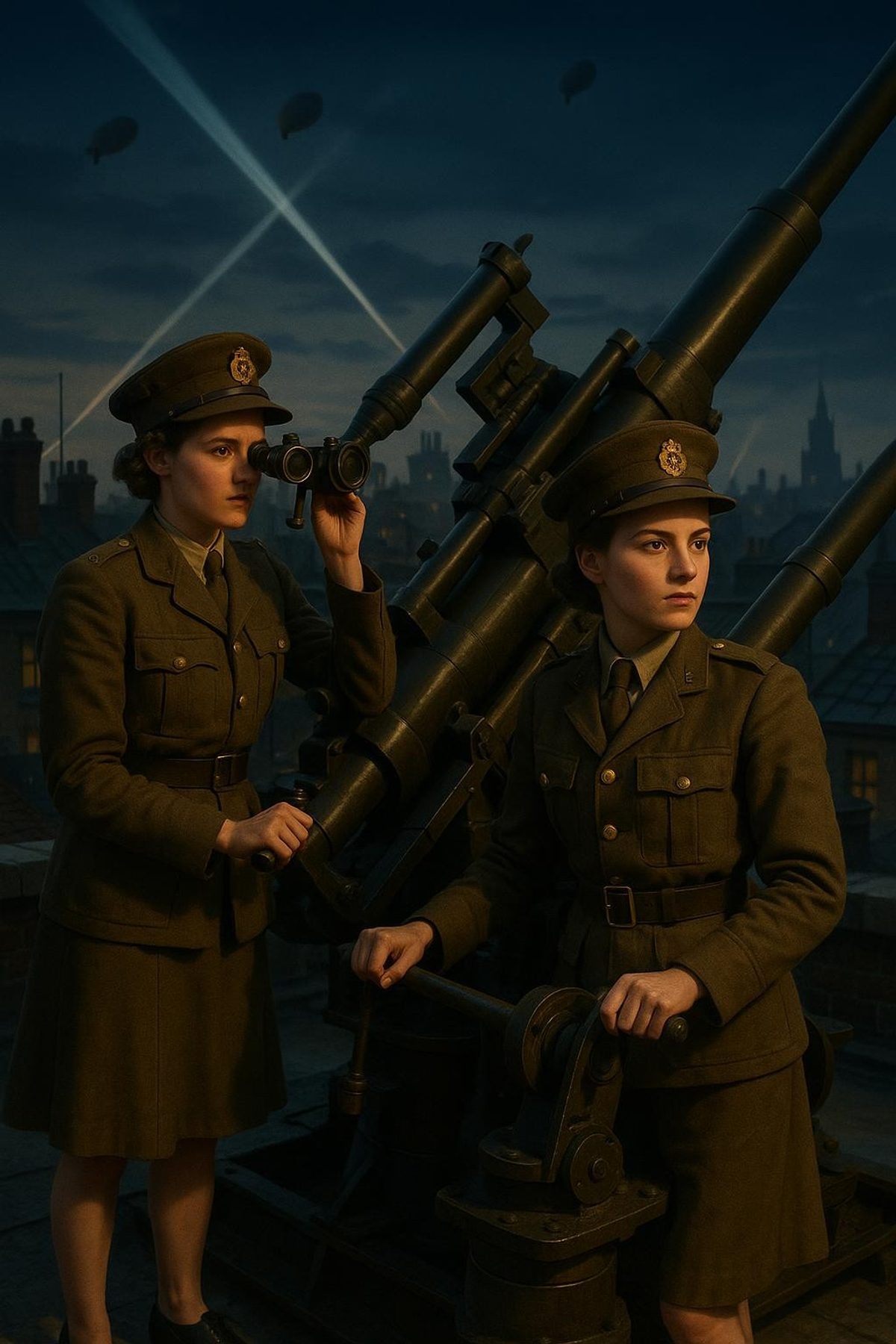
March 22, 1941. The soot and smoke of London’s burning horizon cast an eerie glow over the skyline.
A Desperate Defence
The German Luftwaffe had intensified its bombing campaign against Britain’s capital. The Blitz, as it became known, was a relentless assault, and for months, London had been under siege. Adequate defence required men—thousands of them—to operate the anti-aircraft guns scattered across the city. But there were no men to spare. Britain's military was stretched thin, with soldiers engaged in battles across Europe, North Africa, and beyond. If London was to be defended, it needed fresh hands on deck.
General Sir Frederick Pile, the commanding officer of Britain's anti-aircraft defenses, faced a dire situation. The daily raids were not only destroying the physical landmarks of a nation but threatening its morale. By 1941, Pile reached a crossroads and approached Prime Minister Winston Churchill with an urgent request: to find him an additional 10,000 men to man the guns.
Churchill, a statesman renowned for his unyielding spirit and unconventional strategies, was not one to shy away from making difficult decisions. Instead of granting Pile’s request, he posed a radical alternative: employ women for these roles. Up until this point, women had not been permitted to engage directly in combat roles within the British military. Yet, with necessity pressing and resources depleted, Churchill pushed for the Women’s Auxiliary Territorial Service (ATS) to be expanded into operational roles previously held by men.
Read next: Lee Rode Into the Yard. Grant Was Already Waiting.
This decision was groundbreaking not only in military terms but also for British society, which was still reeling from the conservative restraints of its pre-war norms. Onward, Churchill commanded, and the new directive began to take shape. London’s anti-aircraft defences would soon be bolstered not by enlisted men, but by women answering the call of duty.
The Courageous Undertaking
As April turned to May, the ATS recruitment offices saw a surge of women enlisting, eager to do their part in defending their country. They came from all walks of life—teachers, clerks, and housewives—united by a steely determination. Their training was rigorous. Learning to operate the heavy machinery required mental acuity and physical stamina. These women weren’t just filling roles; they were defining new ones.
One of the most vital tasks they undertook was operating the range-finding equipment and predictive instruments essential to track enemy aircraft accurately. These roles necessitated precision and composure under pressure because any miscalculation could mean the difference between life and death. As they honed their skills, the ATS women earned not only respect but a certain celebrity status among their contemporaries and the city they protected.
Hardly a spectator, Churchill watched their progress closely. His decision to employ women in defence ultimately became pivotal to the war effort. More than 56,000 women served in anti-aircraft command. Their presence was indeed a significant sight—a testament to the seismic shifts taking place in British society. But it wasn’t all smooth sailing. Despite their crucial contributions, these women faced scepticism and derision from both the military establishment and the public, who doubted their capabilities.
But they proved their detractors wrong time and time again, maintaining composure during nightly raids and enabling efficient and fatal responses to Luftwaffe incursions. Each successful mission further cemented their role as an integral part of Britain’s wartime defence mechanism. They were learning, adapting, and innovating under duress. What had been a desperate move began to feel like destiny.
Read next: A Wedding Camera Caught the Last Film of Anne Frank
Defying Boundaries
By the summer of 1941, the impact of the ATS women was undeniable. London had not succumbed to the chokehold of the Blitz. The tireless efforts of these individuals did not only help turn the tide but reshaped the societal canvas. Here were women, resilient against the backdrop of war’s devastation, leaving an indelible mark on the home front.
Churchill publicly acknowledged the contribution of these brave women, his gratitude shifting public sentiment. The ATS’s strategic successes shattered pre-existing limitations imposed on women within the military and laid foundational changes that reverberated through British culture. By the war's end, nearly half a million women had served in the ATS, shaping new norms and inspiring future generations.
Their courage resembled the very essence of Churchill's tenacity—unorthodox yet effective, a hallmark of his storied career. It stood as a testament to the essence of survival against overwhelming odds—not solely through engagement with the enemy’s weaponry but through a willingness to redefine the possible.
Churchill's initiative compelled society to reconsider perceptions of gender roles. Indeed, those involved in this effort inadvertently spearheaded a movement, bolstered by the realisation that women were equally capable in roles historically dominated by men. The story of the ATS women during the Blitz is a vivid reminder of the limitless capacity for adaptation and courage in the face of adversity. It calls to mind the unyielding spirit of a nation, refusing to be swallowed by darkness, reaching instead for resilience.