April 9, 1865, marked the end of four years of profound American suffering. But what followed was not an eruption of joy; it was a solemn, quiet acceptance of an irreversible change.
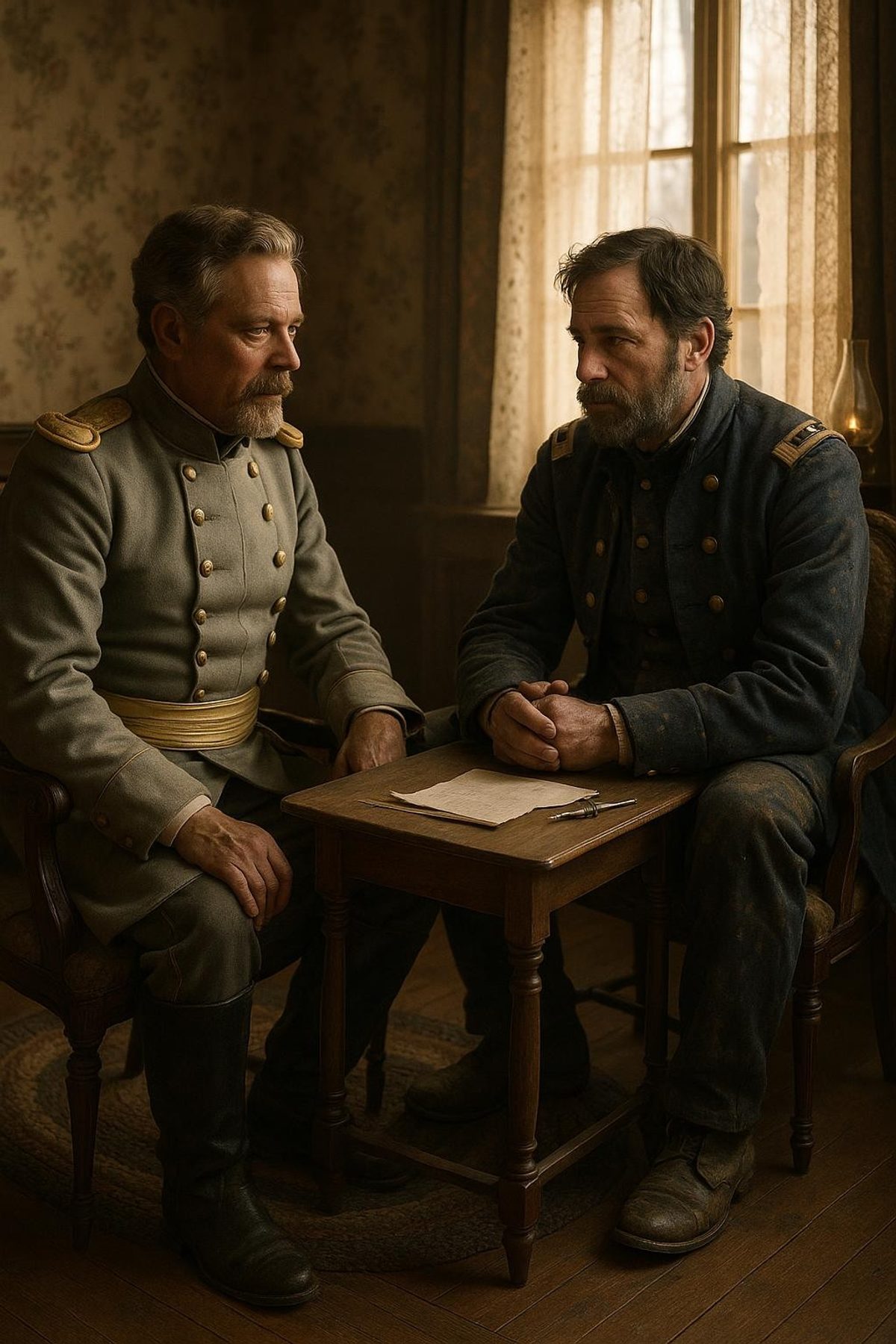
On this day, at the tiny village of Appomattox Court House in Virginia, two men met to conclude the bloodiest conflict in American history. General Robert E. Lee, commander of the Confederate Army, arrived immaculate and serene. His attire, a crisp, custom-tailored uniform, carried his matted dignity and Southern poise. Across the way, General Ulysses S. Grant of the Union Army, sporting a mud-soaked and slightly disheveled field uniform, awaited his arrival with a mix of relief and fatigue.
History mostly remembers these two as stark opposites — Lee, the epitome of Southern chivalry, and Grant, the relentless bulldog of the Union. Yet, their meeting on this day exposed a profound respect rooted in shared experiences from times long past. They were not mere foes bound by the chains of war; they were once comrades-in-arms in the Mexican-American War two decades prior, a war that forged their military acumen and, perhaps unexpectedly, a mutual appreciation.
As they settled into Wilmer McLean's modest parlor, the conversation flowed initially not around the gravely serious business at hand but rather around old times in Mexico. Their comradely banter served as a poignant reminder that before the divisions wrought by state and ideology, these were two soldiers united by a common past. They swiftly moved from reminiscing about those shared experiences to lighthearted discourse on the breeding of horses — a topic revealing a shared affinity that transcended the blue and gray of their uniforms.
Read next: He Named the Bear. A Boy Named His Toy. You Know the Rest.
The parlor, a simple room with horsehair chairs and modest wallpaper, became a sacred chamber of sorts — a site of national significance not for its grandeur, but for the resolution it sheltered. Lee would surrender over 28,000 soldiers to Grant that day, effectively signaling the beginning of the end of the Confederacy. Yet, this was no ordinary military surrender. The terms Grant offered were unexpectedly generous, allowing Confederates to return to their homes peacefully and keep their horses for spring planting — an acknowledgment, perhaps, of their shared humanity and the pressing need to rebuild shattered lives.
What's lesser known is the significant impact of Grant's concession on the soldiers' spirits. Though the soldiers were weary, starved, and significantly outnumbered, they carried with them the burden of honor. By allowing them to maintain their horses and lay down their arms with dignity, Grant quelled the tang of defeated pride that could have festered into lingering resentment. This decision spoke volumes — a sophisticated strategy that fortified the foundation for an eventual reconciliation.
Read next: Lachhiman Gurung Had One Hand. He Held the Line.
The meeting lasted a few solemn hours, yet its effects rippled through history. As Lee mounted his horse, Traveler, and rode back to deliver the shattering news of surrender to his men, the gravity of his decision weighed heavily on his stoic shoulders. Here was a man who, despite his efforts, saw the grand cause to which he had pledged his military genius slip away. Yet, it was his composure that soothed the raw wounds of loss for many of his men. They looked to him, still the emblem of the Confederacy, and found in his demeanor the strength to face a future fraught with uncertainty.
Grant, for his part, exited the McLean house acutely aware of the heavy toll of leadership. The victory was bittersweet. The task ahead — to heal a divided nation — loomed larger than any battlefield conquer. In a surreal twist of fate, the war that began with a cannon shot at Fort Sumter ended here quietly, with a handshake and a silent understanding.
These events at Appomattox were not taught as a historical marvel due to their strategic brilliance or dramatic flair, but rather for their profound simplicity in fostering peace. What took place was a reconciliation not accompanied by humiliation or triumphalism, but one demonstrating that more than bullets and bayonets, it is empathy and understanding that can shape the course of nations.
In reflecting on this poignant moment, one must consider why it stands out not as a mere cessation of hostilities but as a testament to the power of humanity amidst the harshness of war. The choices of these two leaders to act with magnanimity rather than vengeance set a heroic standard in times of strife. It served as a reminder that even amidst the backdrop of discord, there lies potential for grace and unity. The enduring lesson from April 9, 1865, is that history's truest victory often lies in the realm of diplomacy and compassion. It remains a quietly powerful narrative in which resolution, not destruction, became the harbinger of a new dawn for America.