Chunyu Yi may not be a household name. But his legacy continues to influence the practice of medicine to this day.
In 164 BCE, the Han Dynasty stood as one of the most sophisticated civilizations on earth. Underneath its shimmering facade of palaces and learned officials, however, lurked an invisible enemy. The plague crept through the streets of Chang'an, the bustling Han capital, like an unyielding tide, its ominous presence sending shivers down the spines of even the bravest residents. As panic spread, the city's corridors of power began to hollow out, with officials deserting their posts in droves. The safest course was clear—to flee, preserve oneself, and wait for the fatal storm to pass.
Amidst this exodus stood a lone figure, determinedly walking against the flow of fleeing dignitaries. Chunyu Yi, a licensed healer with an insatiable thirst for knowledge, heeded not the cries of fear but rather the suffering of those left behind. At a time when rudimentary knowledge of medicine conspired with mysticism and the divine for answers, Chunyu Yi leaned on observation, record-keeping, and an unwavering dedication to understanding the human body. He wasn’t just tending to the sick—he was pioneering the systematic approach to diagnosis and treatment that would later echo throughout the halls of medical history.
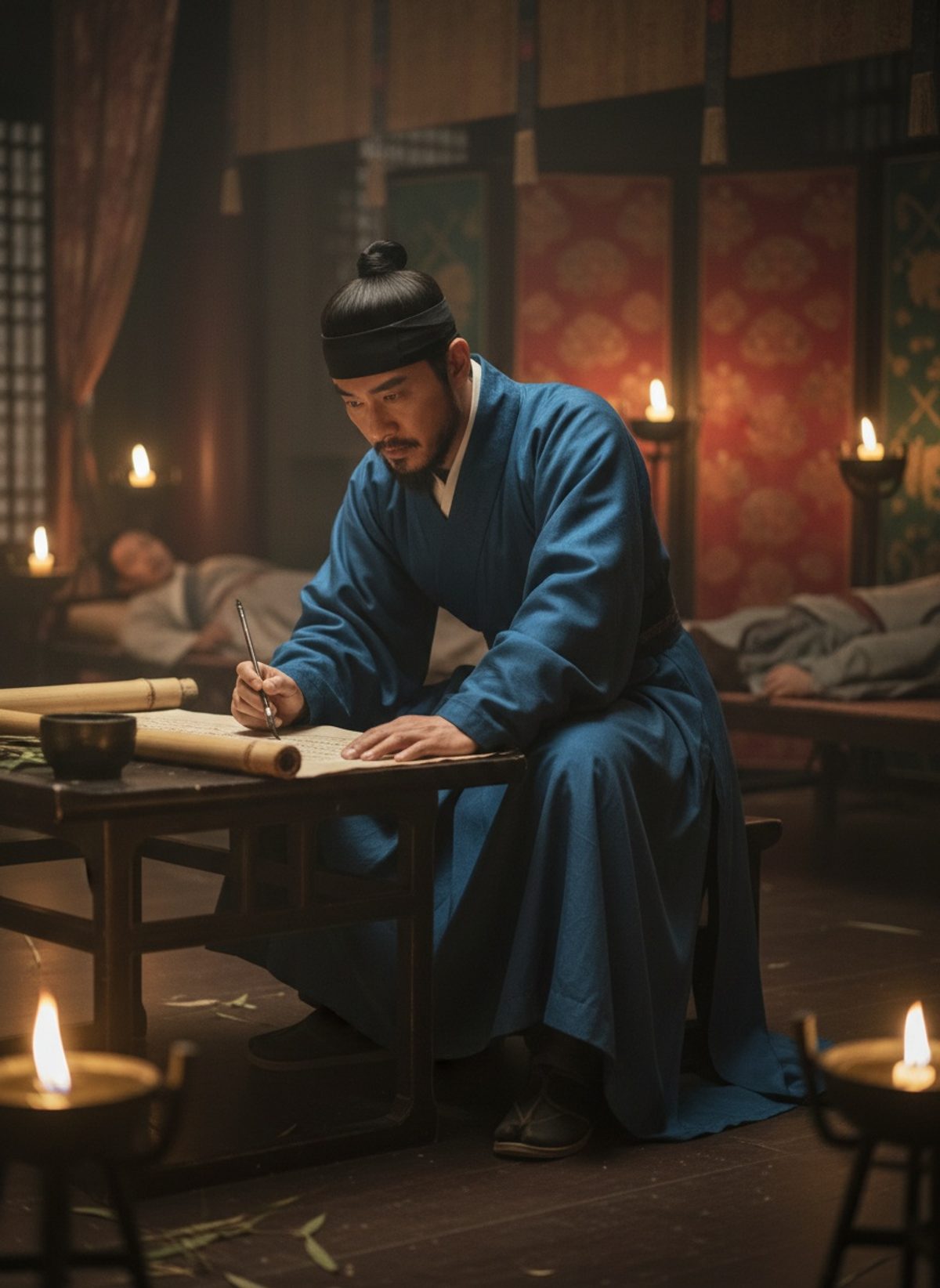
Picture the Han capital, brimming with over a million residents, suddenly overshadowed by the specter of plague. The air inside Chunyu Yi's clinic was thick with the odor of herbal concoctions, each a calculated gamble in the battle against death. Patients arrived with assorted symptoms: fever, limb pain, rashes, and inexplicable fatigue. Where others might have seen chaos, Chunyu Yi observed patterns. He meticulously documented each case, noting the details of his patients' conditions, the treatments tried, and the eventual outcomes.
Read next: Zhuangzi Stood at the Grave. He Began to Sing.
His approach was revolutionary. At the core of his practice lay a notebook—a simple stack of bamboo slips. Yet, upon these slips, Chunyu Yi recorded an invaluable treasure trove of clinical notes, carefully organized. Each line penned was not merely ink; it was an earnest attempt to transmute human suffering into understanding. These notes are believed to be the oldest surviving medical case records, a testament to Chunyu Yi's groundbreaking approach.
But Chunyu Yi's role was a lonely one. The traditional world around him was steeped in supernatural interpretations of disease, where ailments were often attributed to moral failings or the wrath of deities. In stark contrast, Chunyu Yi relied on empirical observation. He saw illness not as some cosmic punishment but as a puzzle to be solved with logic and diligent inquiry. While others scattered in fear, convinced the plague was a harbinger of divine anger, Chunyu Yi remained steadfast, searching for answers in the tangible clues of his patients' ailments.
It's tempting to imagine Chunyu Yi as a solitary genius, yet his insights emerged from a confluence of personal resolve and cultural fruition. The Han dynasty, shaped by Confucian ideals, prized learning and intellectual pursuit. This cultural backdrop, coupled with his access to the rich traditions of Chinese medicine, equipped Chunyu Yi with both the motivation and the means to embark on his meticulous studies. His work would foreshadow the later development of Traditional Chinese Medicine, deeply influencing its principles of holistic diagnosis and personalized treatment.
Read next: Borglum Picked Up the Drill. America Watched.
Beyond the walls of Chunyu Yi's clinic, the city of Chang'an slowly began to succumb to order amid the chaos. Reports of his interventions, however limited by the era's medical standards, infused hope into a beleaguered populace. His methods offered a glimmer of systematic understanding—a harnessing of knowledge that could navigate the tides of illness rather than cower before them. It wasn't just about alleviating individual suffering; it was about challenging the boundaries of what was known.
Chunyu Yi's accounts survived centuries, eventually informing later medical practitioners both within and beyond China. As the plague receded and the capital rebuilt itself, his legacy endured, preserved through countless recitations by scholars of medicine. His work symbolized an early embrace of an empirical approach, where careful record-keeping and observation became integral to the medical profession—a precursor to modern clinical documentation practices.
Looking back through the veil of time, Chunyu Yi's story resonates far beyond a mere historical footnote. It speaks volumes about the courage required to move toward danger rather than away from it, driven not by recklessness but by the hope of mitigating humanity's plight through scientific inquiry. In a world where epidemics have risen again to test our limits, Chunyu Yi's legacy offers a poignant reminder of the power and necessity of knowledge, compassion, and unwavering dedication, even amidst the direst of circumstances. His steps toward the plague, toward the unknown, carry whispers that inspire generations to explore, understand, and heal.