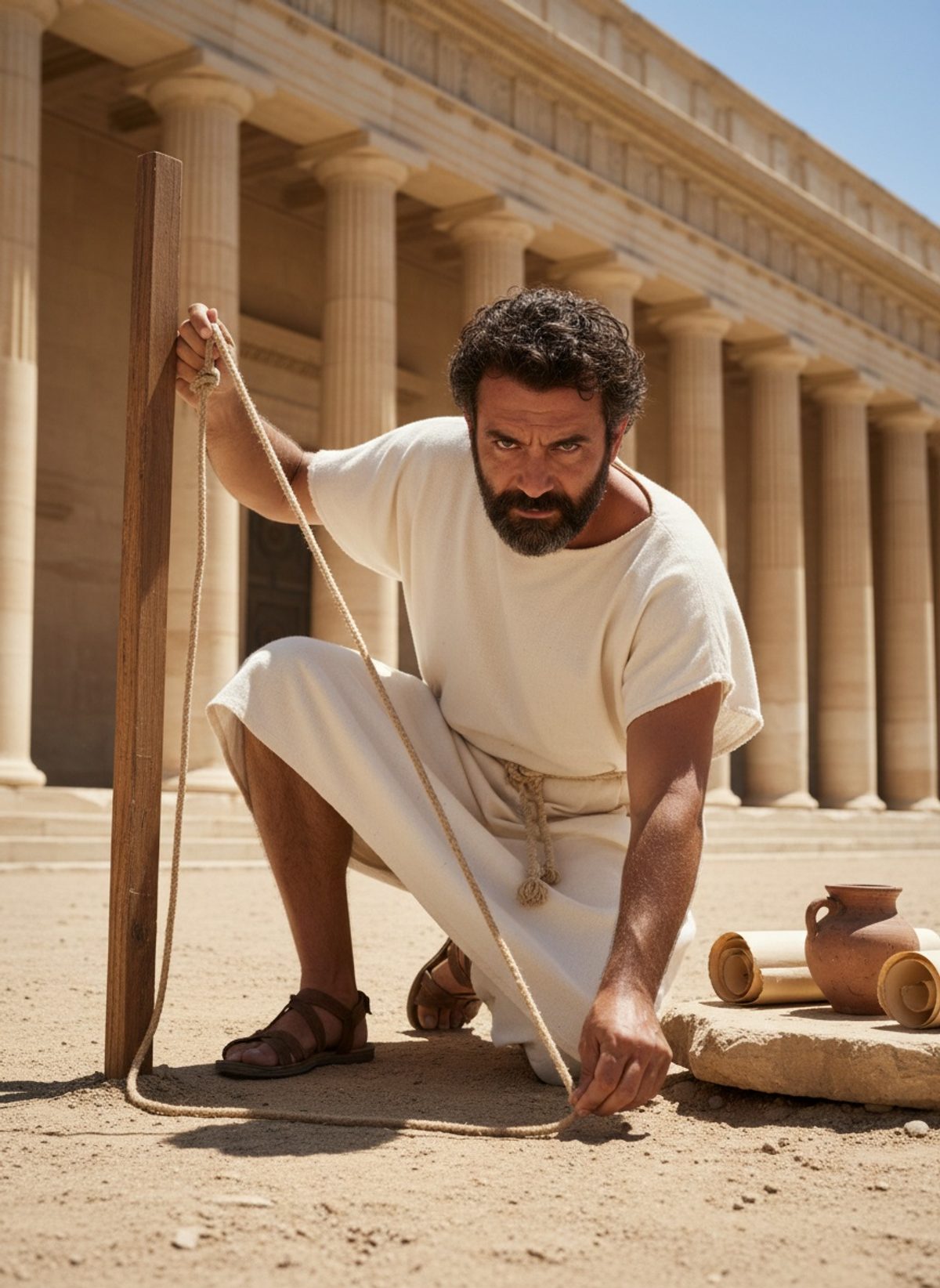
The dusty road stretched out under the unyielding sun, each step releasing a cloud of beige into the still air. It was a landscape of endless horizons, where the light stretched and bent across the sand, and the only sound was the rhythmic crunch of dry earth beneath sandals. In the heart of this arid terrain, where the sky was an unbroken, brilliant expanse of blue, a lone figure walked determinedly. For Eratosthenes, the call of discovery outweighed the discomfort of his journey. There was something more profound than simply reaching Alexandria from Syene; it was the thrill of unveiling the mysteries of the world in an era where imagination often bounded human understanding.
Born in Cyrene, a Greek settlement in what is now modern Libya, Eratosthenes was a man of diverse talents, well suited to the cultural synthesis simmering in Alexandria's vibrant intellectual milieu. This bustling port city was not just a meeting place of goods from around the ancient world, but also a melting pot of ideas. Within its grand library, scholars from every corner of the known world gathered, sharing knowledge and debate. As Chief Librarian, Eratosthenes stood at the epicenter of this vibrant explosion of learning, sharing the company of the greatest thinkers of the age. Yet, it was a simple report from Syene—a humble town far to the south—that captured his imagination and set him on a path of radical insight.
In Syene, it was said that on the summer solstice, the sun cast no shadow at noon, shining directly into the depths of a well. This observation, curious and seemingly trivial, contained within it the seed of a grand revelation. Most would have overlooked it, chalking it up to another enigmatic natural phenomenon. But Eratosthenes, equipped with a mind that refused to dismiss the curious as irrelevant, saw in it a chance to measure the Earth itself. In a time before the vast technology at our disposal today, he leaned into one of the greatest intellectual tools available: geometry.
With the scrolls of Euclid fresh in his memory, Eratosthenes devised an elegant experiment to solve the mystery of the Earth's dimensions. He would use the sun’s position at midday on the longest day of the year. While in Syene, a well was illuminated without a shadow, back in Alexandria—a significant distance to the north—shadows still occurred. The inquisitive scholar planted a stick, or a gnomon, vertically into the sand and waited until the sun was highest.
Read next: Archilochus Threw Down His Shield. Then He Wrote It Down.
As the sun reached its apex, the shadow of the stick veered to the side, forming an angle with the stick itself. Here, Eratosthenes measured the angle of the shadow; it was about 7.2 degrees. Employing the reasoned rigor so admired in his studies, he theorized that the differing shadow lengths between Syene and Alexandria stemmed from the curvature of the Earth.
I realize today, knowing the world's true vastness, that 7.2 degrees in such a sprawling sphere can seem slight. Yet, here lay the genius of Eratosthenes: combining geometry and a fundamental sun observation to unlock the secrets of our planet's size. He hypothesized that if 7.2 degrees was part of the whole 360 degrees that formed a circle, then the distance between the two cities must represent the same fraction of Earth's circumference.
The journey between Syene and Alexandria—believed to be approximately 5,000 stadia (an ancient unit of measure whose exact length is still debated)—must then be multiplied accordingly. Thus, Eratosthenes arrived at a figure close to what today we recognize as astonishing accuracy: the Earth's circumference. His calculation was within a mere percentage point of modern measurements—a staggering achievement 2,000 years ago.
Read next: Democritus Said the World Was Made of Nothing. Greece Laughed.
It's important to imagine the setting he found himself in—no digital calculators or high-speed data processors—yet in the context of what was known and accessible at the time, his method was nothing less than a triumph of human intellect. Eratosthenes observed, calculated, and proved truths that were until then unimaginable, applying a logical approach that laid the groundwork for future generations of thinkers and astronomers.
Yet, this knowledge carried with it something even more profound. By measuring the Earth, Eratosthenes bridged the gap between the celestial and the terrestrial, showing that our world is a part of something far larger than many dared to dream. He revealed that even the simplest observations, with patience and wisdom, could unlock the universe's deepest secrets—a testament to the boundless potential of human curiosity.
In thinking of Eratosthenes today, we see the embodiment of a spirit that continues to drive humanity forward: the desire to understand, to question, and to seek knowledge in the face of the unknown. Through the sun's light in a well and a shadow cast on sand, Eratosthenes did more than measure the world—he expanded it in the minds and hearts of those willing to pursue the truths hidden in plain sight.