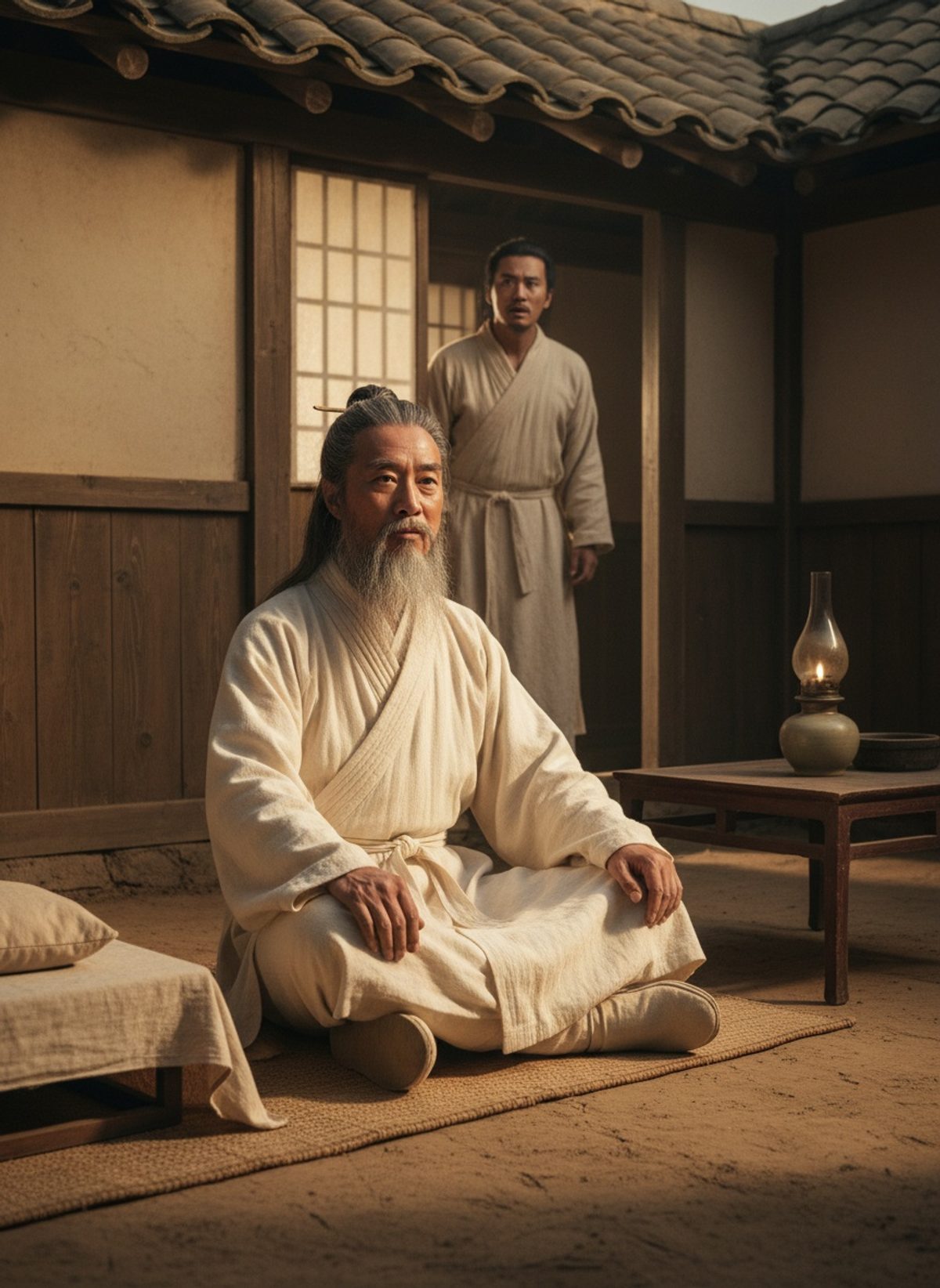
He stood beside her, almost as if the world around him had vanished. She had died, but he sang, his voice breaking the heavy silence. It was an unexpected choice, baffling to those who knew him, but such was the nature of Zhuang Zhou, better known as Zhuangzi — a man who embraced the astonishing fluidity of life and death.
A Song in the Shadow of Loss
The setting was the late Warring States Period, a time of conflict and philosophical blossoming in ancient China. Somewhere in the state of Song, near the place we now know as Shangqiu, Henan, an extraordinary occurrence unfolded. Zhuangzi, a sage whose thoughts would echo through the ages, endured a loss as old as humanity itself — the death of his wife. But here, the mundane meets the profound, as Zhuangzi did not mourn in customary tears.
Imagine this scene: A man, traditionally clad in linen robes, sitting quietly beside the fresh grave. The air is thick with the weight of what should be deep sorrow, yet it is pierced by the gentle strains of a song. His fingers, curled around a wooden lute, strum with an intention that goes beyond mere music. A close friend, anticipating a scene of deep mourning, is instead met with this inexplicable response. Surprised, the friend queries Zhuangzi, expecting an apology perhaps, or an explanation for such an unorthodox display in the face of death.
The response Zhuangzi gives is more than a mere defense of his actions; it is a window into the heart of Taoist philosophy, a school of thought he helped shape alongside the Laozi and its cryptic verses. While others might collapse under grief, Zhuangzi's words float effortlessly like leaves in the wind: "At first," he admits, "I was deeply sad. But then, as I considered it, I realized that she had already been transformed and released, just like the changing seasons." He argued against what many would see as 'appropriate' emotions, reframing grief itself as an insult to the profound cycles of life and nature.
Read next: He Ran 5,373 Miles on One Leg. He Never Finished.
An Exemplar of Taoist Philosophy
The story of Zhuangzi's singing at his wife's grave is not just a personal anecdote; it is a powerful testament to how deeply he embraced the teachings he espoused. The event encapsulates Zhuangzi's worldview, where binaries such as life and death blur into indefinable continuities. His teachings, preserved in the text known simply as the Zhuangzi, are structured around this very ideology.
Historically, the Warring States Period was fertile ground for philosophical innovation, a time when different schools of thought competed for prominence. Amidst the backdrop of war and instability, Confucianism preached moral order and societal harmony, while Mohism advocated for universal love. In contrast, Zhuangzi's approach defied societal norms. His teachings promoted a life of spontaneity and alignment with the natural world, sometimes separating entirely from the constructs of society. He urged followers to dissolve the artificial boundaries humanity imposed — between the self and the other, structure and chaos, life and death.
Never one for conventional logic or rigid dogma, Zhuangzi used parables and fables more than hard philosophical discourse. His stories are rich with humor and irreverence. In his writings, the idea of transforming into anything — a butterfly, a fish, even a drum — becomes not absurd but expected, a reminder that everything changes and nothing truly ends. While Confucius focused on duty, Zhuangzi articulated the joy of what he called "carefree wandering," letting go to become one with the Tao, or the "Way."
The Enduring Influence of Zhuangzi
The Zhuangzi's greatest gift to Chinese literature lies in its narrative style and use of allegory. Through the centuries, the eloquent tales captured the imagination of readers far and wide. Its reach spanned long past its initial age, influencing writers during the Han dynasty and countless others over millennia. Notably, the seminal work has remained an unparalleled pre-Qin text for studying Chinese rhetoric.
Read next: She Nursed Them All. Then She Turned On the System.
Even as the text grew and evolved, from its original 52 to the extant 33 chapters curated by Jin-era scholar Guo Xiang, it retained a potent fascination. This transformative period is often revisited in historical records, particularly the Shiji, compiled by the historian Sima Qian. Commentators like Burton Watson have appreciated the originality stamped across Zhuangzi's narratives, this creativity transcending specific authorship debates about the Outer and Miscellaneous chapters.
While the philosophical content of Zhuangzi's stories remains engrossing, their literary aspect cannot be disregarded. Crafted with deliberate complexity, the tales are designed to bewilder and uplift, conveying truths about the human condition in ways that surpass the often rigid confines of traditional classical thought.
Cycles of Life Dissolved Through Song
Singing in the face of death might seem peculiar, yet through Zhuangzi's perspective, it becomes not just understandable but deeply symbolic. It signifies an acceptance of life's transient nature, the understanding that what has come from nothing will naturally return to nothing. In a world where permanence is sought after, Zhuangzi's acceptance that everything flows and changes offers a radical, liberating view.
As we consider the story of a man sitting by a grave, singing amid loss, we're reminded that philosophy isn't just about grand ideas, but intimate, personal moments. This short narrative from Zhuangzi's life offers a window into ancient Chinese wisdom that remains strikingly relevant. Life and death, joy and sorrow, are not opposites but parts of a whole blend, each necessary, each honored in its own way. It's a perspective that continues to challenge us, urging us to consider our own relationship with the inexorable cycles of existence.