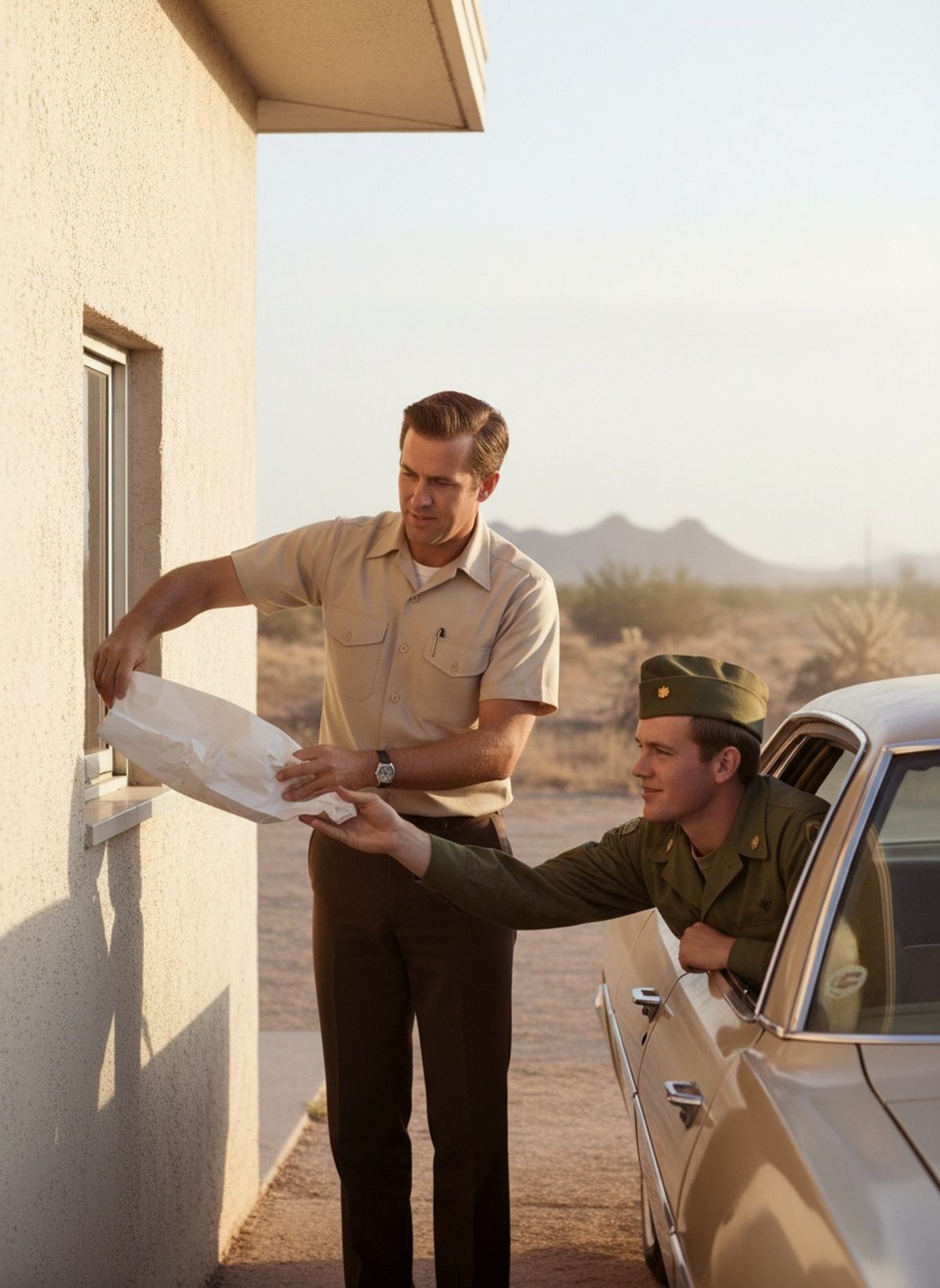
The sizzle of burgers on the grill mingled with the rhythmic hum of uniformed soldiers returning to their barracks, their frustration palpable as they faced the familiar dilemma once again. The lunchtime rush at Fort Huachuca's McDonald's was bottlenecked by a simple rule: soldiers in fatigue uniforms were not to be seen off-base on foot. For those craving a quick, delicious bite without disobeying orders, this was the daily struggle until one ingenious franchisee took a chance that would reverberate through the history of fast food.
The Tactical Inspiration
It was David Rich, the savvy McDonald's franchisee, who first observed the discontent brewing among the soldiers stationed just down the road at Fort Huachuca, Arizona. Unlike other customers, these men and women couldn't merely park their cars and walk inside like civilians. Military regulations were clear: fatigue-clad soldiers needed to adhere to strict conduct, unseen by the public outside predefined areas. Rich saw opportunity in regulation — a chance to serve these dedicated individuals without them having to leave their car seats.
With a novel vision, Rich peered at the blank wall of his establishment. This obstructive barrier, previously a mere support in between two realms — the busy kitchen and the bustling streets — was transformed into a channel of possibility. By cutting a simple hole in the wall, he installed a sliding window, birthing what we now recognize as a quintessential symbol of convenience. On January 24, 1975, this rudimentary innovation became the world’s first McDonald's drive-through window. Soldiers could now cruise through, collect their meals, and return to base without a worry about protocol. An idea so straightforward, yet it would lead to a revolution.
The Evolution of Convenience
Food on-the-go wasn't entirely new; car culture in America had been building up since the mid-20th century, with drive-ins and diners catering to travelers on the open road. What set the drive-through apart was its seamless integration into daily life, blending the swift pace of modern existence with the emerging ethos of fast food convenience. Soldiers at Fort Huachuca might not have appreciated the magnitude of the moment while chowing down on Big Macs in their vehicles, but the implications were enormous.
Read next: Borglum Picked Up the Drill. America Watched.
As the drive-through mechanism spread across more franchises, it became a vital component in the fast-food expansion era. Chains across America realized they could not only serve more customers faster, but they could do so with a reduced need for dining space and fewer staff for in-house service. This operational efficiency translated into increased profitability, as well as a new kind of customer loyalty driven by the simplicity of receiving orders without leaving the car.
Beyond the Battlefield
This innovation, born from a serendipitous military regulation, began influencing broader societal habits. The drive-through concept went beyond merely reshaping how food was served; it transformed the entire dining landscape. While some might argue that it encouraged a sedentary lifestyle, it undeniably catered to the changing dynamics of work, family, and time management in America.
Read next: He Ran 5,373 Miles on One Leg. He Never Finished.
Families, initially accustomed to eating at home or in restaurants, adapted to the car as a new dining venue. The road trip became more than just a journey; it was an experience punctuated by satisfying cravings without the interruption of a dine-in break. Businesses soon identified a goldmine, offering drive-through services for everything from banking to pharmacies. Suddenly, the convenience wasn’t limited to food; it extended to any transaction easily accomplished from within the confines of a vehicle.
Impacts Hanging in the Air
When David Rich made that first cut in the wall of his McDonald’s, he probably couldn’t have envisioned the long-term impact his decision would have. That single action has played a role in the cultural shift towards convenience and efficiency that defines much of today’s society. What started as a solution to accommodate soldiers' uniforms reshaped the fast-food industry, setting a standard for customer service that’s still followed globally.
The story of the McDonald's drive-through, emerging from necessity, speaks to the power of innovation being influenced by everyday problems. While some lament the loss of traditional dining experiences, there is no denying that this leap in food service fundamentally changed how we think about time and convenience. It encourages us to reflect on how a simple idea, catalyzed by an army base's dress code, could ripple outwards, connecting us all in the shared experience of modern life. The sliding window has fed far more than just hungry soldiers — it has nourished a new way of living.